Population, Climate Change, and Society
Contents:
Lecture 1: Introduction
Lecture 2: The world population explosion – causes, content and future prospects
Lecture 3: The world population explosion – causes, content and future prospects
Lecture 4: Climate change mitigation: economics and policy
Lecture 5: Fertility, Natality & Reproduction
Lecture 6: Guest lecture: Why is climate change action so difficult – Brulle & Norgaard (2019)] and
[Climate change as social drama – Smith & Howe]
Lecture 7: Mortality – life expectancy
Lecture 8: Climate Change and Population Structure
Lecture 9: On climate change, inequalities and eco-social policies
Lecture 10: continuation of the other lecture (meso/micro level/fertility rates)
Lecture 11: Mortality transition and socio-economic differences in life expectancy
Lecture 12: Migration
, PCCS Lecture 1: 28/09
Introduction to the subject:
Focus: look at connection between, impact on society, climate through the lens of population
Opening slide: UN has projected growth of human population – broader base of pyramid: and
these pyramid has become fatter, bigger + age has had grown = global phenomena
Demographic transition: thread through the lectures
Goal: impact of society on climate and vice versa
Society assumes that there’s a human population
Political system is not the same as political population – it goes on, with new politicians =
society
How structurally linked with each other, they have their own logic, and have impact on each
other
Demographic focus
Examples.
- Referendum Brexit: importance of demography/population structure => age structure
Our age groups: majority who wanted to remain, but older population voted to leave
the European Union
Demographic transition has political impact + where people live can have important
consequences
- Electoral districts in the USA: proportional in size, colours refer to votes that were
majority: blue democrats, red republicans -> majority voted for Clinton, but Trump
won, coz related to where people were living, much fewer people in Midwest, coz of
the system, each district needs to have his representants => less populated areas
have higher weight than actually
- Conceptions leading to alive births: better predictor than any other to predict
economic ups and downs = aggregate fertility -> number of conceptions now, and
then how economy will be doing in some months
- The human tide: you should look at demography, and the impact of population
- (CC) Impact on human behaviour
Goal of the course
Ongoing process of climate change is connected with major changes in society
Society cannot exist without human population, and human population always assumes
human society – human child cannot survive without help of others, so need of societal
institution
In all parts of the world you need an institution to support a born child, and to deal with death
– different cultures have different ways for that, but we all have ways to deal with it
+ we need natural environment: food, air to breath – to survive as human population
Demographic perspective
Insight in human population, so insight about methods, techniques, concepts of demography
How populations organize themselves
Formulas are the basic of the demographic techniques
Demography
- Achille Guillard
Used this term as the first – ‘Eléments de statistique humaine, ou démographie comparée’
Mostly statistical side
,Definition: natural and social history of the human species => so important: biology and
nature
Three ancestors
1) John Graunt - 1662: more technical demography
- Was a merchant, in 17th century
- Life table: How many of born children of a certain year are still alive at a certain time
Many right conclusions – he described mutual dependence between demographic
parameters and drew conclusions about that
e.g. The number of women when they can be pregnant and predict the expected
number of births in the building
Combined numbers of births + applied bills of mortality: certain number of birth than the
survivor right to that + then you can project the number of productive women in maybe 20
years
Forefather of formal demography: Application of mathematical operations to draw
conclusions about demographic/populations
2) Thomas R. Malthus: inspiration to Darwin
Wrote essay on the principle of population, 18th century
Saw optimism in the age of the enlightenment
Idea: Application of science: solve all problems, and the world will get ever better – but he
wanted to make statement against that!
He saw happening: dark foresides in economy + worry: population in England was growing
rapidly, grow exponentially, but the production/food only linearly => sustainability crisis
Population growth is not sustainable
Working class: didn’t have any means, but still starting families => politically stimulated by
support of the poor – he said they should change that to encourage them
Ancestor of political aspects of demography, these changes always have political/socio
implications
Didn’t use ‘sustainability’, but that was his argument – subsistence wasn’t growing linearly,
he was wrong about that
3) Adolphe Quetelet: fore father standard scientific data collection and application statistical
methods in our field
How to measure and count demographic processes and to handle them statistically
Pioneer in applying statistics to population issues: physique sociale: the gauss curve: the
normal distribution to make predictions of human population
(average can be a dangerous statistic)
Demography?
Science that analyse how population grow/shrink, how they’re composed – and how it
changes, as result of 4 basic streams/flows
- Number of births (causes that lead to birth to)
- Number of deaths: you leave population
- Number of immigration: you can come inside population
- Number of emigration
Describing population in:
- Time
- Space
, Ex.: largest space given to largest number of people – and smallest to country with smallest
people
Two kinds of statistics:
- At a given moment in time
- Relates to changes over time in a population
4 basic streams => demographic balancing equation
= the start of everything in demography
N(T) = population size at given moment in time = T
N = population size
Calculate by looking at N in earlier time in society = N(0)
You can do it for different age groups
Two kinds of statistics:
- Stock: given point of time = T or T+1 or T+2
- Flow: period between first of January 2020 till 31st of December 2020
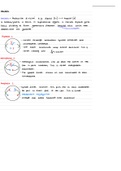
The lexis diagram
= graphing time in two dimensions
Horizontal: historical time, a given year, how it evolves e.g. marriage duration
Vertical: time evolved since some event, e.g. your birth, start of your marriage
Question: children born in 1990 who die at age of 1 = child mortality at age 1 => c
Question: children whose parents got divorced in 1990 while they were two years old => a
[Tip voor mezelf: kijk eerst naar verticale as: welke leeftijd ze hebben: bv. leeftijd 2 jaar, kijk
vanaf lijn die leeftijd 2 aanduidt] – you need to look at 1991 coz a year has passed!
Longitudinal: period of time: in horizontal dimension
= from left to right, and sometimes you go up = following a cohort, staying in a certain age
group OR follow same birth cohort
Combine of the two : cohort perspective, to the right and you also go up = cohort of people =
who have experienced an event in the same time period e.g. their birth
Cross- sectional = transversally: in given moment at the time - vertical
Longitudinal: you follow over time
The world population explosion – causes, context and future prospects
[Niet te horen, doordat hij niet in microfoon spreekt -> uit notities halen]
Today: 0.011 % growth rate
Contents:
Lecture 1: Introduction
Lecture 2: The world population explosion – causes, content and future prospects
Lecture 3: The world population explosion – causes, content and future prospects
Lecture 4: Climate change mitigation: economics and policy
Lecture 5: Fertility, Natality & Reproduction
Lecture 6: Guest lecture: Why is climate change action so difficult – Brulle & Norgaard (2019)] and
[Climate change as social drama – Smith & Howe]
Lecture 7: Mortality – life expectancy
Lecture 8: Climate Change and Population Structure
Lecture 9: On climate change, inequalities and eco-social policies
Lecture 10: continuation of the other lecture (meso/micro level/fertility rates)
Lecture 11: Mortality transition and socio-economic differences in life expectancy
Lecture 12: Migration
, PCCS Lecture 1: 28/09
Introduction to the subject:
Focus: look at connection between, impact on society, climate through the lens of population
Opening slide: UN has projected growth of human population – broader base of pyramid: and
these pyramid has become fatter, bigger + age has had grown = global phenomena
Demographic transition: thread through the lectures
Goal: impact of society on climate and vice versa
Society assumes that there’s a human population
Political system is not the same as political population – it goes on, with new politicians =
society
How structurally linked with each other, they have their own logic, and have impact on each
other
Demographic focus
Examples.
- Referendum Brexit: importance of demography/population structure => age structure
Our age groups: majority who wanted to remain, but older population voted to leave
the European Union
Demographic transition has political impact + where people live can have important
consequences
- Electoral districts in the USA: proportional in size, colours refer to votes that were
majority: blue democrats, red republicans -> majority voted for Clinton, but Trump
won, coz related to where people were living, much fewer people in Midwest, coz of
the system, each district needs to have his representants => less populated areas
have higher weight than actually
- Conceptions leading to alive births: better predictor than any other to predict
economic ups and downs = aggregate fertility -> number of conceptions now, and
then how economy will be doing in some months
- The human tide: you should look at demography, and the impact of population
- (CC) Impact on human behaviour
Goal of the course
Ongoing process of climate change is connected with major changes in society
Society cannot exist without human population, and human population always assumes
human society – human child cannot survive without help of others, so need of societal
institution
In all parts of the world you need an institution to support a born child, and to deal with death
– different cultures have different ways for that, but we all have ways to deal with it
+ we need natural environment: food, air to breath – to survive as human population
Demographic perspective
Insight in human population, so insight about methods, techniques, concepts of demography
How populations organize themselves
Formulas are the basic of the demographic techniques
Demography
- Achille Guillard
Used this term as the first – ‘Eléments de statistique humaine, ou démographie comparée’
Mostly statistical side
,Definition: natural and social history of the human species => so important: biology and
nature
Three ancestors
1) John Graunt - 1662: more technical demography
- Was a merchant, in 17th century
- Life table: How many of born children of a certain year are still alive at a certain time
Many right conclusions – he described mutual dependence between demographic
parameters and drew conclusions about that
e.g. The number of women when they can be pregnant and predict the expected
number of births in the building
Combined numbers of births + applied bills of mortality: certain number of birth than the
survivor right to that + then you can project the number of productive women in maybe 20
years
Forefather of formal demography: Application of mathematical operations to draw
conclusions about demographic/populations
2) Thomas R. Malthus: inspiration to Darwin
Wrote essay on the principle of population, 18th century
Saw optimism in the age of the enlightenment
Idea: Application of science: solve all problems, and the world will get ever better – but he
wanted to make statement against that!
He saw happening: dark foresides in economy + worry: population in England was growing
rapidly, grow exponentially, but the production/food only linearly => sustainability crisis
Population growth is not sustainable
Working class: didn’t have any means, but still starting families => politically stimulated by
support of the poor – he said they should change that to encourage them
Ancestor of political aspects of demography, these changes always have political/socio
implications
Didn’t use ‘sustainability’, but that was his argument – subsistence wasn’t growing linearly,
he was wrong about that
3) Adolphe Quetelet: fore father standard scientific data collection and application statistical
methods in our field
How to measure and count demographic processes and to handle them statistically
Pioneer in applying statistics to population issues: physique sociale: the gauss curve: the
normal distribution to make predictions of human population
(average can be a dangerous statistic)
Demography?
Science that analyse how population grow/shrink, how they’re composed – and how it
changes, as result of 4 basic streams/flows
- Number of births (causes that lead to birth to)
- Number of deaths: you leave population
- Number of immigration: you can come inside population
- Number of emigration
Describing population in:
- Time
- Space
, Ex.: largest space given to largest number of people – and smallest to country with smallest
people
Two kinds of statistics:
- At a given moment in time
- Relates to changes over time in a population
4 basic streams => demographic balancing equation
= the start of everything in demography
N(T) = population size at given moment in time = T
N = population size
Calculate by looking at N in earlier time in society = N(0)
You can do it for different age groups
Two kinds of statistics:
- Stock: given point of time = T or T+1 or T+2
- Flow: period between first of January 2020 till 31st of December 2020
The lexis diagram
= graphing time in two dimensions
Horizontal: historical time, a given year, how it evolves e.g. marriage duration
Vertical: time evolved since some event, e.g. your birth, start of your marriage
Question: children born in 1990 who die at age of 1 = child mortality at age 1 => c
Question: children whose parents got divorced in 1990 while they were two years old => a
[Tip voor mezelf: kijk eerst naar verticale as: welke leeftijd ze hebben: bv. leeftijd 2 jaar, kijk
vanaf lijn die leeftijd 2 aanduidt] – you need to look at 1991 coz a year has passed!
Longitudinal: period of time: in horizontal dimension
= from left to right, and sometimes you go up = following a cohort, staying in a certain age
group OR follow same birth cohort
Combine of the two : cohort perspective, to the right and you also go up = cohort of people =
who have experienced an event in the same time period e.g. their birth
Cross- sectional = transversally: in given moment at the time - vertical
Longitudinal: you follow over time
The world population explosion – causes, context and future prospects
[Niet te horen, doordat hij niet in microfoon spreekt -> uit notities halen]
Today: 0.011 % growth rate