Theory and Practice of Counseling and
Psychotherapy Corey 9th Edition Test Bank
Chapters 1 Back to Top
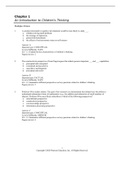
Introduction and Overview
, Note: Below are test items for chapter 1 of Theory and Practice of Counseling and Psychotherapy.
1. Synthesizing the approaches covered in the text:
a. can easily be accomplished after taking an introductory course.
b. is usually mastered by the end of the first year of one’s graduate program.
c. often requires many years of study, training, and practical counseling experience.
d. rarely, if ever, happens and is a completely unrealistic goal.
ANS: C PG: 5
2. Which one of the following is not considered an experiential and relationship-oriented therapy?
a. Gestalt therapy
b. family systems therapy
c. existential approach
d. person-centered approach
ANS: B PG: 10
3. Which one of the following is not associated with the cognitive-behavioral action-oriented therapies?
a. existential therapy
b. cognitive therapy
c. reality therapy
d. behavior therapy
e. rational emotive behavior therapy
ANS: A PG: 10
4. Which humanistic approach emphasizes the basic attitudes of the therapist as the
core of the therapeutic process?
a. psychoanalytic therapy
b. Adlerian therapy
c. person-centered therapy
d. cognitive-behavioral therapy
e. family therapy
ANS: C PG: 12
5. Presenting one model to which all trainees subscribe
a. is what the counseling profession endorses at present.
b. is likely to be a reality by the year 2020 when the CACREP standards are revisited.
c. is dangerous in that it can limit their effectiveness in working with a diverse range of future clients.
d. is illegal in the Northeastern region of the U.S., but not in other parts of the country.
ANS: C PG: 5
6. The author makes a case for:
a. initially getting an overview of the major theoretical orientations, and then delving more deeply
into each approach.
b. delving deeply into one approach initially and then taking a superficial look at other theoretical
models.
Psychotherapy Corey 9th Edition Test Bank
Chapters 1 Back to Top
Introduction and Overview
, Note: Below are test items for chapter 1 of Theory and Practice of Counseling and Psychotherapy.
1. Synthesizing the approaches covered in the text:
a. can easily be accomplished after taking an introductory course.
b. is usually mastered by the end of the first year of one’s graduate program.
c. often requires many years of study, training, and practical counseling experience.
d. rarely, if ever, happens and is a completely unrealistic goal.
ANS: C PG: 5
2. Which one of the following is not considered an experiential and relationship-oriented therapy?
a. Gestalt therapy
b. family systems therapy
c. existential approach
d. person-centered approach
ANS: B PG: 10
3. Which one of the following is not associated with the cognitive-behavioral action-oriented therapies?
a. existential therapy
b. cognitive therapy
c. reality therapy
d. behavior therapy
e. rational emotive behavior therapy
ANS: A PG: 10
4. Which humanistic approach emphasizes the basic attitudes of the therapist as the
core of the therapeutic process?
a. psychoanalytic therapy
b. Adlerian therapy
c. person-centered therapy
d. cognitive-behavioral therapy
e. family therapy
ANS: C PG: 12
5. Presenting one model to which all trainees subscribe
a. is what the counseling profession endorses at present.
b. is likely to be a reality by the year 2020 when the CACREP standards are revisited.
c. is dangerous in that it can limit their effectiveness in working with a diverse range of future clients.
d. is illegal in the Northeastern region of the U.S., but not in other parts of the country.
ANS: C PG: 5
6. The author makes a case for:
a. initially getting an overview of the major theoretical orientations, and then delving more deeply
into each approach.
b. delving deeply into one approach initially and then taking a superficial look at other theoretical
models.