Lecture 8: CH7 – Touch
Part 1: Types of touch
• 7 mechanoreceptor types of touch:
o Light touch/texture, Deep touch/pressure, Stretch, Heat, Cold, Pain
• Skin is main sensory area: 11kg, number of nerves to the central nervous system: 1 million
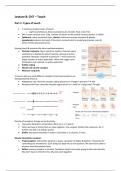
• Epidermis: outer protective layer, dermis: hold most sensory receptors & glands,
hypodermis/subcutis (not part of the skin): connects skin to underlying muscles, joins &
bones. Holds subcutaneous fat.
Sensing touch & pressure the skins mechanoreceptors
• Pacinian corpuscle: big so sensitive. Sodium channels cause
membrane to depolarize when touched, causing an action
potential. Receptor responds to pressure -> more pressure,
larger number of action potentials. When the trigger zone
threshold is not reached, no action potential.
• Ruffini ending
• Merkel cell neurite complex
• Meissner corpuscle
2 reasons why we need different receptors (mechanoreceptors are
distinguished by these 2)
• Adaptation rate: does the receptor signal pressure or change in pressure? à left
• Receptive field size: does the receptor signal touch on a small or a large area? à right
Density of receptors change across the body
• Two-point detection: tell whether there are 1 or 2 points
• When we have 2 stimuli that are close together, the receptor inhibits the responses. So, if
further, we feel it as being 2 points.
• Braille: two-point threshold in action. Each letter is 2 columns, 3 rows.
Muscle kinaestetic receptors
• Proprioception: tells body’s position in space, sensation of object & position. Important for
controlling our movements. Goal: bring our body into a new position. We need to be able to
monitor how that position feels.
• Reflex: sensory receptor in muscles. Sensation travels into spine, going to the brain directly.
We don’t have to think for this. Muscles work together.
, • We cannot control movement without sensory feedback. Not limited to somatosensory
feedback. Touch and movement are carried together to muscles.
• Multisensory interactions: out-of-body experiences. Our sense of self depends very on what
we see. E.g., rubber hand.
Thermoreceptors – hot & cold
• When we touch something of another temperature than
the body, our body cools down or warms up. At 37 degrees,
nothing happens (see figure indicating skin temperature):
à
• When something is pain: thermoreceptor is doing the same
as when there was no pain yet, but the nociceptor (pain receptors just below the skin) is
increasing. 2 main types (also found in bones, joints, arteries, liver, lungs):
o A-delta fibers: insulation around neurons, enabling them to fire action potentials
quickly à shock
o C fibers: less sensitive, react only to
strong signals à more intense and
painful
Together, they underlie the 7 types of touch.
Part 2: Touch perception and processing
Two touch pathways to the brain
• Dorsal column: fine touch, vibration, fast receptive adaptors, limb proprioception, know
where our body is in space
o Back of the brain, from spine to medial lemniscal system to the brain
o Level of decussation: medulla (brain stem)
o Cortical terminations: primary and secondary somatosensory cortex, posterior
parietal cortex
• Anterolateral (or spinothalamic) system: pain, crude tactile sensibility, temperature
o Crossing over spine, anterior spinal cord and from that to the brain via the thalamus
o Level of decussation: spinal cord (quite early)
o Cortical terminations: primary and secondary somatosensory cortex, posterior
parietal cortex
The brain’s somatosensory system
• Both pathways end here; in the
somatosensory cortex (S1), most often
in the primary
• Located at the front of the parietal lobe,
next to the primary motor cortex (which
is located on the frontal lobe) à this is
not surprising, seeing how important
touch is for motor processes
• Stimulation: larger area in the brain
where we have many receptors -> more
sensitive
• Low thresholds for bigger areas à
higher density of receptors
, Pain in the brain
• Subcortical areas: hypothalamus, limbic system and the thalamus
• Cortical areas: S1 & S2 in the somatosensory cortex, the insula, and the anterior cingulate
cortex
• à the pain matrix
Touch perception abilities
• Like vision: allows fine discriminations, object recognition,
sensitive to adaptation
• Types of touch à
• Tactile: using only the skin, haptic: muscles also involved
• We also use things actively to describe the world: active
(controlled) vs passive. Tactile is always active.
• We use different procedures for active touch, for the
properties of an object.
• Object recognition by touch: haptic object recognition is
both fast and accurate (96% correct). Harder if more
complex objects are used.
• Low level haptic perception: to what are you able to see
frequency and detect difference? Ability to see high
frequency lower; amplitude then has to be larger à
• Haptic curve perception: how do we determine round shape? Height between fingers,
orientation fingers, combination. Experiment resulted that height only is very good at this.
Making use of concave & convex.
• Haptic space perception:
experiments: lines that are
haptically parallel are not
physically parallel. à
o Delay causes a
shift from
egocentric to
allocentric, so a
combination is
used. Performance
improves after a
delay.
Part 1: Types of touch
• 7 mechanoreceptor types of touch:
o Light touch/texture, Deep touch/pressure, Stretch, Heat, Cold, Pain
• Skin is main sensory area: 11kg, number of nerves to the central nervous system: 1 million
• Epidermis: outer protective layer, dermis: hold most sensory receptors & glands,
hypodermis/subcutis (not part of the skin): connects skin to underlying muscles, joins &
bones. Holds subcutaneous fat.
Sensing touch & pressure the skins mechanoreceptors
• Pacinian corpuscle: big so sensitive. Sodium channels cause
membrane to depolarize when touched, causing an action
potential. Receptor responds to pressure -> more pressure,
larger number of action potentials. When the trigger zone
threshold is not reached, no action potential.
• Ruffini ending
• Merkel cell neurite complex
• Meissner corpuscle
2 reasons why we need different receptors (mechanoreceptors are
distinguished by these 2)
• Adaptation rate: does the receptor signal pressure or change in pressure? à left
• Receptive field size: does the receptor signal touch on a small or a large area? à right
Density of receptors change across the body
• Two-point detection: tell whether there are 1 or 2 points
• When we have 2 stimuli that are close together, the receptor inhibits the responses. So, if
further, we feel it as being 2 points.
• Braille: two-point threshold in action. Each letter is 2 columns, 3 rows.
Muscle kinaestetic receptors
• Proprioception: tells body’s position in space, sensation of object & position. Important for
controlling our movements. Goal: bring our body into a new position. We need to be able to
monitor how that position feels.
• Reflex: sensory receptor in muscles. Sensation travels into spine, going to the brain directly.
We don’t have to think for this. Muscles work together.
, • We cannot control movement without sensory feedback. Not limited to somatosensory
feedback. Touch and movement are carried together to muscles.
• Multisensory interactions: out-of-body experiences. Our sense of self depends very on what
we see. E.g., rubber hand.
Thermoreceptors – hot & cold
• When we touch something of another temperature than
the body, our body cools down or warms up. At 37 degrees,
nothing happens (see figure indicating skin temperature):
à
• When something is pain: thermoreceptor is doing the same
as when there was no pain yet, but the nociceptor (pain receptors just below the skin) is
increasing. 2 main types (also found in bones, joints, arteries, liver, lungs):
o A-delta fibers: insulation around neurons, enabling them to fire action potentials
quickly à shock
o C fibers: less sensitive, react only to
strong signals à more intense and
painful
Together, they underlie the 7 types of touch.
Part 2: Touch perception and processing
Two touch pathways to the brain
• Dorsal column: fine touch, vibration, fast receptive adaptors, limb proprioception, know
where our body is in space
o Back of the brain, from spine to medial lemniscal system to the brain
o Level of decussation: medulla (brain stem)
o Cortical terminations: primary and secondary somatosensory cortex, posterior
parietal cortex
• Anterolateral (or spinothalamic) system: pain, crude tactile sensibility, temperature
o Crossing over spine, anterior spinal cord and from that to the brain via the thalamus
o Level of decussation: spinal cord (quite early)
o Cortical terminations: primary and secondary somatosensory cortex, posterior
parietal cortex
The brain’s somatosensory system
• Both pathways end here; in the
somatosensory cortex (S1), most often
in the primary
• Located at the front of the parietal lobe,
next to the primary motor cortex (which
is located on the frontal lobe) à this is
not surprising, seeing how important
touch is for motor processes
• Stimulation: larger area in the brain
where we have many receptors -> more
sensitive
• Low thresholds for bigger areas à
higher density of receptors
, Pain in the brain
• Subcortical areas: hypothalamus, limbic system and the thalamus
• Cortical areas: S1 & S2 in the somatosensory cortex, the insula, and the anterior cingulate
cortex
• à the pain matrix
Touch perception abilities
• Like vision: allows fine discriminations, object recognition,
sensitive to adaptation
• Types of touch à
• Tactile: using only the skin, haptic: muscles also involved
• We also use things actively to describe the world: active
(controlled) vs passive. Tactile is always active.
• We use different procedures for active touch, for the
properties of an object.
• Object recognition by touch: haptic object recognition is
both fast and accurate (96% correct). Harder if more
complex objects are used.
• Low level haptic perception: to what are you able to see
frequency and detect difference? Ability to see high
frequency lower; amplitude then has to be larger à
• Haptic curve perception: how do we determine round shape? Height between fingers,
orientation fingers, combination. Experiment resulted that height only is very good at this.
Making use of concave & convex.
• Haptic space perception:
experiments: lines that are
haptically parallel are not
physically parallel. à
o Delay causes a
shift from
egocentric to
allocentric, so a
combination is
used. Performance
improves after a
delay.