BIOL250 Week 6 Unit Exam 2 (Solutions)
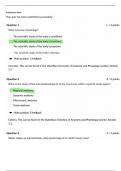
1. Question: The cell membrane (also called the plasma membrane) contains which of the following molecules? 2. Question: The cell membrane (also called the plasma membrane) contains which of the following molecules? 3. Question: Which of the following is NOT a difference between DNA and RNA? 4. Question: Because of their unique molecular structures, only the following bases found in DNA can bind together: 5. Question: Which of these methods that aids in the movement of ions or molecules across a cell membrane requires the use of energy which is supplied by ATP molecules? 6. Question: The most direct method by which an ion or molecule can move across a cell membrane is by_________. 7. Question: Which of the following sequences on a DNA molecule would be complementary to GCTTATAT? 8. Question: Transcription and translation take place in the _______ and , respectively. 9. Question: The jelly-like substance found within cells that provides the fluid medium necessary for biochemical reactions is called________. 10. Question: The molecules which store the genetic instructions of an organism is __________. 11. Question: A molecule (or region of a molecule) that is attracted to water is known as a(n) ________ molecule. 12. Question: Why is DNA replication said to be "semiconservative"? 13. Question: What does the phospholipid bilayer consist of? 14. Question: Which enzyme is required for transcription? 15. Question: The strand of DNA that is continuously synthesized into the replicating fork is: 16. Question: In which phase are the chromatids aligning across the center of the cell? 17. Question: Passive transport resembles which of these processes the most? 18. Question: Which stem cells have the most potential to differentiate into any cells needed by an organism? 19. Question: During prophase, as the centrioles are migrating to opposite ends of the cell, their spindle fibers attach to what part of the chromatids? 20. Question: The cell membrane is composed of numerous proteins, some of which allow for passage of material in and out of the cell. Which of the following proteins allow large molecules to pass through passively? 21. Question: Which of the following is a function of the rough ER? 22. Question: Which of the following phases is characterized by preparation for DNA synthesis? 23. Question: Since the liver cells detoxify drugs, they most likely have an abundance of ______. 24. Question: Zoe has cystic fibrosis. Which of the following is the most likely explanation? 25. Question: Choose the genetic disorder caused by a dominant allele. 26. Question: Which Of Mendel's laws states that when any individual produces sex cells, gametes, the copies of gene separate, so that each sex cell, gamete, receives only one copy. A gamete will receive one allele or the other? 27. Question: Which trait reappears in the second generation after disappearing in the first generation when parents with different traits are bred? 28. Question: Mendel believed that the characteristics of pea plants are determined by which of the following? 29. Question: What is an allele? 30. Question: Marfan syndrome is inherited in an autosomal dominant pattern. Which of the following is TRUE? 31. Question: This cell forms myelin sheath around a segment of an axon in the peripheral nervous system. 32. Question: Differentiated cells in a developing embryo derive from _______. 33. Question: The tight coil of wrapped membranes that encloses the axon is called the _____. 34. Question: Skeletal muscle is composed of very hard-working cells. Which organelles do you expect to find in abundance in skeletal muscle cell? 35. Question: Which of these conduct action potentials and are the structural and functional units of nervous tissue? 36. Question: Which of the following muscle cells is considered voluntary? 37. Question: The tissue from which all other connective tissue eventually rises is called ___________. 38. Question: Atrophy refers to ______. 39. Question: Which of these is a single layer of thin, flattened cells that allow rapid diffusion or transport of substances through membrane; secretes lubricating serous fluid; found lining the air sacs of the lungs, kidneys tubules; and some other viscera? 40. Question: Connective tissue is made of which three essential components? 41. Question: Cells of the body are organized into _________ broad categories of tissue. 42. Question: Striations, cylindrical cells, and multiple nuclei are observed in __________. 43. Question: According to your author, which of the following functions of connective tissue is its most important function? 44. Question: The standard and initial response of the body to injury is called _______. 45. Question: The large sheets of cells covering all the surfaces of the body exposed to the outside world and lining the outside of organs are all called ________ tissue. 46. Question: The following types of tissue all are part of the category named muscle tissue: 47. Question: Which of the following statements is/are true about nervous tissue? 48. Question: The cells responsible for the transmission of the nerve impulse are __________. 49. Question: The basic types of cell-to-cell junctions between epithelial cells are __________. 50. Question: ___________ muscle is also called voluntary muscle.
Escuela, estudio y materia
- Institución
- American Public University
- Grado
- BIOL250 (BIOL250)
Información del documento
- Subido en
- 24 de octubre de 2023
- Número de páginas
- 16
- Escrito en
- 2023/2024
- Tipo
- Examen
- Contiene
- Preguntas y respuestas
Temas
-
biol250 week 6
-
biol250
-
biol250 week 6 unit exam 2 solutions
-
biol250 week 6 unit exam 2