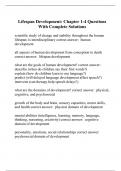
Lifespan Development: Chapter 1-4 Questions With Complete Solutions
scientific study of change and stability throughout the human lifespan; is interdisciplinary correct answer: human development all aspects of human development from conception to death correct answer: lifespan development what are the goals of human development? correct answer: describe (when do children say their first words?) explain (how do children learn to use language?) predict (will delayed language development affect speech?) intervene (can therapy help speech delays?) what are the domains of development? correct answer: physical, cognitive, and psychosocial growth of the body and brain, sensory capacities, motor skills, and health correct answer: physical domain of development mental abilities (intelligence, learning, memory, language, thinking, reasoning, creativity) correct answer: cognitive domain of development personality, emotions, social relationships correct answer: psychosocial domain of development how might one domain affect other domains? correct answer: who you surround yourself with or changing your habits what are the 8 periods of life? correct answer: prenatal period, infancy and toddlerhood, early childhood, middle childhood, adolescence, emerging and young adulthood, middle adulthood, and late adulthood inborn trait or characteristics from biological parents (nature) correct answer: heredity world outside the self, learning from experience (nurture) correct answer: environment unfolding of a universal, natural sequence of changes correct answer: maturation two-generational kinship, economic, and household unit correct answer: nuclear family multigenerational kinship network of grandparents, aunts, cousins, etc. correct answer: extended family income, education, and occupation correct answer: socioeconomic status (SES) a group's total way of life, including customs, traditions, laws, knowledge, beliefs, values, language and physical products correct answer: culture people united by a distinctive culture, ancestry, religion, language, and/or national origin correct answer: ethnicity a social construct with no clear scientific consensus correct answer: race what are the contents of development correct answer: family, socioeconomic status, culture, ethnicity, and race events that affect many or most people in similar ways; age graded influences (menopause, parenthood); history graded influences (technology, Sept 11) correct answer: normative unusual events that have a major impact of individual lives (winning the lottery) correct answer: non-normative specific time when a given event, or its absence, has a specific impact on development correct answer: critical period ________ periods may be more useful than _______ periods because of plasticity correct answer: sensitive; critical body/brain capacity for change based on experience (learning to walk again after major trauma) correct answer: plasticity set of logically related concepts or statements that seek to describe and explain development, predicts what kinds of behavior might occur, and helps organize and explain correct answer: theory what are the three theoretical issues correct answer: 1. nature vs nurture 2. are humans active or reactive in their development 3. is development continuous or does it occur in stages emphasize quantitative change (numerical) correct answer: continuous emphasize qualitative change (hair color, change in values) correct answer: stages unconscious forces, how our mind is shaped by unconscious forces correct answer: psychoanalyst long lasting change in behavior based on experience or adaption to the environment correct answer: learning how thinking occurs, thought process correct answer: cognitive importance social context in development correct answer: contextual behavior evolving overtime/hormones affect behavior correct answer: evolutionary/sociobiological psychosexual development; unconscious force; first 6 years is most important for developing; believed that people are born with biological drives that must be redirected to make it possible to live in society correct answer: Sigmund Freud what are the three parts of a personality correct answer: id, ego, and superego demanding, seek gratification/pleasure (ex. when babies want something) correct answer: id gradually develops over first year; voice of reason; balances the id correct answer: ego early childhood (5 to 6); your conscious; makes you feel guilty correct answer: superego what are the five stages of development correct answer: oral, anal, phallic, latency, and genital sucking and feeding; from birth to 12-18 months correct answer: oral potty training; 12-18 months to 3 years correct answer: anal attachment to parents; 3 to 6 years old correct answer: phallic socialization; 6 years old to puberty correct answer: latency mature adult sexuality; puberty to adulthood correct answer: genital strong attachment to parent of opposite sex correct answer: oedipus and electra complex psychosocial development; emphasized influence of society; development is lifelong; 8 stages of life (a "crisis" in personality at each stage; requires balance of a positive trait and a corresponding negative trait; basic trust vs no trust which is tied to infancy); modified and extended Freudian theory by emphasizing the influence of society on the developing personality (qualitative change) correct answer: Erik Erikson describes observable behavior as a predictable response to the environment; we respond based on whether the situation is painful/threatening or pleasurable correct answer: behaviorism focuses on associative learning, forming mental links between two events; classical and operant conditioning correct answer: behavioral research response to a stimulus is evoked after repeated association with a stimulus that normally elicits a different response correct answer: classical conditioning repeating a behavior that has been reinforced by desirable consequences and suppressing a behavior that has been punished correct answer: operant conditioning we choose models to imitate (ex. learning gender roles) correct answer: observational learning (modeling) a person acts on the world as the world acts on the person; bidirectional correct answer: social learning theory updated version of social learning theory; the change of name reflects a greater emphasis on cognitive processes as central to development correct answer: social cognitive theory cognitive stage theory; inborn ability to adapt to the environment; four qualitatively different stages ranging from simple sensory motor activity to abstract thought; development is discontinuous so his theory describes development in stages correct answer: Jean Piaget what are the four stages according to Jean Piaget correct answer: sensorimotor stage, pre-operational stages, concrete operations stage, and formal operations stage 2 years to 7 years; understand new symbols/pretend/selfish correct answer: pre-operational stage elementary years; logical thinking correct answer: concrete operations stage 11 years and up; abstract ideas correct answer: formal operations stage sociocultural theory; stresses children's active engagement with their environment; concepts include zone of proximal development (ZPD) and scaffolding correct answer: Lev Vygotsky the gap between what they are already able to do by themselves and what they can accomplish with assistance correct answer: zone of proximal development (ZPD) the temporary support that parents, teachers, or others give a child in doing a task until the child can do it alone correct answer: scaffolding bioecological theory including microsystem, mesosystem, exosystem, macrosystem and chronosystsem correct answer: Urie Bronfenbrenner every day environment (home, school, and work) correct answer: microsystem links between elements in the microsystem (working and going to school) correct answer: mesosystem links between the microsystem and systems that don't affect a person directly correct answer: exosystem cultural patterns, values, beliefs, laws, racism, sexism in a culture correct answer: macrosystem changes in the person and environment over time correct answer: chronosystem influence by Darwin's theory of evolution; survival of the fittest, natural selection, evolved mechanisms correct answer: evolutionary/sociobiological perspective the study of the distinctive adaptive behaviors of animal species (imprinting); attachment in humans correct answer: ethology based on the scientific method (identify a problem, formulate hypothesis, collect data, analyze the data, make conclusions, and share findings) correct answer: quantitative research subjective; non-numerical, open ended correct answer: qualitative research combine qualitative and quantitative research correct answer: mixed methods want sample to represent population; random selection and random sample (more for quantitative research) correct answer: sampling what are the forms of data collection correct answer: self report (diaries, interview, questionnaire), naturalistic and laboratory observations, and behavioral and performance measures in depth study of a single case or individual correct answer: case study in-depth study of a culture using a combination of methods (interviewing, participant observation) correct answer: ethnographic study statistical relationship between variables; as one increases the other decreases correct answer: correlation study exposed to treatment correct answer: experimental group not exposed to treatment or receives different treatment correct answer: control group each participant has an equal chance of being assigned to any group correct answer: random assignment what is manipulated correct answer: independent variable what is measured correct answer: dependent variable conducted in a lab correct answer: laboratory experiments conducted in natural setting correct answer: field experiment when random assignment is not possible; actually correlational studies correct answer: natural experiment people of different ages are assessed at one time correct answer: cross sectional design same people are studied more than once correct answer: longitudinal design a complex strategy to overcome the drawbacks of cross sectional and longitudinal designs correct answer: sequential design the dropping out of participants correct answer: attrition beneficence, respect for autonomy, and justice should guide decision making; considerations: right to informed consent, avoidance of deception, right to self-esteem, right to privacy and confidentiality, right to decline or withdraw, correct undesirable effects correct answer: ethics of research process in which sperm and ovum combine to create a zygote correct answer: conception (fertilization) gametes, or sex cells correct answer: sperm and ovum identical twins correct answer: monozygotic twins fraternal twins correct answer: dizygotic twins the basis of heredity correct answer: DNA coils of DNA; consist of genes, functional units of heredity correct answer: chromosomes every cell in the human body (except sperm and ova) have _____ pairs of chromosomes or _______ chromosomes correct answer: 23; 46 sex cells undergo ______ and end of with 23 chromosomes correct answer: meiosis non-sex cells undergo _________ correct answer: mitosis chromosomes not related to sexual expression (22 pairs) correct answer: autosomes determine sex of baby; either X or Y chromosomes; ovum provides X chromosomes and sperm contain either X or Y chromosomes correct answer: sex chromosomes some traits are determined by _________ and _________ inheritance correct answer: dominant; recessive gene that produce alternative expressions of a characteristic; alternate versions of the same gene correct answer: alleles both alleles are the same correct answer: homozygous offspring receive alleles for two contradictory traits but only the dominant is expressed correct answer: heterozygous determined by multiple genes correct answer: polygenic inheritance genetic makeup or allele combination correct answer: genotype observable observations; same __________ may result from different genotype correct answer: phenotype expression of most traits due to _____________ __________ (both genes and environment) correct answer: multifactorial transmission what's an abnormal trait that is dominant? recessive? correct answer: Huntington's disease; sickle cell anemia when a person has 2 different alleles (heterozygous) and a trait is only partially expressed correct answer: incomplete dominance certain recessive disorders are linked to genes on the sex chromosomes; males and females are affected differently; color blindness correct answer: sex-linked inheritance errors in cell division resulting in an extra or missing chromosomes; errors during meiosis (Klinefelter syndrome (XXY), Turner syndrome (XO); errors in autosomes (down syndrome) correct answer: chromosomal abnormalities ___________ ___________ seeks to measure how much heredity and environment influence a particular trait correct answer: behavioral geneticist a statistical estimate of how heredity influences diversity within a specific trait in a given population; a percentage ranging from 0 to 100; for a particular individual cannot be determined correct answer: heritability immediate family members should be more similar than distant relatives; cannot rule out environmental influences correct answer: family studies adopted children and their adoptive families vs adopted children and their biological families; adopted children should be more similar to their biological parents than their adoptive parents correct answer: adoption studies compare monozygotic (identical twins) and same sex dizygotic (fraternal twins); when monozygotic twins have higher concordance for a trait, it is likely due to heredity; adoption studies help to further determine effects of heredity correct answer: twin studies tendency of certain genetic and environmental influence to reinforce each other correct answer: genotype-environment correlations parents provide genes and environment correct answer: passive children with different genes evoke different responses correct answer: reactive (evocative) children actively seek out experiences that are consistent with their genetic tendencies correct answer: active (niche-picking) period between conception and birth; usually about 38 weeks correct answer: gestation period "head to tail"; growth occurs from head and downward correct answer: cephalocaudal principle "near to far"; development occurs from the center of the body and outward correct answer: proximodistal principle begins at conception; lasts 2 weeks; zygote divides, becomes more complex, and is implanted in the wall of the uterus (zygote changes into a blastocyst, cells from blastocyst eventually form embryonic disk, amniotic sac, placenta, and umbilical cord) correct answer: germinal stages does not implant in the wall of uterus correct answer: ectopic pregnancy implants in the fallopian tubes correct answer: tubal pregnancy 2-8 weeks; organs and major body systems develop rapidly; a critical period in development correct answer: embryonic stage most due to chromosomal abnormalities correct answer: spontaneous abortion (miscarriage) 8 weeks to birth; appearance of bones, rapid growth, organs and body systems become more complex, sex can be detected (early as 12 weeks), fetal movement (males are more active than females), and fetal memory correct answer: fetal stage nutrition and maternal weight, physical activity, and age correct answer: maternal factors factors that are capable of causing birth defects; can depend on genes, timing of exposure, dose, duration, and interaction with other __________ correct answer: teratogens what are some common teratogens correct answer: alcohol, nicotine, and drugs leads to contraction and dilation of cervix correct answer: oxytocin used to induce labor correct answer: pitocin false contractions a few months before actual birth date correct answer: Braxton Hicks contractions begins about two weeks before childbirth; change in uterus and cervix that warns that the baby is coming soon correct answer: parturition thinning of the cervix correct answer: effacement what are the stages of labor correct answer: dilation of the cervix, descent and emergence of the body, and expulsion of the placenta what are some common birth settings correct answer: hospitals, home birth, and birthing centers most common form of birth correct answer: vaginal birth why might it be necessary to have a Cesarean section (C-section) correct answer: baby comes out feet/butt first or sideways, any sign that the baby or mother are in any danger, mother has placenta previa, or just elective vaginal birth after cesarean correct answer: VBAC breathing and relaxation techniques correct answer: lamaze method what are the benefits of water births correct answer: the water is comforting to the child, the risk of tearing is reduced, easier transition for the baby what is the most common anesthetic used in child birth correct answer: epidural size and appearance (7.5 pounds, 20 inches long) correct answer: neonate immature liver (normally days after birth) correct answer: neonatal jaundice appearance, pulse, grimace, activity, respiration; usually take all these 5 minutes after birth because it is all normally more positive or higher correct answer: APGAR scale under 37 weeks of gestation correct answer: preterm (premature) infants weigh less than 90% of all babies of the same gestational age; may or may not be preterm correct answer: small for date infants under 5.5 pounds (8%) correct answer: low birth weight what are some long term problems due to low birth weight correct answer: problems with hearing, language or cognitive processes due to lack of development 42+ weeks gestation correct answer: post-maturity death of a fetus at or after the 20th weeks of gestation; more males are ______ than females; higher increase of ______ in 20s and early 30s correct answer: stillbirth in 12 months the birth weight has ________ correct answer: tripled _____ inches during first year correct answer: 10 only breast milk correct answer: first 6 months what is an alternative to breast milk correct answer: iron fortified formula based on cow's milk or soy protein how long should you breast feed correct answer: 1 year at least what are some benefits to breast feeding for the baby correct answer: babies get less infections; less asthma, diabetes, and obesity; easier for them to digest; less crying; lower risk of SIDS; better teeth; bond between mother and baby what are the benefits to breast feeding for the mother correct answer: mothers heal faster (after pregnancy); lower risk of breast and ovarian cancer when should you give iron enriched solid foods to babies correct answer: 6 to 12 months in one year how many teeth will a baby have correct answer: 6-8 when should an infant have all its teeth correct answer: 2 and 1/2 proportion of babies who die within the first year correct answer: infant mortality rate what is a potential cause for SIDS correct answer: birth defect in brain stem how can SIDS be prevented correct answer: baby placed on back in the crib, pacifiers, firm surfaces, less blanket, nice temperature in room, has its own bed by age 3 a child should have _____% of an adult size central nervous system correct answer: 90 balance and motor coordination correct answer: cerebellum right and left hemispheres joined by corpus callosum; thought and action correct answer: cerebrum send information to other neurons correct answer: axons receive information from neurons correct answer: dendrites males exposed to a drug or chemical could have possible effects on his offspring correct answer: paternal teratogen controls breathing, swallowing, heart rate, blood pressure, consciousness, and whether one is awake or tired correct answer: brain stem connects the right and left hemispheres correct answer: corpus callosum nerve cells correct answer: neurons protect neurons correct answer: glial cells allows faster communication between neurons correct answer: myelination sucking, rooting for the nipple correct answer: primitive reflex what senses are developed in the womb/before birth correct answer: smell, taste, and hearing ______ is the least developed sense at birth correct answer: sight _____ is the first sense to develop and for the first several months it is the most mature sensory system correct answer: touch using large muscles correct answer: gross motor skills using small muscles, eye-hand coordination correct answer: fine motor skills when can infants crawl normally correct answer: 6-10 months when can infants walk correct answer: about 12 months
Escuela, estudio y materia
- Institución
- Lifespan Development
- Grado
- Lifespan Development
Información del documento
- Subido en
- 21 de octubre de 2023
- Número de páginas
- 21
- Escrito en
- 2023/2024
- Tipo
- Examen
- Contiene
- Preguntas y respuestas
Temas
-
lifespan development chapter 1 4 questions with c

Documento también disponible en un lote