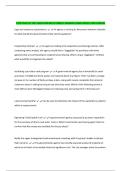
BIOL201 Week 3 Unit Exam 1 (Solved)
1. Question: The state of steady internal conditions maintained by living things is called this. 2. Question: What is the study of the larger structures of the body, visible WITHOUT the aid of magnification? 3. Question: Which organ system is responsible for producing sex hormones and producing milk for an infant? 4. Question: Which organ system is responsible for enabling movement and helping to maintain body temperature? 5. Question: What is the metabolic process whereby smaller, simpler molecules are combined into larger, more complex substances?? 6. Question: What is the study of the interrelationships of all the structures within a specific body region? 7. Question: Which of the following types of substances dissolve in water? 8. Question: During a party, Eli loses a bet and is forced to drink a bottle of lemon juice. Not long thereafter, he begins complaining of having difficulty breathing, and his friends take him to the local emergency room. His blood pH is 7.28. What does this mean? 9. Question: Nitrogen has an atomic number of seven. How many electron shells does it likely have? 10. Question: Jenny mixes up a batch of pancake batter, then stirs in some chocolate chips. As she is waiting for the first few pancakes to cook, she notices the chocolate chips sinking to the bottom of the clear glass 11. Question: A saturated fatty acid has the maximum number of which atoms in its chain? 12. Question: The characteristic that gives an element its distinctive properties is its number of what? 13. Question: Together, just four elements make up more than 95 percent of the body's mass. Which ones are they? 14. Question: What does the phospholipid bilayer consist of? 15. Question: In which phase are the paired chromatids separating and being pulled to opposite ends of the cell? 16. Question: The macrostructure of DNA is which of the following? 17. Question: Since muscle cells make and utilize an abundance of ATP (energy) for muscle activity, which of these does each muscle cell most likely have more of? 18. Question: Which enzyme is required for transcription? 19. Question: Passive transport resembles which of these processes the most? 20. Question: Which type of stem cell gives rise to red and white blood cells? 21. Question: What are microscopic stripes seen in cardiac and skeletal muscle fibers called? 22. Question: Which of the following is NOT released during inflammation? 23. Question: Which of the following types of fibers hold tissue together by forming a net‐like arrangement of fibers? 24. Question: Reduces blood loss from damaged blood vessels and forms a network of fibrin proteins that traps blood vessels and binds the edges of the wound together describes which of these? 25. Question: The tight coil of wrapped membranes that encloses the axon is called the . 26. Question: Transitional epithelium is unique in that it: 27. Question: This cell forms myelin sheath around a segment of an axon in the peripheral nervous system. 28. Question: Which of these is a single layer of thin, flattened cells that allow rapid diffusion or transport of substances through membrane; secretes lubricating serous fluid; found lining the air sacs of the lungs, kidneys tubules; and some other viscera? 29. Question: Which of these conduct action potentials and are the structural and functional units of nervous tissue? 30. Question: The tissue from which all other connective tissue eventually rises is called . 31. Question: Which skin disorder causes damage to keratinocytes of the stratum spinosum? 32. Question: Which gland excretes chemicals that exert subtle effects on the sexual behavior and physiology of other people? 33. Question: In general, skin cancers . 34. Question: What influences the color of skin? 35. Question: Sudoriferous glands are under the control of the nervous system and are located in the dermis. 36. Question: Which of these is the muscle attached to the hair follicle and the basal layer of the epidermis, responsible for goose bumps? 37. Question: What happens when the body's temperature drops? 38. Question: Scarring of skin after wound healing is a natural process. What are the scars that leave a sunken appearance called? 39. Question: Similar to the hair, nails grow continuously throughout our lives. Which of the following is furthest from the nail growth center? 40. Question: Body piercings can cause a wide range of dangers to a person's health. All the following are examples of these EXCEPT for:
Escuela, estudio y materia
- Institución
- American Public University
- Grado
- BIOL201
Información del documento
- Subido en
- 20 de octubre de 2023
- Número de páginas
- 32
- Escrito en
- 2023/2024
- Tipo
- Examen
- Contiene
- Preguntas y respuestas
Temas
-
biol201 week 3 unit exam 1