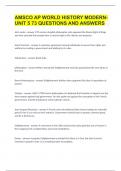
AMSCO AP WORLD HISTORY MODERN- UNIT 5| 73 QUESTIONS AND ANSWERS|GUARANTEED SUCCESS
John Locke 17th century English philosopher who opposed the Divine Right of Kings and who asserted that people have a natural right to life, liberty, and property. Social Contract A voluntary agreement among individuals to secure their rights and welfare by creating a government and abiding by its rules. Tabula Rasa blank slate philosophes Writers during the Enlightenment and who popularized the new ideas of the time. Baron Montesquieu Enlightenment thinker who supported the idea of separation of powers Voltaire () French philosopher. He believed that freedom of speech was the best weapon against bad government. He also spoke out against the corruption of the French government, and the intolerance of the Catholic Church. Jean-Jacques Rousseau A French man who believed that Human beings are naturally good & free & can rely on their instincts. Government should exist to protect common good, and be a democracy Enlightenment A movement in the 18th century that advocated the use of reason in the reappraisal of accepted ideas and social institutions. Deism A popular Enlightenment era belief that there is a God, but that God isn't involved in people's lives or in revealing truths to prophets. Liberalism A belief that government can and should achieve justice and equality of opportunity. Conservatism A political or theological orientation advocating the preservation of the best in society and opposing radical changes. Empiricism the view that knowledge originates in experience and that science should, therefore, rely on observation and experimentation Nationalism A strong feeling of pride in and devotion to one's country Classical Liberalism A term given to the philosophy of John Locke and other 17th and 18th century advocates of the protection of individual rights and liberties by limiting government power. Feminism A female movement for gender equality. abolitionism Movement to end slavery Zionism A policy for establishing and developing a national homeland for Jews in Palestine. Anti-Semitism Prejudice against Jews Theodor Herzl and Zionism Jewish founder of Zoionist Movement (1897) movement to rebuild homeland in Palestine, a policy for establishing and developing a national homeland for Jews in Palestine Dreyfus Affair 1894 Falsely charged for supplying French secrets to the Germans. Coincidentally a jew. Found guilty and sent to Devil's Island. After 10 years there he was given a full pardon by President Loubet Adam Smith Scottish economist who wrote the Wealth of Nations a precursor to modern Capitalism. Wealth of Nations This is the 18th century book written by Scottish economist Adam Smith in which he spells out the first modern account of free market economies. laissez-faire Idea that government should play as small a role as possible in economic affairs. Capitalism An economic system based on private ownership of capital Socialism A system in which society, usually in the form of the government, owns and controls the means of production. utopian socialists Early nineteenth-century socialists who hoped to replace the overly competitive capitalist structure with planned communities guided by a spirit of cooperation. Leading French utopian socialists such as Charles Fourier and Louis Blanc believed that property should be communally owned. Henri de Saint-Simon Utopian socialist who wanted a society led by intellectuals providing for the welfare of the lowest classes Charles Fourier ()-A leading utopian socialist who envisaged small communal societies in which men and women cooperated in agriculture and industry, abolishing private property and monogamous marriage as well. Robert Owen () British cotton manufacturer believed that humans would reveal their true natural goodness if they lived in a cooperative environment. Tested his theories at New Lanark, Scotland and New Harmony, Indiana, but failed Fabian Society Group of English socialists, including George Bernard Shaw, who advocated electoral victories rather than violent revolution to bring about social change. Declaration of Independence the document recording the proclamation of the second Continental Congress (4 July 1776) asserting the independence of the colonies from Great Britain Declaration of the Rights of Man Statement of fundamental political rights adopted by the French National Assembly at the beginning of the French Revolution. Reign of Terror (1793-94) during the French Revolution when thousands were executed for "disloyalty" Liberte, Egalite, Fraternite Liberty! Equality! Fraternity! Chant used by French Revolutionaries. Haiti Name that revolutionaries gave to the former French colony of Saint Domingue; the term means "mountainous" or "rugged" in the Taino language. Simon Bolivar , Venezuelan statesman: leader of revolt of South American colonies against Spanish rule. Lola Rodriguez de Tio Puerto Rican poet who supported Cuban independence. Propaganda Movement reform movement Realpolitik realistic politics based on the needs of the state Giuseppe Mazzini Italian nationalist whose writings spurred the movement for a unified and independent Italy () Risorgimento Italian nationalist movement Giuseppe Garibaldi Italian patriot whose conquest of Sicily and Naples led to the formation of the Italian state (). Immigration Migration to a new location Otto von Bismarck Chancellor of Prussia from 1862 until 1871, when he became chancellor of Germany. A conservative nationalist, he led Prussia to victory against Austria (1866) and France (1870) and was responsible for the creation of the German Empire (714) Ottomanism An ideology developed by the Ottoman govt in order to strengthen their subjects' loyalty and solidarity. Focused on the idea the all subjects are equal (despite religious/ethinic/linguistic differences) and deserved equal rights (reinforced by Imperial decree of 1856). Maroons Runaway slaves who gathered in mountainous, forested, or swampy areas and formed their own self-governing communities. raided plantations for supplies, had military skills from Africa. Mestizos A person of mixed Native American and European ancestory Peninsulares Spanish-born, came to Latin America; ruled, highest social class. Mulattoes People of African and European descent Bastille Medieval fortress that was converted to a prison stormed by peasants for ammunition during the early stages of the French Revolution. Italian Peninsula a boot-shaped peninsula in southern Europe extending into the Mediterranean Sea Spinning Jenny A machine that could spin several threads at once water frame 1780's; Richard Arkwright; powered by water; turned out yarn much faster than cottage spinning wheels, led to development of mechanized looms James Hargreaves Spinning Jenny Richard Arkwright water frame Factory System A method of production that brought many workers and machines together into one building Agricultural Revolution The time when human beings first domesticated plants and animals and no longer relied entirely on hunting and gathering
Escuela, estudio y materia
- Institución
- Abc College
- Grado
- APUSH AMSCO
Información del documento
- Subido en
- 18 de octubre de 2023
- Número de páginas
- 8
- Escrito en
- 2023/2024
- Tipo
- Examen
- Contiene
- Preguntas y respuestas
Temas
-
amsco ap world history modern unit 5

Documento también disponible en un lote