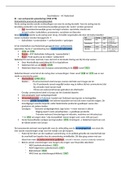
DIVERSITY OF CELL CELLULAR & MOLECULAR NEUROSCIENCE (ELLENDER): & is dependent of the resistance
within the system
TYPES IN THE BRAIN INTRODUCTION & BASIC CONCEPTS → high R: little current
brain (B) → many cell types: → low R: high current
> astrocytes SPATIAL AND TEMPORAL THE MOSAIC MODEL OF THE RESTING MEMBRANE
> endothelial cells blood vessels SCALES OF MEASUREMENTS MEMBRANE = THE BASIS OF POTENTIAL
> schwann cells neuroscience doesn’t have a lot of BIO-ELECTRICITY
> microgliacells = macrophages brain N has a resting membrane potential
equipment to study B
> dendrocytes: help with myelin prod. > phospholipid bilayer impermeable for ions → Vm = Vin - Vout (always 0mv!!) =
→ 2 we will focus on: single unit recordings
> neurons (N) !!! → allow cells to have an intracellular = -100 mV for N
& patch clamp
= excitable cells -> generate action environment detected with glass electrode
→ detect electrophysiology
potentials (AP) !!!! → membrane = insulator between 2 salt
→ N connected with >1000 other N = studying rapid (msec) changes & solutions how many ions to created Vm?
= N circuit level: communication → functions as a capacitor: stores → C = Q/V
excitability of N on cellular & subcellular
via synapses charge → 10-12 mol/cm2 ions need to be
level
→ AP (electrical signal) here > in bilayer flow proteins = IC transferred to get -100 mV
converted to chemical IONIC BASIS OF > bilayer gives cell 2 !!! properties: (tot. number ions 1cm3 = 10-4
signal (neurotransmitters-NT) EXCITABILITY • conductance (g: pS) → only small amount of charge
→ NT comes free ~ post- • capacitance = storage of charge in needed to get a rest
brain function, muscle contraction &
synaptical R system potential)
heart rhythm
→ complex electrical phenomena explained →Q=CxV
big diversity: classification on bio- -> Q = charge: Coulomb, C ION DISTRIBUTIONS
by AP
chemical content (expression P or -> C = capacitance Farad, F ions unequal distributed across bilayer
markers) or AP (what is the pattern) = complex electrical phenomenon ex- -> V = voltage across capacitor, V → is due to Na/K-ATPase pump
plained by ion channels (IC) -> change V in bilayer?: initiation
how can N generate an AP? capacitance current = driving force for ions to flow through
→ ION CHANNELS MAKE N ION CHANNEL PROPERTIES -> N will respons slower + gives IC
EXCITABLE !!!! us a membrane time constant
I. SELECTIVITY: they gate ions (K+, Na+, Cl-) (rm= R x C) of 10-50ms
→ depending on [ion] in/out there will
STUDY OF N & THE
be a reverse potential RESISTANCE: OHM’S LAW
NERVOUS SYSTEM AT II. PERMEABILITY FOR IONS: can be V = I x R → Ohm’s law
DIFFERENT LEVELS selective permeable (closed from in -> -> I = current = V/R = g x V: pA
out, but open from out-> in) -> R = resistance: MΩ → Na+ & Cl- = more out cell
III. KINETICS: they have a probability
to be open can be bound to a NT or → K+ & A- = more in cell
be changed by voltage can calculate resistance over bilayer or if
→ there is a time course activation there’s change in voltage how much current will
& inactivation (we’ll see this later) flow through circuit
→ if you apply a potential through system
there will flow a current through the circuit
, ION CHANNELS CONSEQUENCE OF model explains original observation
= transmembrane proteins that gate/ + predicts outcome new experiments
conduct/pass selective ions
A-SYMMETRIC -> yes? -> good model
→ open IC? CONCENTRATIONS & NERST -> no? -> poor model
→ membrane potential moves you can predict how N responds if you change !!!! no model is final: there will always be
towards equilibrium potential parameters in circuit new processes that requires you to
for that ion → Ix = gx (E,T) x (E - Ex) change model
→ current = conductance x driving force
= potential where no net flow → if you change voltage + conductance↑ ELECTRICAL UNITS &
of ion occurs across membrane
(there is a balance in and out)
more current will flow across bilayer FUNDAMENTAL CONSTANTS
via IC
→ set by 2 gradients:
> concentration gradient !!! to know IC are not passively open
= ions what an evenly & closing but they are depending on
distribution in and out voltage
> voltage gradient → certain IC are closed at particular
= electrical potential voltages & other open (changing
across a distance configuration takes a while)
= voltage gated channels
ION PUMPS
Na/K-ATPase !!! role in uneven distribution biological voltage range = -90 to +60 mV
→ bind ATP: Na+ out & K+ in N -> -90 mV= reverse potential K+
→ with ATP it tries to keep -> +60 mV = reverse potential Na+
concentrations on either side of -> cell potential always between
membrane away from equilibrium these 2
potential CLASSICAL ION CHANNEL
→ this makes the N excitable &
makes AP propagation possible BIOPHYSICS
NERNST EQUATION
to calculate the equilibrium potential for
all ions & is based on [in] & [out] of cell
→ takes into account voltage &
concentration gradient
we try to generate models that can
predict/prescribe what we see in systems
→ need sufficient, relevant & reliable info
for right model (simple models preferred)
, NEURONAL MEMBRANE 1985-1995
RECORDING BIO-ELECTRICITY HISTORY
RESISTANCE (Rm) & cloning of IC genes
CAPACITANCE (Cm) KEY HISTORICAL ADVANCES IN → detailed studies possible
HODGKIN & HUXLEY
> resistance ELECTROPHYSIOLOGY: 1939: !!!! FIRST INTRACELLULAR AP
= ability for current to flow across McKINNON 1998
> Bernard 19th century: cells are bathed in RECORINDGS !!!
a membrane (possible bcs bilayer crystalized IC to see what happens
solutions that mimic the oerzee → caused a paradigm shift in understanding
is impermeable for ions) → he measured ions in oerzee when IC open/closes
AP generation
→𝑹= 𝑰
𝑽 → paradigm shift
→ different [in] & [out]: he thought → observed 2 things:
--> R = resistance -> Ohm that membrane potential = selective > resting membrane potential = - HODGKIN & HUXLEY MORE IN
--> depends on IC: close/open permeability for K+ > human AP has an overshoot: peak
> Nernst: developed Nernst equitation AP at +40mV & not 0mV
DETAIL
--> V = voltage -> voltage
--> I = current -> Ampere → rest membrane potential = negative → so Bernsteins hypothesis impaled N with electrode: inside more neg.
> capacitance → matched hypothesis from Bernard: = wrong: there must be something than outside
= ability of membrane to hold/store rest potential close to equilibrium else → Vm = Vin - Vout
charge (looks like a battery, but a potential K+ (-90mV) Kuhn cycle: → AP = tiny signal (mV) -> need high
battery slowly gives away his V, > Bernstein 1902: AP = non-specific breakdown a) scientist makes model to understand impedance amplifiers
while a capacitor gives it all away of K+ permeability (membrane just opens, so something
immediately) permeability↓) b) science progresses -> new observations HIGH IMPEDANCE
→𝑸 = 𝑪∙𝑽 -> model doesn’t fit anymore AMPLIFIERS
--> Q = charge stored -> Coulombs BERNSTEIN’S SUGGESTION c) model drifts away from what it originally
--> C = capacitance -> Farads was set up: fine tip (1µm) glass electrode
--> V = voltage I. [K+]in > [K+]out → it fails to explain reality filled with electrolyte salt solution
II. K+ permeability highest off = point of reality → then record Vm relative to extra-
LUIGI GALVANI: 1781 all ions d) model changed = model revolution cellular environment
III. Vm → change old -> new = paradigm shift → need high impedance amplifiers:
Galvani saw biological systems use = equilibrium potential K+
electricity to function has very resistance & can detect
IV. neuronal activity represents a short 1945-52: development voltage clamp very small potential differences
→ stimulated nerves with electricity circuit of the cell membrane (CM) → clamped voltage N & probed which ionic + doesn’t take current for N
→ muscle contraction resistance current is responsible for AP generation away
→ suggested that the short circuit → again paradigm shift → other amplifiers do this:
additional setup: dissected frog in vase would make N approach 0mV during modification potential
on table AP
→ he waited till lightning from storm NEHER-SAKMAN 1981 (used by HH)
→ hard to know: till 1939 AP were back in the days: triode tubes:
hit the antenna always recorded extracellular !!! development patch clamp !!!
electrons in tube move away
→ thought that animal would come → but then Hodgkin & Huxley → recording small currents (pA): now recording
from 2 wires (- & +) & flow
back alive single ion channel currents possible
electrons can be modified with
→ paradigm shift: understanding
wire mech
excitability bcs of IC↑ (how IC open/ → can now dial up/down signal input:
close) can change ion flux across bridge
→ amplification signal x fold
within the system
TYPES IN THE BRAIN INTRODUCTION & BASIC CONCEPTS → high R: little current
brain (B) → many cell types: → low R: high current
> astrocytes SPATIAL AND TEMPORAL THE MOSAIC MODEL OF THE RESTING MEMBRANE
> endothelial cells blood vessels SCALES OF MEASUREMENTS MEMBRANE = THE BASIS OF POTENTIAL
> schwann cells neuroscience doesn’t have a lot of BIO-ELECTRICITY
> microgliacells = macrophages brain N has a resting membrane potential
equipment to study B
> dendrocytes: help with myelin prod. > phospholipid bilayer impermeable for ions → Vm = Vin - Vout (always 0mv!!) =
→ 2 we will focus on: single unit recordings
> neurons (N) !!! → allow cells to have an intracellular = -100 mV for N
& patch clamp
= excitable cells -> generate action environment detected with glass electrode
→ detect electrophysiology
potentials (AP) !!!! → membrane = insulator between 2 salt
→ N connected with >1000 other N = studying rapid (msec) changes & solutions how many ions to created Vm?
= N circuit level: communication → functions as a capacitor: stores → C = Q/V
excitability of N on cellular & subcellular
via synapses charge → 10-12 mol/cm2 ions need to be
level
→ AP (electrical signal) here > in bilayer flow proteins = IC transferred to get -100 mV
converted to chemical IONIC BASIS OF > bilayer gives cell 2 !!! properties: (tot. number ions 1cm3 = 10-4
signal (neurotransmitters-NT) EXCITABILITY • conductance (g: pS) → only small amount of charge
→ NT comes free ~ post- • capacitance = storage of charge in needed to get a rest
brain function, muscle contraction &
synaptical R system potential)
heart rhythm
→ complex electrical phenomena explained →Q=CxV
big diversity: classification on bio- -> Q = charge: Coulomb, C ION DISTRIBUTIONS
by AP
chemical content (expression P or -> C = capacitance Farad, F ions unequal distributed across bilayer
markers) or AP (what is the pattern) = complex electrical phenomenon ex- -> V = voltage across capacitor, V → is due to Na/K-ATPase pump
plained by ion channels (IC) -> change V in bilayer?: initiation
how can N generate an AP? capacitance current = driving force for ions to flow through
→ ION CHANNELS MAKE N ION CHANNEL PROPERTIES -> N will respons slower + gives IC
EXCITABLE !!!! us a membrane time constant
I. SELECTIVITY: they gate ions (K+, Na+, Cl-) (rm= R x C) of 10-50ms
→ depending on [ion] in/out there will
STUDY OF N & THE
be a reverse potential RESISTANCE: OHM’S LAW
NERVOUS SYSTEM AT II. PERMEABILITY FOR IONS: can be V = I x R → Ohm’s law
DIFFERENT LEVELS selective permeable (closed from in -> -> I = current = V/R = g x V: pA
out, but open from out-> in) -> R = resistance: MΩ → Na+ & Cl- = more out cell
III. KINETICS: they have a probability
to be open can be bound to a NT or → K+ & A- = more in cell
be changed by voltage can calculate resistance over bilayer or if
→ there is a time course activation there’s change in voltage how much current will
& inactivation (we’ll see this later) flow through circuit
→ if you apply a potential through system
there will flow a current through the circuit
, ION CHANNELS CONSEQUENCE OF model explains original observation
= transmembrane proteins that gate/ + predicts outcome new experiments
conduct/pass selective ions
A-SYMMETRIC -> yes? -> good model
→ open IC? CONCENTRATIONS & NERST -> no? -> poor model
→ membrane potential moves you can predict how N responds if you change !!!! no model is final: there will always be
towards equilibrium potential parameters in circuit new processes that requires you to
for that ion → Ix = gx (E,T) x (E - Ex) change model
→ current = conductance x driving force
= potential where no net flow → if you change voltage + conductance↑ ELECTRICAL UNITS &
of ion occurs across membrane
(there is a balance in and out)
more current will flow across bilayer FUNDAMENTAL CONSTANTS
via IC
→ set by 2 gradients:
> concentration gradient !!! to know IC are not passively open
= ions what an evenly & closing but they are depending on
distribution in and out voltage
> voltage gradient → certain IC are closed at particular
= electrical potential voltages & other open (changing
across a distance configuration takes a while)
= voltage gated channels
ION PUMPS
Na/K-ATPase !!! role in uneven distribution biological voltage range = -90 to +60 mV
→ bind ATP: Na+ out & K+ in N -> -90 mV= reverse potential K+
→ with ATP it tries to keep -> +60 mV = reverse potential Na+
concentrations on either side of -> cell potential always between
membrane away from equilibrium these 2
potential CLASSICAL ION CHANNEL
→ this makes the N excitable &
makes AP propagation possible BIOPHYSICS
NERNST EQUATION
to calculate the equilibrium potential for
all ions & is based on [in] & [out] of cell
→ takes into account voltage &
concentration gradient
we try to generate models that can
predict/prescribe what we see in systems
→ need sufficient, relevant & reliable info
for right model (simple models preferred)
, NEURONAL MEMBRANE 1985-1995
RECORDING BIO-ELECTRICITY HISTORY
RESISTANCE (Rm) & cloning of IC genes
CAPACITANCE (Cm) KEY HISTORICAL ADVANCES IN → detailed studies possible
HODGKIN & HUXLEY
> resistance ELECTROPHYSIOLOGY: 1939: !!!! FIRST INTRACELLULAR AP
= ability for current to flow across McKINNON 1998
> Bernard 19th century: cells are bathed in RECORINDGS !!!
a membrane (possible bcs bilayer crystalized IC to see what happens
solutions that mimic the oerzee → caused a paradigm shift in understanding
is impermeable for ions) → he measured ions in oerzee when IC open/closes
AP generation
→𝑹= 𝑰
𝑽 → paradigm shift
→ different [in] & [out]: he thought → observed 2 things:
--> R = resistance -> Ohm that membrane potential = selective > resting membrane potential = - HODGKIN & HUXLEY MORE IN
--> depends on IC: close/open permeability for K+ > human AP has an overshoot: peak
> Nernst: developed Nernst equitation AP at +40mV & not 0mV
DETAIL
--> V = voltage -> voltage
--> I = current -> Ampere → rest membrane potential = negative → so Bernsteins hypothesis impaled N with electrode: inside more neg.
> capacitance → matched hypothesis from Bernard: = wrong: there must be something than outside
= ability of membrane to hold/store rest potential close to equilibrium else → Vm = Vin - Vout
charge (looks like a battery, but a potential K+ (-90mV) Kuhn cycle: → AP = tiny signal (mV) -> need high
battery slowly gives away his V, > Bernstein 1902: AP = non-specific breakdown a) scientist makes model to understand impedance amplifiers
while a capacitor gives it all away of K+ permeability (membrane just opens, so something
immediately) permeability↓) b) science progresses -> new observations HIGH IMPEDANCE
→𝑸 = 𝑪∙𝑽 -> model doesn’t fit anymore AMPLIFIERS
--> Q = charge stored -> Coulombs BERNSTEIN’S SUGGESTION c) model drifts away from what it originally
--> C = capacitance -> Farads was set up: fine tip (1µm) glass electrode
--> V = voltage I. [K+]in > [K+]out → it fails to explain reality filled with electrolyte salt solution
II. K+ permeability highest off = point of reality → then record Vm relative to extra-
LUIGI GALVANI: 1781 all ions d) model changed = model revolution cellular environment
III. Vm → change old -> new = paradigm shift → need high impedance amplifiers:
Galvani saw biological systems use = equilibrium potential K+
electricity to function has very resistance & can detect
IV. neuronal activity represents a short 1945-52: development voltage clamp very small potential differences
→ stimulated nerves with electricity circuit of the cell membrane (CM) → clamped voltage N & probed which ionic + doesn’t take current for N
→ muscle contraction resistance current is responsible for AP generation away
→ suggested that the short circuit → again paradigm shift → other amplifiers do this:
additional setup: dissected frog in vase would make N approach 0mV during modification potential
on table AP
→ he waited till lightning from storm NEHER-SAKMAN 1981 (used by HH)
→ hard to know: till 1939 AP were back in the days: triode tubes:
hit the antenna always recorded extracellular !!! development patch clamp !!!
electrons in tube move away
→ thought that animal would come → but then Hodgkin & Huxley → recording small currents (pA): now recording
from 2 wires (- & +) & flow
back alive single ion channel currents possible
electrons can be modified with
→ paradigm shift: understanding
wire mech
excitability bcs of IC↑ (how IC open/ → can now dial up/down signal input:
close) can change ion flux across bridge
→ amplification signal x fold