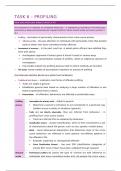
TASK 6 – PROFILING
HOW DOES PROFILING WORK & WHAT IS IT?
THE PERSONALITY PARADOX IN OFFENDER PROFILING – A THEORETICAL REVIEW OF THE PROCESSES
INVOLVED IN DERIVING BACKGROUND CHARACTERISTICS FROM CRIME SCENE ACTIONS (ALISON ET
AL.)
Profiling – derivation of personality characteristics from crime scene actions
Offender profile – focuses attention on individuals with personality traits that parallel
traits of others who have committed similar offences
Assessment of accuracy – in the past: post hoc asked police officers how satisfied they
were with advice
Investigators approved of advice given & found it useful in various ways
Limitations: no representative sample of profiles, relied on subjective opinions of
investigators
Few studies looked into profiling process itself on which methods are founded
This study: review validity of assumptions important to process of profiling
THE PROFILING PROCESS RELIES ON A NAÏVE TRAIT APPROACH
Traditional trait theory – underpins most forms of offender profiling
Traits are stable & general
Establishes general laws based on studying a large number of offenders & use
these to generalise them to others
Deterministic – all offenders’ behaviours are affected in predictable ways
Profiling Assumption for primary traits – stable & general
process Determine a person’s inclination to act consistently in a particular way
(stable) across a variety of situations (general)
Traits are not directly observable, they are inferred from behaviour – in
profiling from crime scene actions
Traits are inferred from & explained by behaviour
Classification system – choose classification, which is then connected to a set
of characteristics about the person, such as race, gender, marital status
Belief – same behavioural dispositions that determine style of the crime
scene behaviour are reflected in more general, non-offense patterns in
the offender’s life
Example: organised vs. disorganised offender
Crime Classification Manual – has over 200 classification categories of
murder BUT none of them have been validated through research
Research Professional profilers (1) assess the type of criminal act with reference to
on the individuals who have committed similar acts, (2) analyse the crime scene,
, profiling (3) scrutinise the background of the victim & possible suspects, (4)
process establish likely motivations of all parties involved, (5) description of
perpetrator is generated from characteristics connected with their
“psychological make-up”
“What” to “Why” to “Who” inference – on the basis of crime scene material
(What), a particular motivation for the offense is attributed to the
perpetrator (Why). This leads to the perpetrator’s likely characteristics
(Who)
Problematic – not clear how profilers move from one point to the next
Little evidence for traditional view of personality disposition
Potential problems
Difficult to correctly classify the offender based on extremely limited material
Can’t draw reliable conclusions based on “nothing more than what one knows
about a particular subtype”
MOST CURRENT PROFILING METHODS RELY ON A NAÏVE & OUTDATED UNDERSTANDING OF PERSONALITY & THE
TRAIT APPROACH
TOWARD A CONTEMPORARY MODEL OF OFFENDER PROFILING
Theoretical framework emphasising importance of Person x Situation interactions in
generating behaviour
Contemporary Traits – probable “if…then…” relations between clusters of behaviours &
trait situations
approaches Takes account of contextual details
Primary unit of observation – the conditional probability of a certain
behaviour / category of behaviours given a certain condition / set of
conditions has occurred
Recognise that behaviour & situation categories vary in degree to which
they are “well defined or fuzzy”
Links between behaviour & situation categories will vary probabilistic nature
Determine what affects behavioural consistency of offenders across
their crime series & how consistent they are between criminal & non-
criminal life
Challenges for Understand relationship between people’s behaviour, on the one hand,
contemporary & situations they typically encounter, on the other extremely difficult
model Investigative domain – little known about context in which crime takes
place
Non-criminal domain – have people generate “if…then…” contingencies
to describe why they think people behave the way they do
, o Cluster analysis can identify important situational features
o Classification systems may NOT account for every individual
Situational similarities defined purely by physical features of situations
does NOT appear to influence noncriminal behaviour consistently
Psychological meaning of specific situations to certain individual must be
established to generate any valid inferences
o Types of interpersonal interactions, competency demands
characteristics of a situation
Limitations Bandwidth-fidelity / abstraction issue – the differences in precision of
personality measurement at different levels of abstraction
Examine offense behaviour at general level might be able to
predict very general information about offender’s background BUT
not specific background characteristics
Bandwidth is gained at expense of fidelity
Psychological profiling – refers to profiling demographic characteristics
Would be better described as referring to particular psychological
constructs
o Example: 50 rapists assigned to 3 groups difference sin
personality disorders
THEORETICAL FRAMEWORK EMPHASISING THE IMPORTANCE OF PERSON X SITUATION INTERACTIONS IN
GENERATING BEHAVIOUR MAY LEAD TO A MORE PRODUCTIVE RESEARCH ENDEAVOUR
A NEW GEOGRAPHIC PROFILING SUSPECT MAPPING & RANKING TECHNIQUE FOR CRIME
INVESTIGATIONS: GP-SMART (CURTIS-HAM ET AL.)
Geographic profiling – examining information in geography of crimes & suspects to inform investigative
activities, including prioritising suspects
Analysing locations & series of crimes believed to have been committed by the same
unknown offender
Suspects can be ranked by proximity of known activity nodes to areas crimes were
committed in
Algorithms automatised this prediction process
Aim: filter through large number of suspect NOT identify the offender
Complementary approach – focuses on suspects, examining their known activity nodes
Can be applied to single crimes BUT big potential suspect pool without pre-filtering
This study: introduces Geographic Profiling Suspect Mapping And Ranking Technique
(GP-SMART)
SUSPECT-BASED GEOGRAPHIC PROFILING ALGORITHMS
HOW DOES PROFILING WORK & WHAT IS IT?
THE PERSONALITY PARADOX IN OFFENDER PROFILING – A THEORETICAL REVIEW OF THE PROCESSES
INVOLVED IN DERIVING BACKGROUND CHARACTERISTICS FROM CRIME SCENE ACTIONS (ALISON ET
AL.)
Profiling – derivation of personality characteristics from crime scene actions
Offender profile – focuses attention on individuals with personality traits that parallel
traits of others who have committed similar offences
Assessment of accuracy – in the past: post hoc asked police officers how satisfied they
were with advice
Investigators approved of advice given & found it useful in various ways
Limitations: no representative sample of profiles, relied on subjective opinions of
investigators
Few studies looked into profiling process itself on which methods are founded
This study: review validity of assumptions important to process of profiling
THE PROFILING PROCESS RELIES ON A NAÏVE TRAIT APPROACH
Traditional trait theory – underpins most forms of offender profiling
Traits are stable & general
Establishes general laws based on studying a large number of offenders & use
these to generalise them to others
Deterministic – all offenders’ behaviours are affected in predictable ways
Profiling Assumption for primary traits – stable & general
process Determine a person’s inclination to act consistently in a particular way
(stable) across a variety of situations (general)
Traits are not directly observable, they are inferred from behaviour – in
profiling from crime scene actions
Traits are inferred from & explained by behaviour
Classification system – choose classification, which is then connected to a set
of characteristics about the person, such as race, gender, marital status
Belief – same behavioural dispositions that determine style of the crime
scene behaviour are reflected in more general, non-offense patterns in
the offender’s life
Example: organised vs. disorganised offender
Crime Classification Manual – has over 200 classification categories of
murder BUT none of them have been validated through research
Research Professional profilers (1) assess the type of criminal act with reference to
on the individuals who have committed similar acts, (2) analyse the crime scene,
, profiling (3) scrutinise the background of the victim & possible suspects, (4)
process establish likely motivations of all parties involved, (5) description of
perpetrator is generated from characteristics connected with their
“psychological make-up”
“What” to “Why” to “Who” inference – on the basis of crime scene material
(What), a particular motivation for the offense is attributed to the
perpetrator (Why). This leads to the perpetrator’s likely characteristics
(Who)
Problematic – not clear how profilers move from one point to the next
Little evidence for traditional view of personality disposition
Potential problems
Difficult to correctly classify the offender based on extremely limited material
Can’t draw reliable conclusions based on “nothing more than what one knows
about a particular subtype”
MOST CURRENT PROFILING METHODS RELY ON A NAÏVE & OUTDATED UNDERSTANDING OF PERSONALITY & THE
TRAIT APPROACH
TOWARD A CONTEMPORARY MODEL OF OFFENDER PROFILING
Theoretical framework emphasising importance of Person x Situation interactions in
generating behaviour
Contemporary Traits – probable “if…then…” relations between clusters of behaviours &
trait situations
approaches Takes account of contextual details
Primary unit of observation – the conditional probability of a certain
behaviour / category of behaviours given a certain condition / set of
conditions has occurred
Recognise that behaviour & situation categories vary in degree to which
they are “well defined or fuzzy”
Links between behaviour & situation categories will vary probabilistic nature
Determine what affects behavioural consistency of offenders across
their crime series & how consistent they are between criminal & non-
criminal life
Challenges for Understand relationship between people’s behaviour, on the one hand,
contemporary & situations they typically encounter, on the other extremely difficult
model Investigative domain – little known about context in which crime takes
place
Non-criminal domain – have people generate “if…then…” contingencies
to describe why they think people behave the way they do
, o Cluster analysis can identify important situational features
o Classification systems may NOT account for every individual
Situational similarities defined purely by physical features of situations
does NOT appear to influence noncriminal behaviour consistently
Psychological meaning of specific situations to certain individual must be
established to generate any valid inferences
o Types of interpersonal interactions, competency demands
characteristics of a situation
Limitations Bandwidth-fidelity / abstraction issue – the differences in precision of
personality measurement at different levels of abstraction
Examine offense behaviour at general level might be able to
predict very general information about offender’s background BUT
not specific background characteristics
Bandwidth is gained at expense of fidelity
Psychological profiling – refers to profiling demographic characteristics
Would be better described as referring to particular psychological
constructs
o Example: 50 rapists assigned to 3 groups difference sin
personality disorders
THEORETICAL FRAMEWORK EMPHASISING THE IMPORTANCE OF PERSON X SITUATION INTERACTIONS IN
GENERATING BEHAVIOUR MAY LEAD TO A MORE PRODUCTIVE RESEARCH ENDEAVOUR
A NEW GEOGRAPHIC PROFILING SUSPECT MAPPING & RANKING TECHNIQUE FOR CRIME
INVESTIGATIONS: GP-SMART (CURTIS-HAM ET AL.)
Geographic profiling – examining information in geography of crimes & suspects to inform investigative
activities, including prioritising suspects
Analysing locations & series of crimes believed to have been committed by the same
unknown offender
Suspects can be ranked by proximity of known activity nodes to areas crimes were
committed in
Algorithms automatised this prediction process
Aim: filter through large number of suspect NOT identify the offender
Complementary approach – focuses on suspects, examining their known activity nodes
Can be applied to single crimes BUT big potential suspect pool without pre-filtering
This study: introduces Geographic Profiling Suspect Mapping And Ranking Technique
(GP-SMART)
SUSPECT-BASED GEOGRAPHIC PROFILING ALGORITHMS