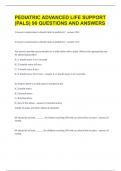
PEDIATRIC ADVANCED LIFE SUPPORT (PALS) |90 QUESTIONS AND ANSWERS.
1 rescuer compression to breath ratio in pediatrics? 30:2 2 rescuer compression to breath ratio in pediatrics? 15:2 You need to provide rescue breaths to a child victim with a pulse. What is the appropriate rate for delivering breaths? A.) 1 breath every 3 to 5 seconds B.) 2 breaths every 6-8 secs C.) 1 breath every 6 secs D.) 1 breath every 10-12 secs A.) 1 breath every 3 to 5 seconds An infant's (birth-1 yr old) pulse is checked at the A.) Carotid artery B.) Femoral artery C.) Brachial artery D.) Any of the above C.) Brachial artery (inside of upper arm btwn elbow & shoulder) BP should be at least _______ for infants receiving CPR with an arterial line in place 25 mmHg BP should be at least ______ for children receiving CPR with an arterial line in place 30 mmHg Admin the initial dose of epinephrine within _______ mins from the start of chest compressions 5 Compression depth for infants (birth-1 yr old) should be 1/3 of the chest, usually 1.5" (4 cm) Someone on your team asks you to do something outside your scope of practice. A proper communication response is to: A.) Offer to help out with a different task B.) Perform the task C.) Refuse to do the task D.) Seek expert consultation A.) Offer to help out with a different task Compression depth for children should be 1/3 of the chest, usually 2 inches (5 cm) If you are the only person at the scene and find an unresponsive infant or child, perform CPR for 2 minutes BEFORE calling EMS or getting an AED If you are the only person & witness a cardiac arrest (V-fib & pulseless V-tach) in an infant or child --> call EMS and get an AED BEFORE starting CPR A child's (1+ yrs old) pulse is checked at the carotid artery on the side of the neck or the femoral pulse on the inner thigh Norm BP for children 3-7 yrs old (preschool & school-age) 89-115 / 46-76 even lower BP for infants & toddlers Norm HR for newborns to 1 yr old 107-180 bpm Norm RR for newborns to 6 yrs 21-35 /min Children have ____________ metabolic rates compared to adults? higher The primary assessment includes all of the following assessments except; A.) Airway B.) Breathing C.) Choking D.) Exposure Choking Which of the following is a sign of upper airway obstruction? A.) Fever B.) Stridor C.) Nasal flaring D.) Itching Stridor The following is an indication of poor ventilation: A.) HTN B.) Hyperthyroidism C.) Hypercarbia D.) None of the above Hypercarbia All of the following cause sinus tachycardia except: A.) Metabolic stress B.) Mobitz type II block C.) Fever D.) Acute blood loss B.) Mobitz Type II block Common causes of acute community-acquired pneumonia include which of the following? A.) Streptococcus pneumonia B.) Mycoplasma pneumonia C.) Chlamydia pneumonia D.) All of the above D? All of the above Hypoxemia is defined as a room air SpO2 reading less than _______ in a child A.) 98% B.) 94% C.) 90% D.) 96% B.) 94% Common causes of upper airway obstruction include all of the following except: A.) aspirated foreign body B.) asthma C.) allergic reactions D.) peritonsillar abscess B.) Asthma The following may be used in the treatment of croup: A.) dexamethasone B.) nebulized epinephrine C.) oxygen D.) all of the above D.) all of the above Which statement concerning asystole is not correct? A.) Asystole is a state of no myocardial contractions and no cardiac output or blood flow B.) An asystolic person has no detectable electrical activity C.) A flat line on an ECG always indicates asystole D.) Asystole is one of the rhythms associated with cardiac arrest C.) A flat line on an ECG always indicates asystole Types of shock include all of the following except: A.) Anaphylactic shock B.) Hypovolemic shock C.) Cardiogenic shock D.) Hypothermic shock D.) Hypothermic shock When providing fluid resuscitation in children, how should intravenous fluid boluses be given? A.) 15 mL/kg bolus over 5-20 minutes B.) 20 mL/kg bolus over 5-20 minutes C.) 25 mL/kg bolus over 5-20 minutes D.) 30 mL/kg bolus over 5-20 minutes B.) 20 mL/kg bolus over 5-20 minutes Effectiveness of fluid resuscitation and medication therapy should be frequently monitored by which of the following? A.) Heart rate (HR) B.) Blood pressure (BP) C.) Mental status D.) All of the above D.) All of the above Common S/S of compensated shock include: A.) Excessive sweating B.) Increased heart rate C.) Wide pulse pressure D.) Hypertension B.) Increased heart rate When should vasopressors be administered during the management of septic shock? A.) When the person is responding to fluid resuscitation B.) When the person is severely hypotensive despite proper fluid management C.) Alway indicated as soon as IV access is obtained D.) Vasopressors are never used for septic shock B.) When the person is severely hypotensive despite proper fluid management For fluid resuscitation in hypovolemic shock, give about _______ of crystalloid for every ______ of blood lost A.) 1 mL, 2 mL B.) 3 mL, 2 mL C.) 3 mL, 1 mL D.) 2 mL, 3 mL C.) 3 mL, 1 mL Hypoglycemia is defined as _________ in infants, children, and adolescents. A.) >/= 40 mg/dL B.) >/= 50 mg/dL C.) </= 60 mg/dL D.) </= 70 mg/dL C.) </= 60 mg/dL The gold standard for anaphylactic shock is A.) Milrinone B.) Epinephrine C.) Dopamine D.) Dobutamine B.) Epinephrine The preferred order of drug delivery routes are: A.) IV route, IO route, ET route B.) ET route, IV route, IO route C.) IO route, ET route, IV route D.) IV route, ET route, IO route A.) IV route, IO route, ET route Which rhythm should be shocked? A.) Ventricular fibrillation B.) Pulseless ventricular tachycardia C.) Pulseless electrical activity (PEA) D.) Both A & B D.) Both A & B
Escuela, estudio y materia
- Institución
- Havard School
- Grado
- American Red Cross Advanced Life Support
Información del documento
- Subido en
- 16 de octubre de 2023
- Número de páginas
- 21
- Escrito en
- 2023/2024
- Tipo
- Examen
- Contiene
- Preguntas y respuestas
Temas
-
pediatric advanced life support pals

Documento también disponible en un lote