Neonatal and pediatric final exam review
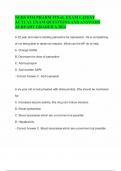
Neonatal and pediatric final exam reviewharryson Disclaimer: Medicine and respiratory therapy are continuously changing practices. The author and publisher have reviewed all information in this report with resources believed to be reliable and accurate and have made every effort to provide information that is up to date with the best practices at the time of publication. Despite our best efforts we cannot disregard the possibility of human error and continual changes in best practices the author, publisher, and any other party involved in the production of this work can warrant that the information contained herein is complete or fully accurate. The author, publisher, and all other parties involved in this work disclaim all responsibility from any errors contained within this work and from the results from the use of this information. Readers are encouraged to check all information in this book with institutional guidelines, other sources, and up to date information. Respiratory Therapy Zone is not affiliated with the NBRC, AARC, or any other group at the time of this publication. You can get access to our massive bank of TMC Practice Questions by Clicking Here. J Copyright © Respiratory Therapy Zone harryson Introduction Why hello there! Thank you so much for downloading this study guide! In this book, you will find a ton of helpful practice questions, all, of course, covering the topic of — Neonatal and Pediatric Respiratory Care. These questions are designed to help you prepare for the Neo/Peds final exam in Respiratory Therapy School. Hopefully, by going through these practice questions, you will be able to boost your knowledge to a whole new level and ace your final exam. This is definitely one of the most important subjects in Respiratory Therapy School. Not to mention, it’s also the topic that some students struggle with. With that being said, (hopefully) this study guide, along with the resources on our website and YouTube channel can help. So if you’re ready, let’s go ahead and get started. Good luck! J harryson 1. Which of the following statements describe truncus arteriosus? A. The pulmonary artery arises from the left ventricle, and the aorta stems from the right ventricle. B. A large VSD allows total mixing of blood from the two ventricles. C. If SVR decreases relative to PVR, blood flow will be shunted from right to left, bypassing the lungs. D. All of the above 2. What factor is responsible for closure of the foramen ovale? A. Increased PaO2 B. Increased pressure on the left side of the heart C. Blood flowing through the lungs D. High pulmonary vascular resistance 3. What is the incidence of respiratory distress syndrome (RDS) among infants born at less than 28 weeks of gestation? A. 30% to 40% B. 40% to 50% C. 60% to 80% D. >80% 4. What radiographic features is the therapist likely to see on a typical chest X-ray of an infant with MAS? A. Ground-glass appearance B. Complete whiteout C. Decreased lung volume D. Patchy areas of atelectasis 5. The therapist is treating a child with TOF who appears to be having a “tet” spell. What should the therapist suggest to treat this event? A. Beta blockers B. Knee-chest position to increase SVR C. Morphine sulfate D. All of the above harryson 6. The therapist is setting pulse oximetry to determine the presence of right-to-left shunt in an infant suspected of having a heart defect. Where should the therapist place the pulse ox probe to obtain the most accurate measure of preductal oxygen saturation? A. Any finger of the right hand B. Any finger of the left hand C. Left earlobe D. Lower extremities 7. Which of the following physiologic mechanisms need to be in place to ensure adequate systemic perfusion in infants with hypoplastic left heart syndrome (HLHS)? A. Presence of an ASD B. Presence of a mitral regurgitation C. Adequate left atrial function D. Presence of a PDA 8. Blood samples are simultaneously obtained from both the right radial artery and the umbilical artery, and the arterial partial pressure of oxygen (PaO2) value from the right radial artery is 20 mm Hg greater than that analyzed from the umbilical artery sample. On the basis of this finding, which of the following conditions does the neonate likely have? A. PPHN B. MAS C. Neonatal pneumonia D. RDS 9. What ventilator settings should a therapist select for a newborn with respiratory distress syndrome? A. PIP 25-30 cm H2O B. PEEP 3-6 cm H2O C. VT 5-6 mL/kg D. Frequency 60 breaths per minute
Escuela, estudio y materia
- Institución
- Neonatal and pediatrick
- Grado
- Neonatal and pediatrick
Información del documento
- Subido en
- 16 de octubre de 2023
- Número de páginas
- 31
- Escrito en
- 2023/2024
- Tipo
- Examen
- Contiene
- Preguntas y respuestas
Temas
-
neonatal and pediatric final exam review
-
harryson disclaimer medicine and respiratory ther