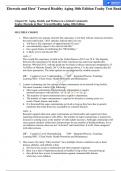
Liver NCLEX questions and answers well illustrated.
Liver NCLEX questions and answers well illustrated. 1. A health care provider who has not been immunized for hepatitis B is exposed to the hepatitis B virus (HBV) through a needle stick from an infected patient. The infection control nurse informs the individual that treatment for the exposure should include a. baseline hepatitis B antibody testing now and in 2 months. b. active immunization with hepatitis B vaccine. c. hepatitis B immune globulin (HBIG) injection. d. both the hepatitis B vaccine and HBIG injection. - correct answers.D Rationale: The recommended treatment for exposure to hepatitis B in unvaccinated individuals is to receive both HBIG and the hepatitis B vaccine, which would provide temporary passive immunity and promote active immunity. Antibody testing may also be done, but this would not provide protection from the exposure. Cognitive Level: Application Text Reference: p. 1096 Nursing Process: Implementation NCLEX: Physiological Integrity 2. A patient contracts hepatitis from contaminated food. During the acute (icteric) phase of the patient's illness, the nurse would expect serologic testing to reveal a. hepatitis B surface antigen (HBsAg). b. anti-hepatitis B core immunoglobulin M (anti-HBc IgM). c. anti-hepatitis A virus immunoglobulin G (anti-HAV IgG). d. anti-hepatitis A virus immunoglobulin M (anti-HAV IgM). - correct answers.D Rationale: Hepatitis A is transmitted through the oral-fecal route, and antibody to HAV IgM appears during the acute phase of hepatitis A. The patient would not have antigen or antibodies for hepatitis B. Anti-HAV IgG would indicate past infection and lifelong immunity. Cognitive Level: Application Text Reference: p. 1089 Nursing Process: Assessment NCLEX: Physiological Integrity 3. During evaluation of a patient at an outpatient clinic, the nurse determines that administration of hepatitis B vaccine has been effective when a specimen of the patient's blood reveals a. HBsAg. b. anti-HBs. c. anti-HBc IgM. d. anti-HBc IgG - correct answers.B Rationale: The presence of surface antibody to HBV (anti-HBs) is a marker of a positive response to the vaccine. The other laboratory values indicate current infection with HBV. Cognitive Level: Application Text Reference: pp. 1089, 1093 Nursing Process: Evaluation NCLEX: Health Promotion and Maintenance 4. A patient in the outpatient clinic has positive serologic testing for anti-HCV. Which action by the nurse is appropriate? a. Schedule the patient for HCV genotype testing. b. Teach the patient that the HCV will resolve in 2 to 4 months. c. Administer immune globulin and the HCV vaccine. d. Instruct the patient on self-administration of -interferon. - correct answers.A Rationale: Genotyping of HCV has an important role in managing treatment and is done before drug therapy with -interferon or other medications is started. HCV has a high percentage of conversion to the chronic state so the nurse should not teach the patient that the HCV will resolve in 2 to 4 months. Immune globulin or vaccine is not available for HCV. Cognitive Level: Application Text Reference: p. 1092 Nursing Process: Planning NCLEX: Physiological Integrity 5. A homeless patient with severe anorexia, fatigue, jaundice, and hepatomegaly is diagnosed with viral hepatitis and has just been admitted to the hospital. In planning care for the patient, the nurse assigns the highest priority to the patient outcome of a. maintaining adequate nutrition. b. establishing a stable home environment. c. increasing activity level. d. identifying the source of exposure to hepatitis. - correct answers.A Rationale: The highest priority outcome is to maintain nutrition because adequate nutrition is needed for hepatocyte regeneration. Finding a home for the patient and identifying the source of the infection would be appropriate activities, but they do not have as high a priority as having adequate nutrition. Although the patient's activity level will be gradually increased, rest is indicated during the acute phase of hepatitis. Cognitive Level: Application Text Reference: p. 1097 Nursing Process: Planning NCLEX: Physiological Integrity 6. A patient with acute hepatitis B asks the nurse if treatment is available for the condition. The nurse explains to the patient that a. because no medication is available to treat acute viral hepatitis, adequate nutrition and rest are the most important treatments. b. lamivudine (Epivir) can decrease viral load and liver damage in patients with acute hepatitis B, but it must be taken for at least 1 year. c. patients with acute hepatitis B can be given HBIG to help reduce the symptoms. d. various antiviral drugs are available to treat acute hepatitis B, but serious side effects limit their use. - correct answers.A Rationale: There are no drug therapies to treat acute hepatitis, although -interferon and nucleoside analogs (i.e., lamivudine) may be used to treat chronic hepatitis B. Immune globulin may be given within 24 hours after exposure to prevent hepatitis B, but it is not used to decrease symptoms for patients with acute hepatitis. Cognitive Level: Application Text Reference: p. 1093 Nursing Process: Implementation NCLEX: Physiological Integrity 7. Combination therapy of -interferon and ribavirin (Rebetol) is being used to treat hepatitis C in a patient with human immunodeficiency virus (HIV). The nurse will plan to monitor a. blood glucose. b. lymphocyte count. c. potassium level. d. serum creatinine. - correct answers.B Rationale: Therapy with ribavirin and -interferon may decrease lymphocyte counts. The other laboratory values should not be changed by the drug therapy. Cognitive Level: Application Text Reference: p. 1095 Nursing Process: Planning NCLEX: Physiological Integrity 8. When taking a health history for a new patient, which information given by the patient would indicate that screening for hepatitis C is appropriate? a. The patient had a blood transfusion after surgery in 1998. b. The patient reports a one-time use of IV drugs 20 years ago. c. The patient eats frequent meals in fast-food restaurants. d. The patient recently traveled to an undeveloped country. - correct answers.B Rationale: Any patient with a history of IV drug use should be tested for hepatitis C. Blood transfusions given after 1992, when an antibody test for hepatitis C became available, do not pose a risk for hepatitis C. Hepatitis C is not spread by the oral-fecal route and therefore is not caused by contaminated food or by traveling in underdeveloped countries. Cognitive Level: Application Text Reference: pp. 1090, 1098 Nursing Process: Assessment NCLEX: Health Promotion and Maintenance 9. A patient is admitted with an abrupt onset of jaundice, nausea and vomiting, hepatomegaly, and abnormal liver function studies. Serologic testing is negative for viral causes of hepatitis. Which question by the nurse is most appropriate? a. "Have you been around anyone with jaundice?" b. "Do you use any prescription or over-the-counter (OTC) drugs?" c. "Are you taking corticosteroids for any reason?" d. "Is there any history of IV drug use?" - correct answers.B Rationale: The patient's symptoms, lack of antibodies for hepatitis, and the abrupt onset of symptoms suggest toxic hepatitis, which can be caused by commonly used OTC drugs such as acetaminophen (Tylenol). Exposure to a jaundiced individual and a history of IV drug use are risk factors for viral hepatitis. Corticosteroid use does not cause the symptoms listed. Cognitive Level: Application Text Reference: pp. Nursing Process: Assessment NCLEX: Health Promotion and Maintenance 10. When teaching a patient recovering from hepatitis B about management of the illness, the nurse determines that additional teaching is needed when the patient says a. "I should not drink alcohol for at least the next year." b. "My family members should be tested for hepatitis B." c. "When the jaundice is gone, I have recovered from my illness and the infection is cured." d. "Until my tests for the virus are negative, I should use a condom for sexual intercourse." - correct answers.C Rationale: After the acute (icteric) phase, there is a convalescent phase lasting several months. The other patient statements are correct and indicate that teaching has been effective. Cognitive Level: Application Text Reference: pp. 1091, 1098 Nursing Process: Evaluation NCLEX: Health Promotion and Maintenance 11. A patient with cirrhosis has 4+ pitting edema of the feet and legs and massive ascites. The data indicate that it is most important for the nurse to monitor the patient's a. temperature. b. albumin level. c. hemoglobin. d. activity level. - correct answers.B Rationale: The low oncotic pressure caused by hypoalbuminemia is a major pathophysiologic factor in the development of ascites and edema. The other parameters should also be monitored, but they are not contributing factors to the patient's current symptoms. Cognitive Level: Application Text Reference: p. 1104 Nursing Process: Assessment NCLEX: Physiological Integrity 12. A 32-year-old patient has early alcoholic cirrhosis diagnosed by a liver biopsy. When planning patient teaching, the priority information for the nurse to include is the need for a. vitamin B supplements. b. abstinence from alcohol. c. maintenance of a nutritious diet. d. long-term, low-dose corticosteroids. - correct answers.B Rationale: The disease progression can be stopped or reversed by alcohol abstinence. The other interventions may be used when cirrhosis becomes more severe to decrease symptoms or complications, but the priority for this patient is to stop the progression of the disease. Cognitive Level: Application Text Reference: pp. Nursing Process: Planning NCLEX: Physiological Integrity 13. A patient with cirrhosis who is being treated with spironolactone (Aldactone) and furosemide (Lasix) has a serum sodium level of 135 mEq/L (135 mmol/L) and serum potassium 3.2 mEq/L (3.2 mmol/L). Before notifying the health care provider, the nurse should a. administer the furosemide and withhold the spironolactone. b. give both drugs as scheduled. c. administer the spironolactone. d. withhold both drugs until talking with the health care provider. - correct answers.C Rationale: Spironolactone is a potassium-sparing diuretic and will help to increase the patient's potassium level. The nurse does not need to talk with the doctor before giving the
Escuela, estudio y materia
- Institución
- Liver NCLEX
- Grado
- Liver NCLEX
Información del documento
- Subido en
- 12 de octubre de 2023
- Número de páginas
- 8
- Escrito en
- 2023/2024
- Tipo
- Examen
- Contiene
- Preguntas y respuestas
Temas
-
liver nclex questions

Documento también disponible en un lote