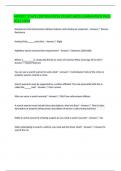
NYSTCE Visual Arts (079) VERIFIED SOLUTIONS 100%
NYSTCE Visual Arts (079) VERIFIED SOLUTIONS 100% drawing in the Middle Ages - ANSWER -Mostly used as preparation for paintings -done on animal skin, wood, wax, or slate -some artists used drawings as a record instead of working from a live model -some artists would complete finished drawings as illuminations for manuscripts drawing during Pre-history - ANSWER -Used on cave walls as early as 10,000 BCE -cave paintings used to express ideas and scenes -Used by Egyptians 3,000 BCE on drawing during the Renaissance - ANSWER -Drawing became more widely used, due to the increase in the availability of paper -Students were taught how to draw before painting or sculpting -used to study nature, record anatomy (Da Vinci) -Drawing materials used: pen and ink, black and red charcoal drawing in Baroque period - ANSWER More expressive and less exact than Renaissance drawings pencils - ANSWER -first manufactured in the 1800's, became a widely used drawing tool -range in hardness from 10H to 10B -greater detail than charcoal drawings in Northern Europe (1500s) - ANSWER -artists began creating drawings as works of art -Albrecht Durer and Hans Holbein the Younger used drawings drawings in the 1600's - ANSWER -Rembrandt created detailed drawings -Dutch artists used sketchbooks to draw scenes to paint later charcoal - ANSWER -Drawing material made from slowly burned wood -used for cave drawings -lightweight -stick or pencil form -often used for large gesture drawings or as underdrawing red chalk - ANSWER -Drawing material made from iron oxide pigment and refined clay -popular in the 16th and 17th century -used by Da Vinci, in the Renaissance black chalk - ANSWER -drawing material made of carbaceous shale -softer than red chalk used in 15th cent Italy for underdrawings for ink and metalpoint -used by Durer and van Dyck white chalk - ANSWER -made of calcium carbonate or soapstone -used to make highlights conte crayons - ANSWER -developed in the 1800's -made in red, black, and white -harder than chalk, smoother lines graphite - ANSWER -form of carbon -first discovered in the 1500's -later encased in wood to make pencils ink - ANSWER -liquid pigment -used with pen or brush pen - ANSWER -first made from bird feathers and reeds (quills) -later created with metal tips tortillon - ANSWER -a tightly rolled paper stump that is used for blending drawings, either charcoal or pencil maulstick (or mahlstick) - ANSWER a stick with a padded head used to rest hand while drawing or painting to keep steady kinds of erasers - ANSWER -kneaded eraser can be rolled into small size, will not leave crumbs -gum eraser is yellowish, crumbles, best for large areas -pink eraser is firmer and more precise, still leaves crumbs Dry cleaning bag - ANSWER fabric bag of eraser bits used to clean up fingerprints, smudges, and dust from larger areas on the paper parchment - ANSWER -writing/drawing surface made from animal skin -used in the Middle Ages paper - ANSWER -first created in China 105 AD -wasn't widely used until the 1800's -comes in hot pressed or cold pressed -used for watercolor or acrylic but not oil hot pressed paper - ANSWER smoothest type of paper cold pressed paper - ANSWER more textured paper sketch paper - ANSWER thinner than drawing paper newsprint - ANSWER another paper also used for sketching illustration board - ANSWER -thicker cardboard, with hot or cold pressed paper attached -allows for great detail archival material - ANSWER -will be labeled as acid free, should not deteriorate over time -should be used for finished drawings contour drawing - ANSWER -a line drawing that defines the outer and inner shapes of forms -does not include any shading blind contour - ANSWER drawing without looking at the paper gesture drawing - ANSWER -The drawing of lines quickly and loosely to show movement in a subject. -done in 30-60 seconds perspective drawing - ANSWER -a drawing technique that show spatial relationships and gives an illusion of space -two point perspective hatching - ANSWER the use of non-overlapping parallel lines to convey darkness or lightness cross-hatching - ANSWER lines are used perpendicularly to convey darkness, creates heavier shades than hatching oil painting - ANSWER -a fine art medium first used in the 15th century in N. Europe -Van Eyck used oil on wood panels first -later people started to use canvas at the end of the 15th cent. -allows for longer working time (longer drying) than acrylic -stays workable on the palette for 4-6 hours -can take a full 6 months for an oil painting to dry fully -more blending possible on the canvas than acrylic -"fat over lean" - increased oil content in paint on the outer layers acrylic paint - ANSWER -water soluble -dries more quickly than oil -less blending possible -turns into a kind of plastic when it dries -dried acrylic cannot be removed from a paint brush easily -can be used as a base for oil paintings (but not the other way around) -has only been used since the 1940's -more media can be layered on top of it than oils, makes it good for collage -15-20 mins drying time for each layer -first developed for housepainting but got recognition as an art material after Warhol used it watercolor - ANSWER -first used widely during the Renaissance -it is pigment added to gum arabic binder -transparent and layered techniques are used watercolor brushes - ANSWER shorter handle with either natural or synthetic hairs egg tempera - ANSWER -A painting medium in which ground pigments are bound with egg yolk -tempera was replaced by oil paint in the 15th century -substances such as white wine, vinegar, and water can be added to keep the dry paint from cracking -dries quickly -continual adding of water -short brushstrokes used -cross hatching can be utilized -20th century artists began using it again gouache - ANSWER -An opaque, water-soluble paint. -gum arabic is the binder, white pigment added making it more opaque than watercolo
Escuela, estudio y materia
- Institución
- NYSTCE
- Grado
- NYSTCE
Información del documento
- Subido en
- 9 de octubre de 2023
- Número de páginas
- 64
- Escrito en
- 2023/2024
- Tipo
- Examen
- Contiene
- Preguntas y respuestas
Temas
-
nystce visual arts 079 verified solution
-
nystce visual arts 079 verified solutions 100

Documento también disponible en un lote