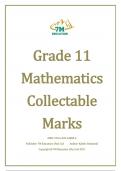
Grade 11
Mathematics
Collectable
Marks
ISBN: 978-0-620-94858-6
Publisher: 7M Education (Pty) Ltd Author: Kabelo Sedumedi
Copyright © 7M Education (Pty) Ltd 2021
,Table of Contents
Examination Overview .............................................................................................................................................. 2
Chapter 1: Algebra ...................................................................................................................................................... 3
Chapter 2: Number Patterns ................................................................................................................................ 14
Chapter 3: Finance ................................................................................................................................................... 23
Chapter 4: Functions ............................................................................................................................................... 35
Chapter 5: Probability ............................................................................................................................................ 67
Chapter 6: Statistics ................................................................................................................................................ 80
Chapter 7: Analytical Geometry ......................................................................................................................... 90
Chapter 8: Trigonometry ...................................................................................................................................... 95
Chapter 9: Euclidean Geometry .......................................................................................................................118
1
Copyright reserved
,Examination overview
1. Breakdown of marks per section in examinations
Paper 1 Marks % Paper 2 Marks %
A) Algebra 45±3 ±30% A) Statistics 20±3 ±13%
B) Number Patterns 25±3 ±17% B) Analytical Geometry 30±3 ±20%
C) Finance 15±3 ±10% C) Trigonometry 50±3 ±33%
D) Functions 45±3 ±30% D) Euclidean Geometry 50±3 ±33%
E) Probability 20±3 ±13%
Total 150 100% Total 150 100%
* Theorems and/or trigonometric proofs: maximum 12 marks
2. Breakdown of types of questions in examinations
Cognitive levels % Description of skills to be demonstrated
Knowledge 20% Straight recall e.g. domain and range
Routine 35% Routine exercises e.g. proofs of theorem proofs, solve for
Procedures 𝑥, general solutions
Complex 30% Routine exercises that require higher reasoning. There is
Procedures often not an obvious route to the solution e.g. complex
differentiation
Problem Solving 15% Non-routine exercises that require the ability to break
down the question into smaller parts (or sections), may
or may not be difficult
3. How to prepare for each type of question
Cognitive levels How to prepare
Knowledge It is important for learners to be aware that 55% of the
examination papers is based on knowledge and routine
Routine questions. These are basic questions. Learners assume that the
Procedures paper is based on mostly complex questions and hence place
much effort on complex questions without mastering the basics.
Complex Learners should practise complex procedure and problem
Procedures solving questions only after they have mastered the knowledge
Problem Solving and routine procedure questions. It is important for learners to
understand the Mathematical language as well as to know how
to apply the Mathematics tips in order to be able to attempt
complex procedure and problem solving questions. Learners
should break down these questions into smaller sections so as
to make them simpler to understand and to solve.
2
Copyright reserved
, Chapter 1: Algebra
1 Solve for 𝑥 by factorising p4 Use:
a) trinomials
b) common factors
c) difference of 2 squares
2 Solve for 𝑥 by using the quadratic Use:
formula p4
−𝑏 ± √𝑏2 − 4𝑎𝑐
𝑥=
2𝑎
3 Inequalities p4 Use:
a) number line
b) graph
4 Solve for 𝑥 in surds p7 Steps:
a) square both sides of the equation and solve
b) substitute 𝑥 values to check if 𝑥 values are
valid
5 Simultaneous equations p8 Steps:
a) make 𝑥 or 𝑦 the subject in the simpler
equation
b) substitute 𝑥 or 𝑦 in the other equation and
solve
6 Exponents (simplifying) p10 Two types:
a) when no addition or subtraction between
bases
b) addition or subtraction between bases
7 Exponents (solve for 𝑥) p11 Two types:
a) when 𝑥 is an exponent
b) when 𝑥 is a base
3
Copyright reserved
Mathematics
Collectable
Marks
ISBN: 978-0-620-94858-6
Publisher: 7M Education (Pty) Ltd Author: Kabelo Sedumedi
Copyright © 7M Education (Pty) Ltd 2021
,Table of Contents
Examination Overview .............................................................................................................................................. 2
Chapter 1: Algebra ...................................................................................................................................................... 3
Chapter 2: Number Patterns ................................................................................................................................ 14
Chapter 3: Finance ................................................................................................................................................... 23
Chapter 4: Functions ............................................................................................................................................... 35
Chapter 5: Probability ............................................................................................................................................ 67
Chapter 6: Statistics ................................................................................................................................................ 80
Chapter 7: Analytical Geometry ......................................................................................................................... 90
Chapter 8: Trigonometry ...................................................................................................................................... 95
Chapter 9: Euclidean Geometry .......................................................................................................................118
1
Copyright reserved
,Examination overview
1. Breakdown of marks per section in examinations
Paper 1 Marks % Paper 2 Marks %
A) Algebra 45±3 ±30% A) Statistics 20±3 ±13%
B) Number Patterns 25±3 ±17% B) Analytical Geometry 30±3 ±20%
C) Finance 15±3 ±10% C) Trigonometry 50±3 ±33%
D) Functions 45±3 ±30% D) Euclidean Geometry 50±3 ±33%
E) Probability 20±3 ±13%
Total 150 100% Total 150 100%
* Theorems and/or trigonometric proofs: maximum 12 marks
2. Breakdown of types of questions in examinations
Cognitive levels % Description of skills to be demonstrated
Knowledge 20% Straight recall e.g. domain and range
Routine 35% Routine exercises e.g. proofs of theorem proofs, solve for
Procedures 𝑥, general solutions
Complex 30% Routine exercises that require higher reasoning. There is
Procedures often not an obvious route to the solution e.g. complex
differentiation
Problem Solving 15% Non-routine exercises that require the ability to break
down the question into smaller parts (or sections), may
or may not be difficult
3. How to prepare for each type of question
Cognitive levels How to prepare
Knowledge It is important for learners to be aware that 55% of the
examination papers is based on knowledge and routine
Routine questions. These are basic questions. Learners assume that the
Procedures paper is based on mostly complex questions and hence place
much effort on complex questions without mastering the basics.
Complex Learners should practise complex procedure and problem
Procedures solving questions only after they have mastered the knowledge
Problem Solving and routine procedure questions. It is important for learners to
understand the Mathematical language as well as to know how
to apply the Mathematics tips in order to be able to attempt
complex procedure and problem solving questions. Learners
should break down these questions into smaller sections so as
to make them simpler to understand and to solve.
2
Copyright reserved
, Chapter 1: Algebra
1 Solve for 𝑥 by factorising p4 Use:
a) trinomials
b) common factors
c) difference of 2 squares
2 Solve for 𝑥 by using the quadratic Use:
formula p4
−𝑏 ± √𝑏2 − 4𝑎𝑐
𝑥=
2𝑎
3 Inequalities p4 Use:
a) number line
b) graph
4 Solve for 𝑥 in surds p7 Steps:
a) square both sides of the equation and solve
b) substitute 𝑥 values to check if 𝑥 values are
valid
5 Simultaneous equations p8 Steps:
a) make 𝑥 or 𝑦 the subject in the simpler
equation
b) substitute 𝑥 or 𝑦 in the other equation and
solve
6 Exponents (simplifying) p10 Two types:
a) when no addition or subtraction between
bases
b) addition or subtraction between bases
7 Exponents (solve for 𝑥) p11 Two types:
a) when 𝑥 is an exponent
b) when 𝑥 is a base
3
Copyright reserved