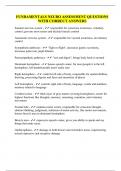
FUNDAMENTALS NEURO ASSESSMENT QUESTIONS WITH CORRECT ANSWERS
Somatic nervous system - responsible for conscious awareness, voluntary control; governs most senses and skeletal muscle control Autonomic nervous system - responsible for visceral awareness, involuntary control Sympathetic pathways - "fight or flight", decreases gastric secretions, increases pulse rate, pupil dilation Parasympathetic pathways - "rest and digest", brings body back to normal Dominant hemisphere - houses speech center, for most people it is the left hemisphere, left handed people aren't really sure Right hemisphere - controls left side of body, responsible for spatial abilities, drawing, processing figures and faces and memories of places Left hemisphere - controls right side of body, language, words and numbers, memory related to language Cerebral cortex - thick layer of gray matter covering hemispheres, center for highest functions like thoughts, memory, reasoning, sensation, and voluntary movement Frontal lobe - contains motor cortex, responsible for conscious thought, abstract thinking, judgement, initiation of motor activity, fine motor movements, houses broca's area in dominant hemisphere Broca's area - expressive speech center, gives you ability to speak and say things that make sense Global aphasia - damage to both broca's and wernicke's areas, experiencing mixed expressive and receptive damage Parietal lobe - processes sensory data, interpretation of tactile, visual, gustatory, olfactory, and auditory sensations, recognition of body parts (proprioception), area most commonly affected by strokes Affect of strokes on parietal lobe - patients unable to distinguish between left and right sides of body, unable to recognize object in hand due to sensation loss, have difficulty telling time Temporal lobe - perception/interpretation of sounds, integration fo taste, smell and balance, houses wernicke's area, contains hippocampus, converts short term memory to long term memory Wernicke's area - receptive speech center, understands auditory speech Occipital lobe - primary vision center, interpretation of visual data, transmits via optic nerve Limbic system - mediates primative behavior, visceral responses to emotional and biological rhythms Olfactory nerve - cranial nerve 1, sensory, carries smell impulses from nasal mucous membrane to brain Optic nerve - cranial nerve 2, sensory, carries visual impulses from eye to brain Oculomotor nerve - cranial nerve 3, motor, contracts eye muscles control eye movements, constricts pupils, elevates eyelids Trochlear nerve - cranial nerve 4, motor, moves eye downward and inward Trigeminal nerve - cranial nerve 5, mixed, carries sensory impulses of pain, touch, and temperature from the face to the brain, infuences clenching and jaw movements Abducens nerve - cranial nerve 6, motor, controls lateral eye movements Facial nerve - cranial nerve 7, mixed, sensory for taste on anterior two thirds of tongue, stimulates secretions from salivary glands and tears from lacrimal glands, creates facial expressions Acoustic/vestibulocochlear nerve - cranial nerve 8, sensory, sensory fibers for hearing and balance Glossopharyngeal nerve - cranial nerve 9, mixed, contains sensory fibers for taste on posterior third of tongue, stimulate gag reflex of pharynx, provides secretory fibers to parotid glands, promotes swallowing Vagus nerve - cranial nerve 10, mixed, sensations from throat, larynx, heart, lungs, bronchi, gi, abdominal viscera, promotes swallowing, talking, and production of digestive juices Spinal accessory nerve - cranial nerve 11, motor, moves shoulders and head, some movement of larynx Hypoglossal nerve - cranial nerve 12, motor, innervates tongue muscles that provide movement Diencephalon - location of cranial nerve 2 Midbrain - location of cranial nerves 3 and 4, connects pons to cerebral cortex, contains substani nigri, processes visual stimuli, cerebral aqueduct Pons - location of cranial nerves 5,6,7 and 8; controls rate and length of respiration Medulla oblongata - location of cranial nerves 9,10,11,12, medulla foramen magnum, contains centers for regulating basic inspiration rhythm, rate and strength of heartbeat, diamter of blood vessels, regulates reflexes of vomiting, sneezing, swallowing and coughing Cauda equina - "horse tail" at the end of the spinal cord, dangling spinal nerves, can cause permanent damage if left compressed ("cauda equina syndrome") Grey matter - neuron cell bodies, inner region of the spinal cord
Escuela, estudio y materia
- Institución
- NEURO
- Grado
- NEURO
Información del documento
- Subido en
- 5 de octubre de 2023
- Número de páginas
- 8
- Escrito en
- 2023/2024
- Tipo
- Examen
- Contiene
- Preguntas y respuestas
Temas
-
fundamentals neuro assessment questions
-
fundamentals neuro assessment

Documento también disponible en un lote