CONTENTS
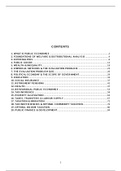
1. WHAT IS PUBLIC ECONOMICS ................................................................................................2
2. FOUNDATIONS OF WELFARE & DISTRIBUTIONAL ANALYSIS ......................................4
3. EXTERNALITIES............................................................................................................................8
4. PUBLIC GOODS ..........................................................................................................................14
5. WEALTH & INEQUALITY ...........................................................................................................18
6. EMPIRICAL METHODS & THE EVALUATION PROBLEM .................................................23
7. THE EVALUATION PROBLEM (2/2)........................................................................................26
8. POLITICAL ECONOMY & THE SCOPE OF GOVERNMENT..............................................29
9. EDUCATION .................................................................................................................................33
10. SOCIAL INSURANCE ...............................................................................................................37
11. RETIREMENT PENSIONS .......................................................................................................42
12. HEALTH .......................................................................................................................................47
13. BEHVARIOUAL PUBLIC ECONOMICS ................................................................................53
14. TAX INCIDENCE ........................................................................................................................58
15. POVERTY ALLEVIATION ........................................................................................................63
16. TAXES, TRANSFERS & LABOUR SUPPLY........................................................................67
17. TAXATION & MIGRATION ......................................................................................................72
18. TAX INEFFICIENCIES & OPTIMAL COMMODITY TAXATION........................................76
19. OPTIMAL INCOME TAXATION ..............................................................................................80
20. PUBLIC FINANCE & DEVELOPMENT..................................................................................84
1
, 1. WHAT IS PUBLIC ECONOMICS
First Fundamental Theorem of Private market outcomes are Pareto-efficient under a
Welfare Economics: broad set of conditions
Any Pareto-efficient allocation can be achieved through
Second Fundamental Theorem of
a decentralized equilibrium given some redistribution
Welfare Economics:
under a broad set of conditions
Pareto efficiency: No one can be made better off without making
someone else worse off
4 main reasons for gov intervention:
i. Create a framework of law in which markets operate (creation/prohibition of markets)
ii. Market failures (e.g. externalities/ public goods)
iii. Paternalistic concerns when individuals act against their own self interest
iv. Redistribution
Gov intervenes if the economy is not on the efficiency frontier but is within it
i. Markets only exist in the context of rules:
• Markets need secure property rights
o Police/justice system needed to ensure that private contracts are enforceable
o Research shows the importance of legal & cultural institutions in shaping economic
interactions
• Gov restricts the existence of some markets (e.g. market for organs/ drugs)
ii. Welfare theorems only hold under several conditions: 3 main sources of market failures:
• No externalities 1. Externalities & public
• Complete markets goods
• Perfect info 2. Asymmetric info
• Perfect competition 3. Imperfect competition
If these conditions don’t hold, you have market failure
iii. People do not behave in the way that theorems predict them to
• Impatience/ time-inconsistency/ self-control issues
• Overconfidence (e.g. about future returns)
• Default options & inattention
iv. Redistribution is concerned with movement along the frontier
• It is to do with equity concerns BUT redistributing endowments is impractical
• Redistribution distorts incentives for work equity-efficiency trade-off
How gov should intervene
i. Set an objective
ii. Then select policies to maximize this objective
i. Set objectives by attempting to deal with and/or aggregate individual preferences
This requires perfect knowledge of individual preferences BUT
• Individuals don’t always have incentives to reveal their preferences truthfully
• There’s tension between preference aggregation & democratic decision making
Fundamental conflict between social & individual choice
The effects of gov intervention
• Direct (mechanical) effects
2
, • Indirect (behavioural) effects
Analysing the effects of economics policies:
• Theoretical toolkit
• Empirical methods
Why the gov behaves in the ways we observe
i. Optimal policies aren’t always implementable
ii. Gov failures
i.
• Optimal policies may lack majority support
• First-best policies aren’t always credible
• First-best policies are costly/difficult to implement
ii. Policy makers may have objectives that differ from social welfare
• Favours from & for lobbyists
• Favours for friends & donors
• Desire for re-election
3
, 2. FOUNDATIONS OF WELFARE & DISTRIBUTIONAL ANALYSIS
Public policies influence people’s budget constraints
• Changing income by transferring resources
• Changing prices through taxes & subsidies
• Directly providing goods (e.g. education)
• Mandating the purchase of some goods (e.g. health insurance)
Utility functions 𝑼 = 𝒇(𝑿𝟏 , … , 𝑿𝑵 )
Assumptions about benefit of additional consumption (holding consumption of other goods
constant):
𝛿𝑈
1. Non-satiation 𝛿𝑋
>0
1
𝛿2𝑈
2. Diminishing marginal utility 𝛿𝑋12
<0
Marginal utility: the incremental utility gained by an additional unit of consumption
(holding all else constant)
𝛿𝑈
• 𝑀𝑈𝑋1 = 𝛿𝑋
1
Marginal rate of the rate at which consumers are willing to trade 1 good for another
substitution (MRS): • MRS describes the slope of the IC
𝑀𝑈
• 𝑀𝑅𝑆 = − 𝐵
𝑀𝑈𝐴
Indifference curve: a curve containing the set of consumption bundles from which the
consumer obtains the same level of utility
Budget constraints
Budget constraint: mathematical representation of all affordable combination of goods
• 𝑌 = 𝑃𝐴 𝑄𝐴 + 𝑃𝐵 𝑄𝐵
𝑃
• Slope of BC is the ratio of prices – 𝑃𝐵
𝐴
Consumer problem
𝐦𝐚𝐱 𝑼(𝑸𝑩 , 𝑸𝑨 ) 𝐬. 𝐭 . 𝒀 = 𝑷𝑨 𝑸𝑨 + 𝑷𝑩 𝑸𝑩
Using Lagrangian:
max 𝐿(𝑄𝐵 , 𝑄𝐴 ) where 𝐿(𝑄𝐵 , 𝑄𝐴 ) = 𝑈(𝑄𝐵 , 𝑄𝐴 ) − 𝜆(𝑃𝐴 𝑄𝐴 + 𝑃𝐵 𝑄𝐵 − 𝑌)
𝑄𝐴 ,𝑄𝐵
FOCs:
𝛿𝑈
• 𝛿𝑄𝐴
− 𝜆𝑃𝐴 = 0 & similarly for 𝑄𝐵
• 𝑃𝐴 𝑄𝐴 + 𝑃𝐵 𝑄𝐵 − 𝑌 = 0
Combining FOCS:
𝑴𝑼 𝑷
• 𝑴𝑹𝑺 = − 𝑴𝑼𝑩 = − 𝑷𝑩 i.e. utility is maximised at the point where the IC & BC
𝑨 𝑨 have same slope
𝑀𝑈𝐵 𝑀𝑈𝐴 “bang for the buck”
• 𝑃𝐵
= 𝑃𝐴
MU from the last dollar spent on good B = MU from last
dollar spent on good A
Analysing policies that affect people’s BC (e.g. a tax that doubles the price of good B)
4
1. WHAT IS PUBLIC ECONOMICS ................................................................................................2
2. FOUNDATIONS OF WELFARE & DISTRIBUTIONAL ANALYSIS ......................................4
3. EXTERNALITIES............................................................................................................................8
4. PUBLIC GOODS ..........................................................................................................................14
5. WEALTH & INEQUALITY ...........................................................................................................18
6. EMPIRICAL METHODS & THE EVALUATION PROBLEM .................................................23
7. THE EVALUATION PROBLEM (2/2)........................................................................................26
8. POLITICAL ECONOMY & THE SCOPE OF GOVERNMENT..............................................29
9. EDUCATION .................................................................................................................................33
10. SOCIAL INSURANCE ...............................................................................................................37
11. RETIREMENT PENSIONS .......................................................................................................42
12. HEALTH .......................................................................................................................................47
13. BEHVARIOUAL PUBLIC ECONOMICS ................................................................................53
14. TAX INCIDENCE ........................................................................................................................58
15. POVERTY ALLEVIATION ........................................................................................................63
16. TAXES, TRANSFERS & LABOUR SUPPLY........................................................................67
17. TAXATION & MIGRATION ......................................................................................................72
18. TAX INEFFICIENCIES & OPTIMAL COMMODITY TAXATION........................................76
19. OPTIMAL INCOME TAXATION ..............................................................................................80
20. PUBLIC FINANCE & DEVELOPMENT..................................................................................84
1
, 1. WHAT IS PUBLIC ECONOMICS
First Fundamental Theorem of Private market outcomes are Pareto-efficient under a
Welfare Economics: broad set of conditions
Any Pareto-efficient allocation can be achieved through
Second Fundamental Theorem of
a decentralized equilibrium given some redistribution
Welfare Economics:
under a broad set of conditions
Pareto efficiency: No one can be made better off without making
someone else worse off
4 main reasons for gov intervention:
i. Create a framework of law in which markets operate (creation/prohibition of markets)
ii. Market failures (e.g. externalities/ public goods)
iii. Paternalistic concerns when individuals act against their own self interest
iv. Redistribution
Gov intervenes if the economy is not on the efficiency frontier but is within it
i. Markets only exist in the context of rules:
• Markets need secure property rights
o Police/justice system needed to ensure that private contracts are enforceable
o Research shows the importance of legal & cultural institutions in shaping economic
interactions
• Gov restricts the existence of some markets (e.g. market for organs/ drugs)
ii. Welfare theorems only hold under several conditions: 3 main sources of market failures:
• No externalities 1. Externalities & public
• Complete markets goods
• Perfect info 2. Asymmetric info
• Perfect competition 3. Imperfect competition
If these conditions don’t hold, you have market failure
iii. People do not behave in the way that theorems predict them to
• Impatience/ time-inconsistency/ self-control issues
• Overconfidence (e.g. about future returns)
• Default options & inattention
iv. Redistribution is concerned with movement along the frontier
• It is to do with equity concerns BUT redistributing endowments is impractical
• Redistribution distorts incentives for work equity-efficiency trade-off
How gov should intervene
i. Set an objective
ii. Then select policies to maximize this objective
i. Set objectives by attempting to deal with and/or aggregate individual preferences
This requires perfect knowledge of individual preferences BUT
• Individuals don’t always have incentives to reveal their preferences truthfully
• There’s tension between preference aggregation & democratic decision making
Fundamental conflict between social & individual choice
The effects of gov intervention
• Direct (mechanical) effects
2
, • Indirect (behavioural) effects
Analysing the effects of economics policies:
• Theoretical toolkit
• Empirical methods
Why the gov behaves in the ways we observe
i. Optimal policies aren’t always implementable
ii. Gov failures
i.
• Optimal policies may lack majority support
• First-best policies aren’t always credible
• First-best policies are costly/difficult to implement
ii. Policy makers may have objectives that differ from social welfare
• Favours from & for lobbyists
• Favours for friends & donors
• Desire for re-election
3
, 2. FOUNDATIONS OF WELFARE & DISTRIBUTIONAL ANALYSIS
Public policies influence people’s budget constraints
• Changing income by transferring resources
• Changing prices through taxes & subsidies
• Directly providing goods (e.g. education)
• Mandating the purchase of some goods (e.g. health insurance)
Utility functions 𝑼 = 𝒇(𝑿𝟏 , … , 𝑿𝑵 )
Assumptions about benefit of additional consumption (holding consumption of other goods
constant):
𝛿𝑈
1. Non-satiation 𝛿𝑋
>0
1
𝛿2𝑈
2. Diminishing marginal utility 𝛿𝑋12
<0
Marginal utility: the incremental utility gained by an additional unit of consumption
(holding all else constant)
𝛿𝑈
• 𝑀𝑈𝑋1 = 𝛿𝑋
1
Marginal rate of the rate at which consumers are willing to trade 1 good for another
substitution (MRS): • MRS describes the slope of the IC
𝑀𝑈
• 𝑀𝑅𝑆 = − 𝐵
𝑀𝑈𝐴
Indifference curve: a curve containing the set of consumption bundles from which the
consumer obtains the same level of utility
Budget constraints
Budget constraint: mathematical representation of all affordable combination of goods
• 𝑌 = 𝑃𝐴 𝑄𝐴 + 𝑃𝐵 𝑄𝐵
𝑃
• Slope of BC is the ratio of prices – 𝑃𝐵
𝐴
Consumer problem
𝐦𝐚𝐱 𝑼(𝑸𝑩 , 𝑸𝑨 ) 𝐬. 𝐭 . 𝒀 = 𝑷𝑨 𝑸𝑨 + 𝑷𝑩 𝑸𝑩
Using Lagrangian:
max 𝐿(𝑄𝐵 , 𝑄𝐴 ) where 𝐿(𝑄𝐵 , 𝑄𝐴 ) = 𝑈(𝑄𝐵 , 𝑄𝐴 ) − 𝜆(𝑃𝐴 𝑄𝐴 + 𝑃𝐵 𝑄𝐵 − 𝑌)
𝑄𝐴 ,𝑄𝐵
FOCs:
𝛿𝑈
• 𝛿𝑄𝐴
− 𝜆𝑃𝐴 = 0 & similarly for 𝑄𝐵
• 𝑃𝐴 𝑄𝐴 + 𝑃𝐵 𝑄𝐵 − 𝑌 = 0
Combining FOCS:
𝑴𝑼 𝑷
• 𝑴𝑹𝑺 = − 𝑴𝑼𝑩 = − 𝑷𝑩 i.e. utility is maximised at the point where the IC & BC
𝑨 𝑨 have same slope
𝑀𝑈𝐵 𝑀𝑈𝐴 “bang for the buck”
• 𝑃𝐵
= 𝑃𝐴
MU from the last dollar spent on good B = MU from last
dollar spent on good A
Analysing policies that affect people’s BC (e.g. a tax that doubles the price of good B)
4