WOUND CARE FINAL EXAM QUESTIONS WITH CORRECT ANSWERS GRADED TO PASS
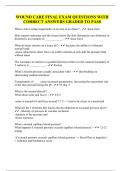
What is force acting tangentially on an area of an object? - shear force Skin remains stationary and the tissues below the skin (fat/muscle) are deformed or distorted is an example of: ____________ - shear force What do shear stresses on a tissue do? - decrease the ability to withstand normal loads -tissue subjected to shear force can suffer ischemia at only half the pressure than without shear The resistance to motion in a parallel direction relative to the common boundary of 2 surfaces is: ___________ - friction What is friction pressure usually associated with? - skin/bedding on skin/seating cushion interfaces Temperatures of ____ cause increased perspiration, increasing the maceration risk of the skin and increasing the ph - 95 deg. F What is the normal skin ph? What about urine and feces? - 4-6.5 -urine is around 6.8 and feces around 7-7.5 --> tend to be closer to a neutral ph What are the 3 elements that lead to the development of an actual pressure ulcer? - -intensity of pressure & vascular occlusion -duration of the pressure and -tissue tolerance What is normal capillary blood pressure? What happens if external pressure exceeds capillary blood pressure? - 12-32 mmhg -if external pressure exceeds capillary blood pressure --> blood flow is impeded --> ischemia and breakdown occur Tissue damage was thought to be caused by compression of capillaries, known as ________ _________ _________ - capillary closing pressure What happens if pressure to the skin is relieved within a few hours? - a brief period of reactive hyperemia occurs (redness) with no lasting tissue damage -will have blanching What happens if pressure to the skin is unrelieved? - the endothelial cells lining the capillaries become disrupted with platelet aggregation --> forming micro-thrombi that block blood flow and cause anoxic necrosis of surrounding tissue What is more sensitive to pressure: muscle or skin? - muscle is more sensitive to pressure What is considered hypoalbuminia and why is this important? - <3.4 g/dl --> important because malnutrition can lead to increased risk at developing a pressure ulcer What are the common locations of pressure ulcers in supine position? - occiput, scapula, sacrum, heels What are the common locations of pressure ulcers in sidelying (lateral)? - ear, acromion process, elbow, trochanter, medial and lateral epicondyles and malleoli, heels What are the common locations of pressure ulcers in prone? - elbow, ear, cheek, nose, breasts/genitals, iliac crest, patella, toes What is the scale used to assess who is at risk of developing a pressure ulcer? What is the cut-off? What is it out of? - branden scale score (done by nursing staff) Cut off: 16-18 --> trigger alternative mattresses and nursing interventions Out of 23 (the lower the score the worse) What are the 3 options for scales of who is at risk for developing a pressure ulcer? - -branden scale score -norten sclae (oldest) -gosnell scale What is a stage 1 pressure ulcer like? - non-blanchable -pt's with darker skin will present with: discoloration of the skin, warmth, edema, induration, or hardness as indicators What is a stage 2 pressure ulcer like? How does it present clinically? How will it heal? - -partial thickness skin loss involving the epidermis and/or dermis -will heal via re-epithelializaiton -presents clinically as an abrasion, blister or shallow crater What is a stage 3 pressure ulcer like? How does it present clinically? - full thickness skin loss, involving damage or necrosis of the subcuteanous tissue, which may extend down to but not through underlying fascia -presents clinically as a deep crater with or without undermining of adjacent tissue -will heal with granulation tissue What is a stage 4 pressure ulcer like? How will it present clinically? - full thickness skin loss with extensive damage, tissue necrosis, or damage to muscle/bone/supporting structures (such as tendon or joint capsule) -usually require complex closure due to sig. Tissue loss
Escuela, estudio y materia
- Institución
- WOCN
- Grado
- WOCN
Información del documento
- Subido en
- 3 de octubre de 2023
- Número de páginas
- 13
- Escrito en
- 2023/2024
- Tipo
- Examen
- Contiene
- Preguntas y respuestas
Temas
-
wound care final exam
-
wocn

Documento también disponible en un lote