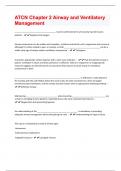
ATCN Chapter 2 Airway and Ventilatory Management Questions With Correct Answers!!
_____________________________________ must be administered to all severely injured trauma patients - Supplemental oxygen Airway compromise can be sudden and complete,, insidious and partial, and / progressive and recurrent. Although it is often related to pain, or anxiety, or both ________________________________ can be a subtle early sign of airway and/or ventilatory compromise. - Tachypnea A positive, appropriate verbal response with a clear voice indicates : - That the patients airway is patent, ventilation is intact, and brain perfusion is sufficient. Failure to respond or an inappropriate response suggests an altered level of consciousness that may be result of airway or ventilatory compromise or both. ___________________________________________________________ is defined as a tube placed in the trachea with the cuff inflates below the vocal cords, the tube connected to a form of oxygen enriched assisted ventilation, and the airway secured in place with an appropriate stabilizing method. - Definitive Airway Maintaining ____________________________ and preventing ______________________________ are critical in managing trauma patients, especially those who have sustained head injuries. - Oxygenation And preventing hypoxia An understanding of the ____________________________________. Is mandatory to providing adequate airway management while anticipating the risks. - Understanding the type of injury This injury is indicated by a triad of clinical signs: Hoarseness Subcutaneous emphysema Palpable fractures - Laryngeal Trauma________________________________________ can cause abnormal breathing patterns and compromise adequacy of ventilation. - Intracranial Injury Cervical spinal cord injury can result in respiratory muscle paresis and paralysis. Cervical injuries below _________________ result in maintenance of the diaphragmatic function but loss of the intercostal and abdominal muscles contribution to respiration. - C 3 Typically these patients display a seesaw pattern of breathing in which the abdomen is pushed out with inspiration, while the lower rib cage is pulled in. ______________________________ patients may sustain significant thoracic injuries without rib fractures - Pediatric patients Objective signs of adequate breathing - Symmetrical rise and fall of the chest and adequate wall excursion (asymmetry suggests splinting of the rib cage) Listen for movement of air on both sides of the chest. (Decreased lung sounds could alert to thorax injury) Use of pulse oximeter to measure a patients oxygen saturation and perfusion Note, however that this device does not measure adequacy of ventilation. Use of capnography in spontaneously breathing and intubated patients to assess whether ventilation is adequate. Also used to confirm proper placement of ET tube List the factors that indicate potential difficulties with airway maneuvers: - C -Spine injury Severe arthritis of the c spine Significant maxillofacial or mandibular trauma Limited mouth opening Obesity Anatomical variations (receding chin, overbite, short/muscular neck) Pediatric patientsThe mnemonic LEMON is a helpful tool in assessing the potential difficult airway. - Look Externally - look for characteristics known to contribute to difficult intubation & ventilation Evaluate the 3-3-2 Rule I . The distance between the patients incisor teeth should be at least 3 finger breaths II. The distance between the hyoid bone and the chin should be at least 3 finger breaths III. The distance between the thyroid notch ad the floor of the mouth should be at least 2 finger breaths Mallampati Score: Ensure the hypopharynx is adequately visualized Obstruction. - Any condition that can cause obstruction of the airway will make laryngoscopy and ventilation difficult. Neck Mobility - Vital requirement of successful intubation List the first priority of airway management - Is to ensure continued oxygenation while restricting cervical spine motion.
Escuela, estudio y materia
- Institución
- ATCN Chapter 2 Airway and Ventilatory Managem
- Grado
- ATCN Chapter 2 Airway and Ventilatory Managem
Información del documento
- Subido en
- 2 de octubre de 2023
- Número de páginas
- 5
- Escrito en
- 2023/2024
- Tipo
- Examen
- Contiene
- Preguntas y respuestas
Temas
-
atcn chapter 2 airway and ventilatory managem

Documento también disponible en un lote