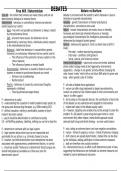
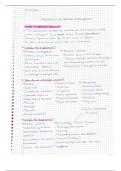
Free Will / Determinism DEBATES Nature vs Nurture
Free will – the notion that humans can make choices and are not Debate is concerned with the extent to which behaviour is due to
determined by biological or external forces inherited or acquired characteristics
Determinism – behaviour is controlled by internal and external Heredity – genetic transmission of mental and physical
events beyond our control characteristics, concordance rates used
- Hard – free will is not possible as behaviour is always created Nature – human characteristics are innate, focus on heredity,
by internal/external forces hormones and chemicals inherited influences or heredity,
- Soft – all events have causes, but behaviour can be psychological characteristics like intelligence /personality are
determined by conscious choice, individuals actively respond determined by biological factors (genes)
to the internal/external forces Nurture – behaviourist approach, mind is a blank state at birth 3
levels:
- Biological – belief that behaviour is caused either genetic,
- Pre-natal – mother state during pregnancy
hormonal, or evolutionary influences that we cannot control
- Post-natal – conditions child grows in
o The influence of the autonomic nervous system on the
- Social, cultural, and historical context
stress response
Interactionist approach – nature and nurture are linked, diathesis
o The influence of genes on mental health
stress model, biology needs to be triggered by environment;
- Environmental – behaviour is caused by features such as epigenetics – change in our genetic activity without changing the
systems or reward or punishment beyond our control code, leaves ‘marks’ which tell us out future DNA what to ignore and
o Skinners rats (conditioning) keep – alters genetic code of children
o Reinforcement
- Psychic – behaviour is caused by unconscious thoughts, P – all sides of debate have applications
repressed in childhood E – nature can offer drug treatments to target neurochemistry,
o Freud psychosexual stages theory nurture can predict at risk children based on their environments and
‘step in’ to offer support
P – determinism is useful E – by focusing on the separate stances, the contribution of each side
E – understanding the causation to health problems helps predict at of the debate can be understood and targeted for intervention
risk group and develop drug therapies, e.g. SSRIs treating OCD L – makes both sides of the debate equally useful
E – without causation, nothing is predictable, purpose of psych CA – however, targeting one variable may not be enough to solve the
research becomes useless problem. If a SZ patient is given drugs but goes home to a toxic
L – psych should be deterministic to contribute to society environment they often relapse, interactionist approach would
CA – self-fulfilling prophecy, labelling, nothing you can do to stop this advocate both drugs and family therapy – so more useful stance
P – determinism contrasts with our legal system P – also, taking an extreme stance can have negative connotations
E – legal systems states which says we are responsible and E – nature – threat of eugenics, nurture – threat of behaviour shaping
punishable for our actions, e.g. criminals choose to be one E – both stances are equally deterministic, implies little can be done
E – however, too little serotonin/too much testosterone has been by the individual, adding justification to these extreme measures
associated with aggressiveness, predetermined factors, no control L – both are therefore very socially sensitive
L – should we punish if behaviour is determined? Society argues we CA – interactionist less so, as offers a soft determinism point of view,
should hold people accountable so is there any room for suggesting that behaviours are malleable, so extreme measures not
deterministic stance? needed to control behavioural outcomes
Free will – the notion that humans can make choices and are not Debate is concerned with the extent to which behaviour is due to
determined by biological or external forces inherited or acquired characteristics
Determinism – behaviour is controlled by internal and external Heredity – genetic transmission of mental and physical
events beyond our control characteristics, concordance rates used
- Hard – free will is not possible as behaviour is always created Nature – human characteristics are innate, focus on heredity,
by internal/external forces hormones and chemicals inherited influences or heredity,
- Soft – all events have causes, but behaviour can be psychological characteristics like intelligence /personality are
determined by conscious choice, individuals actively respond determined by biological factors (genes)
to the internal/external forces Nurture – behaviourist approach, mind is a blank state at birth 3
levels:
- Biological – belief that behaviour is caused either genetic,
- Pre-natal – mother state during pregnancy
hormonal, or evolutionary influences that we cannot control
- Post-natal – conditions child grows in
o The influence of the autonomic nervous system on the
- Social, cultural, and historical context
stress response
Interactionist approach – nature and nurture are linked, diathesis
o The influence of genes on mental health
stress model, biology needs to be triggered by environment;
- Environmental – behaviour is caused by features such as epigenetics – change in our genetic activity without changing the
systems or reward or punishment beyond our control code, leaves ‘marks’ which tell us out future DNA what to ignore and
o Skinners rats (conditioning) keep – alters genetic code of children
o Reinforcement
- Psychic – behaviour is caused by unconscious thoughts, P – all sides of debate have applications
repressed in childhood E – nature can offer drug treatments to target neurochemistry,
o Freud psychosexual stages theory nurture can predict at risk children based on their environments and
‘step in’ to offer support
P – determinism is useful E – by focusing on the separate stances, the contribution of each side
E – understanding the causation to health problems helps predict at of the debate can be understood and targeted for intervention
risk group and develop drug therapies, e.g. SSRIs treating OCD L – makes both sides of the debate equally useful
E – without causation, nothing is predictable, purpose of psych CA – however, targeting one variable may not be enough to solve the
research becomes useless problem. If a SZ patient is given drugs but goes home to a toxic
L – psych should be deterministic to contribute to society environment they often relapse, interactionist approach would
CA – self-fulfilling prophecy, labelling, nothing you can do to stop this advocate both drugs and family therapy – so more useful stance
P – determinism contrasts with our legal system P – also, taking an extreme stance can have negative connotations
E – legal systems states which says we are responsible and E – nature – threat of eugenics, nurture – threat of behaviour shaping
punishable for our actions, e.g. criminals choose to be one E – both stances are equally deterministic, implies little can be done
E – however, too little serotonin/too much testosterone has been by the individual, adding justification to these extreme measures
associated with aggressiveness, predetermined factors, no control L – both are therefore very socially sensitive
L – should we punish if behaviour is determined? Society argues we CA – interactionist less so, as offers a soft determinism point of view,
should hold people accountable so is there any room for suggesting that behaviours are malleable, so extreme measures not
deterministic stance? needed to control behavioural outcomes