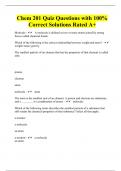
Chem 201 Quiz Questions with 100% Correct Solutions Rated A+
Molecule - A molecule is defined as two or more atoms joined by strong forces called chemical bonds. Which of the following is the correct relationship between weight and mass? - weight=mass×gravity The smallest particle of an element that has the properties of that element is called a(n): proton electron atom molecule - atom The atom is the smallest unit of an element. A proton and electron are subatomic, and a ________ is a combination of atoms. - molecule Which of the following terms describes the smallest particle of a substance that still retains the chemical properties of that substance? Select all that apply. a mixture a molecule an atom a neutron - a molecule an atom Depending on whether the substance in question is an element or a compound, either an atom or a molecule is the smallest particle of that substance that retains its chemical properties. A substance cannot decompose into protons, neutrons and electrons without changing its very nature. The word "atom" is derived from which language? - Atom is derived from the Greek word "atomos" meaning "uncuttable". Which of the following statements about atoms and molecules are true? All substances are composed of molecules. Atoms in a molecule are held together by chemical bonds. All molecules are composed of atoms. All substances are held together by chemical bonds. - Atoms in a molecule are held together by chemical bonds. All molecules are composed of atoms. Which of the following is a molecule? water (H20) ozone (O3) glucose (C6H12O6) all of the above - all of the above Weight, though often mistaken for mass, is technically the force of gravity on an object. From Newton's second law, we can calculate it as mass times the acceleration of gravity. w=___x_____ - w = mass * gravity A molecule comprised of more than one type of atom is called a(n): compound mixture element reactant (1.2.4 Elements, Compounds, and Mixtures) - Compound A mixture is composed of... (1.2.4 Elements, Compounds, and Mixtures) - two or more types of matter and can be separated by physical changes. Elements are (1.2.4 Elements, Compounds, and Mixtures) - pure substances that cannot be broken down into simpler substances by chemical changes. And reactants are (1.2.4 Elements, Compounds, and Mixtures) - substances undergoing reaction. A homogenous mixture varies from a heterogenous mixture in that a homogenous mixture has properties that: do not vary in the mixture vary in the mixture suspend in a liquid dissolve a solute (1.2.4 Elements, Compounds, and Mixtures) - do not vary in the mixture What are the the most common elements in... A) The Universe B) You Body (1.2.4 Elements, Compounds, and Mixtures) - A) Hydrogen (91%) Helium (9%) Other (<1%) B) Hydrogen (63%) Oxygen (25%) Carbon (10%) Nitrogen (1%) Other (<1%) Organic Elements (1.2.4 Elements, Compounds, and Mixtures) - Hydeogen, Oxygen, Carbon, Nitrogen Atomic Number (1.2.4 Elements, Compounds, and Mixtures) - the number of protons in the nucleus of an atom What do an element an an isotope have in common? (1.2.4 Elements, Compounds, and Mixtures) - Elements and isotopes contain only one type of atom. Subatomic particles are (1.2.4 Elements, Compounds, and Mixtures) - the components that make up an atom. A homogeneous mixture like salt and water can be separated by: (1.2.4 Elements, Compounds, and Mixtures) - Distillation A homogeneous mixture can be separated by physical means, such as causing one substance to boil away while the other remains, which is what distillation accomplishes. We can divide pure substances into two classes: - Elements and Compounds. An element and a compound are both considered to be pure substances. Elemental iron, for example, contains only iron atoms. Pure water, which is a compound, contains only water molecules, and nothing else. heterogeneous vs homogeneous mixtures - A mixture is composed of two or more types of matter that can be present in varying amounts and can be separated by physical changes, such as evaporation (you will learn more about this later). A mixture with a composition that varies from point to point is called a heterogeneous mixture. Italian dressing is an example of a heterogeneous mixture (Figure 1.13). Its composition can vary because we can make it from varying amounts of oil, vinegar, and herbs. It is not the same from point to point throughout the mixture—one drop may be mostly vinegar, whereas a different drop may be mostly oil or herbs because the oil and vinegar separate and the herbs settle. Other examples of heterogeneous mixtures are chocolate chip cookies (we can see the separate bits of chocolate, nuts, and cookie dough) and granite (we can see the quartz, mica, feldspar, and more). A homogeneous mixture, also called a solution, exhibits a uniform composition and appears visually the same throughout. An example of a solution is a sports drink, consisting of water, sugar, coloring, flavoring, and electrolytes mixed together uniformly (Figure 1.13). Each drop of a sports drink tastes the same because each drop contains the same amounts of water, sugar, and other components. Note that the composition of a sports drink can vary—it could be made with somewhat more or less sugar, flavoring, or other components, and still be a sports drink. Other examples of homogeneous mixtures include air, maple syrup, gasoline, and a solution of salt in water.
Escuela, estudio y materia
- Institución
- Chem 201
- Grado
- Chem 201
Información del documento
- Subido en
- 28 de septiembre de 2023
- Número de páginas
- 10
- Escrito en
- 2023/2024
- Tipo
- Examen
- Contiene
- Preguntas y respuestas
Temas
-
chem 201 quiz
-
chem 201
-
chem 201 quiz questions with 100 correct solution

Documento también disponible en un lote