NASM CES Exam Prep Latest Questions (solved) 2023/2024
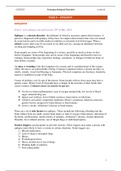
1. Muscles involved in the Anterior Oblique subsystem (AOS) Internal Oblique and adductor complex, external oblique and hip external rotators 2. Function of anterior oblique subsystem provides transverse plane stabilization and force transmission necessary for functional activities involving the trunk and extremities Provides rotation of the pelvis *provides dynamic stabilization of lumbo-pelvic-hip complex 3. Muscles involved in the lateral subsystem (LS) Gluteus medius, tensor fascia latae, adducor complex and quadratus lumborum 4. Function of lateral subsystem (LS) frontal plan stability and pelvo-femoral stability, 5. Dysfunction in the Lateral subsystem (LS) is evident by increased pronation of the knee, hip, or feet during walking, squats, lunges or climbing chairs 6. Unwanted frontal plane movement is characterized by Decreased strength and neuromuscular control in the lateral subsystem (LS) 7. The anterior subsystem (AOS) functions in the in which plane transverse 8. Force couple the synergistic action of a muscle to produce movement around a joint 9. length tension relationships the resting length of a muscle and the tension the muscle can produce while resting 10.The global stabilization subsystem in predominantly responsible for LPHC stabilization and eccentric deceleration 11.The global stabilization subsystem consists of Superficial musculature that originates from the pelvis to the ribcage, the lower extremities or both 12.The major muscles of the global stabilization subsystem rectus abdominis, external obliques, erector spinae, quadratus lumborum, psoas, and adductors 13.The global stabilization subsystem muscles are predominately larger and associated with movement of the trunk and limbs 14.The global stabilization subsystem equalizes external loads placed upon the body 15.The muscles of the global stabilization subsystem are important in transferring and absorbing forces from the upper and lower extremities to the pelvis (eccentric deceleration) 16.The global movement system is predominately responsible for concentric force production (acceleration) 17.The muscles that make up global movement system gastrocnemius, hamstrings, quadriceps, gluteus maximus, latissimus dorsi and pectoralis major 18.The local muscular system or local stabilization system consists of muscles that are primarily involved in joint support or stabilization 19.The local muscular system or local stabilization system joint support muscles are not movement specific 20.The local muscular system or local stabilization system joint support muscles provide stability to allow joint movement 21.Overhead squat anterior view, feet turn out probable overactive muscles soleus, lat. gastrocnemius, biceps femoris, tensor fascia late 22.Overhead squat anterior view, feet turn out probable under active muscles med gastrocnemius, med hamstring, gluteus medius/maximus, gracilis, sartorius, popliteus 23.Overhead squat anterior view, feet move inward probable overactive muscles adductor complex, biceps femoris, TFL, lat gastrocnemius, vastus lateralis 24.Overhead squat anterior view, feet move inward probable underactive muscles med hamstring, med gastrocnemius, gluteus medius/maximus, vastas medialis 25.Overhead squat anterior view, feet move outward probable overactive muscles piriformis, bicep femoris, TFL, gluteus medius/maximus 26.Overhead squat anterior view, feet move outward probable under active muscles adductor complex, med hamstring, gluteus maximus ead squat assessment lateral view, LPHC, excessive forward lean probable overactive muscles soleus, gastrocnemius, hip flexor complex, abdominal complex ead squat assessment lateral view, LPHC, excessive forward lean probable under active muscles anterior tibialis, gluteus maximus, erector spinae ead squat assessment lateral view, LPHC, low back arches probable overactive muscles hip flexor complex, erector spinae, latissimus dorsi
Escuela, estudio y materia
- Institución
- NASM Ces
- Grado
- NASM Ces
Información del documento
- Subido en
- 27 de septiembre de 2023
- Número de páginas
- 87
- Escrito en
- 2023/2024
- Tipo
- Examen
- Contiene
- Desconocido
Temas
-
nasm ces exam prep 2023
-
nasm ces exam prep 2024
-
nasm ces exam prep latest questions solved
-
nasm ces exam prep latest questions solved 2023

Documento también disponible en un lote