ATI RN Mental Health Online Practice 2019 B (60 Questions)
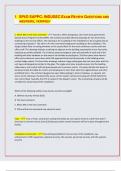
ATI RN Mental Health Online Practice 2019 B (60 Questions) 1. A nurse is caring for a client whose child has a terminal illness. The client requests information about how to deal with the upcoming loss. Which of the following statements should the nurse make: a. "It will be better for you to keep busy to avoid thinking about your child's death." Encouraging the client to avoid thinking about the child's death will not allow the client to begin anticipatory grieving. b. "You will complete the grieving process about a year after your child's death." The grief process has no timeline. It varies for each individual. c. "The grief process will start once your child actually dies." The client can begin anticipatory grieving during the child's illness. d. "It is not uncommon to feel angry toward yourself or others." Feelings of blame and anger towards oneself or others are an expected reaction when a client is experiencing a loss. 2. A nurse is teaching a client who has bipolar disorder and a prescription for lithium. Which of the following instructions should the nurse include in the teaching? a. "Take this medication with food." Lithium can cause gastrointestinal distress. Therefore, this medication should be taken with food. b. c. d. "Reduce sodium intake to 1,000 milligrams each day." The client should maintain an adequate and consistent sodium intake to decrease the risk for lithium toxicity. The recommended sodium intake for adults is 1,500 mg/day. "Limit fluid intake to 1,200 milliliters each day." The client should consume 2,000 to 3,000 mL/day of fluids during initial treatment with lithium. "Be aware that this medication can be addictive." Lithium is not classified as an addictive medication. 3. A nurse is planning care for four clients in a mental health facility. Which of the following clients is at the greatest risk for injury when performing ADLs a. A client who has severe Alzheimer's disease The greatest risk to this client is injury from performing ADLs. Clients who have severe Alzheimer's disease are typically confused, have memory difficulties, tend to wander, and need assistance to perform ADLs. A client who is in the maintenance phase of schizophrenia Clients who are in the maintenance phase of schizophrenia are calm and able to provide self-care with minimal risk for injury. Therefore, another client is at a greater risk for injury. A client who has obsessive-compulsive disorder A client who has obsessive-compulsive disorder typically performs ADLs repetitively and precisely. The client should be able to provide self-care with minimal risk for injury. Therefore, another client is at a greater risk for injury. A client who has dysthymic disorder Clients who have dysthymic disorder may have low energy or chronic fatigue, but they should be able to provide self-care with minimal risk for injury. Therefore, another client is at a greater risk for injury. b. c. d. 4. A nurse who works with newborns is assessing the potential for abuse or neglect. Which of the following family groups should the nurse identify as the highest potential for future child abuse a. A family in which both parents are adolescents A family in which both parents are adolescents indicates a risk for the parents to become abusive toward the newborn due to lack of experience and knowledge regarding parenting. However, another family group is at a higher risk for potential abuse. b. A family in which the parents respond indifferently toward their newborn A family in which the parents act indifferently about their newborn indicates a risk for the parents to become abusive toward the newborn due to impaired bonding. However, another family group is at a higher risk for potential abuse. c. A family where one or both parents witnessed intimate partner violence in the home as children Parents who witnessed intimate partner violence as children are more likely to become abusive themselves. Therefore, this is the family group with the greatest potential for future child abuse. d. A family in which one or both parents has a developmental disability A family in which one or both parents have a developmental disability indicates a risk for the parents to become abusive toward the newborn due to difficulty learning new skills. However, another family group is at a higher risk for potential abuse. 5. A nurse is performing an admission assessment on a client and notices that the client appears withdrawn and fearful. To establish a trusting nurse-client relationship, which of the following actions should the nurse take first a. Inform the client that her admission is confidential. According to evidence-based practice, the nurse should first inform the client about confidentiality during the orientation phase of the nurse-client relationship. b. c. d. Introduce the client to other clients in the day room. The nurse should introduce the client to other clients in the day room to help the client interact with others during the working phase of the nurse-client relationship. However, evidence-based practice indicates that the nurse should take a different action first. Assist the client in facilitating behavioral change. The nurse should assist the client with behavioral change during the working phase of the nurse- client relationship. However, evidence-based practice indicates that the nurse should take a different action first. Determine coping strategies that the client has used in the past. The nurse should determine what coping strategies the client used in the past during the working phase of the nurse-client relationship. However, evidence-based practice indicates that the nurse should take a different action first. 6. A nurse is admitting a client who has schizophrenia to an acute care setting. When the nurse questions the client regarding his admission, the client states, "I'm red, in the head, and I'm going to bed!" The nurse should document the client's speech pattern as which of the following a. Clang association The nurse should document that the client's speech uses clang associations, which often rhyme or contain a string of words that can have the same beginning sound. b. c. d. Word salad In word salad, words are completely meaningless and disorganized. This client's speech pattern is not word salad. Neologism Neologism consists of words that are made up by the client. This client's speech pattern does not contain neologisms. Echolalia In echolalia, the client repeats the words of another person. This client's speech pattern is not echolalia. 7. A nurse is caring for four clients in an inpatient mental health facility. Which of the following clients can give informed consent a. b. c. A 35-year-old client who has major depressive disorder A client who has major depressive disorder is capable of making health care decisions unless the client is determined to be legally incompetent. d. A 17-year-old client who lives with friends Individuals younger than 18 years of age can only provide informed consent if they are married, pregnant, parents, or emancipated. A 50-year-old client who has a blood alcohol level of 0.08 A client who is intoxicated cannot legally give informed consent. A 65-year-old client who just received a dose of morphine A client who has just received morphine, an opioid analgesic, is functionally incompetent due to the medication's effect on the CNS. 8. A nurse in a mental health unit is admitting a client who is anxious because he often hears voices telling him what to do. Which of the following actions should the nurse take a. b. c. d. Ask the client what the voices are saying. It is important for the nurse to ask the client directly about the hallucinations to determine if the client or others are at risk for injury. Tell the client that the voices do not really exist. The nurse should avoid negating the client's hallucination. Touch the client to help reduce his anxiety. Touching the client violates his personal space and may increase, rather than decrease, his anxiety. Instruct the client to go to a quiet room when he hears voices. The nurse should instruct the client to listen to music or use other auditory distractions when he hears voices. 9. A nurse is educating the parent of a child who has a new diagnosis of autism spectrum disorder. Which of the following manifestations of this disorder should the nurse include in the teaching a. b. c. d. Language delay A child who has autism spectrum disorder usually has language delay. Fear of abandonment Fear of abandonment is a manifestation of separation anxiety disorder rather than autism spectrum disorder. Motor and verbal tics Motor and verbal tics are a manifestation of Tourette's syndrome rather than autism spectrum disorder. Hostile behavior Hostile behavior is a manifestation of oppositional defiant disorder rather than autism spectrum disorder. 10. A nurse is updating the plan of care for a client who has bulimia nervosa and is 5% above his ideal body weight? Which of the following interventions should the nurse include in the plan? a. b. Identify the client's trigger foods. The nurse should identify the trigger foods that initiate the client's binge and assist the client to understand his thoughts and behavior that relate to the food. c. d. Include a liquid supplement with meals. The nurse should include a liquid supplement for a client who is below ideal body weight and might not be able to eat solid foods at first or might need the additional nutrition to gain weight. Allow the client at least 1 hr for each meal. The nurse should limit the client's meal times to about 30 min to prevent putting excessive focus on food. Weigh the client at bedtime each day. The nurse should weigh the client immediately after he wakes up and voids and prior to oral intake. The nurse should weigh the client daily for the first week and then three times per week. 11. A nurse is caring for an older adult client who begins to cry and states, "I knew God would punish me and I deserve this horrible sickness!" Which of the following responses should the nurse make a. b. c. "Let's talk about what is upsetting you." The nurse is acknowledging the client's concerns and is showing a desire to understand what the client is thinking and feeling. d. "Why do you think you deserve this punishment?" Asking a "why" question can make the client feel defensive. "Don't worry about being punished by God." The nurse is minimizing the client's feelings. This response does not show empathy toward the client and is belittling the client's feelings. "You shouldn't say things that will upset you so much." The nurse is showing disapproval, which can make the client defensive. 12. A nurse is providing care for a client who has bipolar disorder and is experiencing acute mania. The client's morning lithium level is 1.5 mEq/L. Which of the following laboratory findings should the nurse report to the provider? (Click on the "Exhibit" button below for additional client information. There are three tabs that contain separate categories of data a. b. c. d. Sodium level 125 mEq/L In the presence of low sodium levels, renal excretion of lithium is reduced and the client is at risk for lithium toxicity. Therefore, the nurse should report this laboratory value to the provider. Erythrocyte sedimentation rate 18 mm/hr This finding is within the expected reference range and the nurse does not need to report this laboratory value to the provider. Hemoglobin 15 g/dL This finding is within the expected reference range and the nurse does not need to report this laboratory value to the provider. Serum T4 5 mcg/dL This finding is within the expected reference range and the nurse does not need to report this laboratory value to the provider. 13. A school nurse is assessing a school-age child who experienced the traumatic loss of a parent 8 months ago. Which of the following findings should the nurse identify as an indication that the child is experiencing post traumatic stress disorder (PTSD) a. b. c. d. Lack of interest in an upcoming holiday The child who has PTSD will have negative moods and difficulty remembering aspects of the traumatic event. The child can also have a loss of interest or lack of participation in significant activities and events such as holidays. Clinging behaviors directed toward a teacher PTSD manifestations seen in children include detachment or estrangement from others rather than clinging behavior.
Escuela, estudio y materia
- Institución
- Chamberlain College Of Nursing
- Grado
- ATI RN Mental
Información del documento
- Subido en
- 26 de septiembre de 2023
- Número de páginas
- 37
- Escrito en
- 2023/2024
- Tipo
- Examen
- Contiene
- Preguntas y respuestas
Temas
-
ati rn mental
-
online practice
-
best health rating
-
correct 60 questions