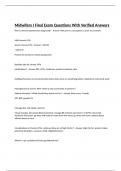
Midwifery I Final Exam Questions With Verified Answers
How is chronic hypertension diagnosed? - Answer HTN prior to conception or prior to 20 weeks Mild chronic HTN Severe chronic HTN - Answer >140/90 >160/110 Persists for at least 12 weeks postpartum Baseline labs for chronic HTN Medications? - Answer CBC, LFTS, creatinine, protein/creatinine ratio Antihypertensives not recommended unless they were on something before, labetolol is commonly used Management of chronic HTN--when to see pt and tests to perform? Patient education? What should they watch out for? - Answer Visits every 3 weeks NST, BPP, growth US Manage diet, salt intake, exercise Visual changes, decreased fetal movement, manage BP at home and report >140/90, new-onset headache that won't go away with tylenol, heart burn that won't go away with tums, edema above elbows/knees or face Complications of chronic HTN---what are they are at high risk for? - Answer High risk for: preterm labor, placental abruption, cesarean, IUGR, oligohydramnios When is a pt considered to have gestational htn? Can she have proteinuria? Does it resolve postpartum? - Answer Has two separate readings >140 systolic OR 90 diastolic (for the first time) at least 6 hours apart AFTER 20 weeks gestation No proteinuria Resolves within 12 weeks postpartum What labs to monitor for gestational HTN? Management? what tests to run? - Answer urine protein, platelets, LFTs Serial growth U/S, BP readings at home 2x No medications are necessary Watch for s/s of preeclampsia 1. Pathophysiology of preeclamspia 2. Mild preeclamspia defined as? 3. Severe preeclampsia defined as? 4. When does preeclampsia usually occur? - Answer 1. Abnormal trophoblastic invasion of the uterus at the placental site Causes narrowing of spiral arteries 2. 2 separate readings at least 6 hrs apart >140 OR >90 after 20 weeks OR Protein--> +300mg in 24 hr urine OR PCR 0.3 OR +1 urine dip on two samples at least 6 hrs apart 3. 2 separate readings at least 6 hrs apart >160 OR >110 after 20 weeks Protein-->+500mg in 24 hr urine OR +3 urine dip on two samples 6hrs apart 4. Usually occurs late onset, >36 weeks Diagnostic evaluation for preeclampsia Severe features defined as? - Answer HTN after 20 weeks greater than 140/90 AND ONE of the following: Proteinuria Greater than 300 in 24 hour urine PCR >0.3 Greater than 1+ dipstick Visual or cerebral symptoms Platelets <100,000 Serum creatinine >1.1 Elevated liver enzymes Pulmonary edema Systolic BP >160 OR diastolic >110 (BP bumps up to the next level) Everything else the same as above ^ S/S of preeclampsia What labs would you draw? Surveillance? What things should you monitor? - Answer Visual changes epigastric pain/RUQ pain Headache Dependent and facial edema SOB elevated reflexes, clonus 24 hour urine (for protein), CrCl, BUN, uric acid, CBC (H&H and platelets), LFTs, PT/aPTT, peripheral smear Protein--+1 for mild, +3 for severe CrCl-->1.1 Platelets--<100,000 LFTs--elevated BPP and NST at diagnosis and 2x weekly until delivery CBC and 24 hr urine weekly Symptom assessment Blood pressure measurements 3-4 day intervals Growth U/S Fetal movement monitoring Only cure for preeclampsia is? - Answer DELIVERY When is magnesium sulfate used? - Answer Use for neuroprotection/seizure prophylaxis Used for preeclamspia w/ severe features, not indicated for mild cases shown to reduce eclamspia rates Eclampsia What is the most common prodromal symptom? - Answer Gradual onset of grand mal seizures more be preceded by severe preeclamptic symptoms but may also occur unexpectedly Headache most common prodromal symptom HELLP Syndrome Symptoms? - Answer Hemolysis elevated liver enzymes Low platelets N/V--most common fatigue/malaise abdominal pain--indigestion, heart burn--most common headache elevated BP preeclamspia s/s Which women should receive rhogam? When is it given? Dosage for before 12 weeks? After 12 weeks? - Answer Any women with vaginal bleeding who are Rh-negative and are desensitized Given 48-72 hrs from onset of bleeding <12 weeks: 50ug >12 weeks: 200 ug Complete abortion 1. Cervix: 2. U/S: 3. Uterus size 4. BHCG 5. S/S - Answer 1. Closed 2. normal, no products of conception 3. small 4. low/falling 5. s/s of normal non-pregnant pt
Escuela, estudio y materia
- Institución
- Midwifery
- Grado
- Midwifery
Información del documento
- Subido en
- 23 de septiembre de 2023
- Número de páginas
- 19
- Escrito en
- 2023/2024
- Tipo
- Examen
- Contiene
- Preguntas y respuestas
Temas
-
midwiferystuvia
-
midwifery i final exam questions with verified ans
-
how is chronic hypertension diagnosed htn prior t
-
mild chronic htn severe chronic htn

Documento también disponible en un lote