ATI FUNDAMENTALS EXAM 100% questions and correct answers2023
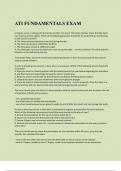
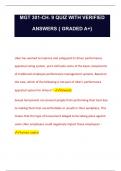
ATI FUNDAMENTALS EXAM A hospice nurse is visiting with the family member of a client. The family member states that the client has insomnia almost nightly. Which of the following practices should the nurse identify as contributing to the client's insomnia? A. The client watches television in her bed during the day. B. The client drinks warm milk before bedtime. C. The client goes to bed at 2200 every night. D. The client gets up to use the bathroom once during the night. - correct answersA. The client watches television in her bed during the day. To promote sleep, the client should avoid watching television in bed. She should use the bed only for sleep or sexual activities. A nurse is providing oral care for a client who is unconscious. Which of the following actions should the nurse take? A. Place the client in a lateral position with the head turned to the side before beginning the procedure B. Use the thumb and index finger to keep the client's mouth open C. Rinse the client's mouth with an alcohol-based mouthwash following the procedure D. Cleanse the client's mucous membranes with lemon-glycerin sponges A. Place the client in a lateral position with the head turned to - correct answersA. Place the client in a lateral position with the head turned tothe side before beginning the procedure The nurse should place the client in a lateral position with the head turned to the side to reduce the risk of aspiration of fluids and secretions. - use a padded tongue blade - use either water or alcohol-free mouthwash - use a foam swab because lemon-glycerin swabs dry and irritate the mouth and can damage the teeth. A nurse is planning care for a client who is confused and requires a prescription for wrist restraints. Which of the following interventions should the nurse include in the plan of care? A. Renew the prescription for the use of restrains within 24 hr B. Secure the restraint with the buckle side next to the client's skin C. Ensure 4 fingers can be inserted under the secured restraint D. Remove the restraint every 3 hr - correct answersA. Renew the prescription for the use of restrains within 24 hr The nurse should plan to renew the prescription for the restraints within 24 hours, only after the provider has evaluated the client. - secure with the softer side next to skin with the buckle or Velcro closure on the outside. - ensure 2 fingers, unable to insert 2 fingers, could cause impaired circulation to the extremities. - remove at least every 2 hours; at that time, check skin, change position, and toilet or exercise the client. A nurse is caring for a client who has major fecal incontinence and reports irritation in the perianal area. Which of the following actions should the nurse take first? A. Apply a fecal collection system B. Apply a barrier cream C. Cleanse and dry the area D. Check the client's perineum - correct answersD. Check the client's perineum Nursing action is for the nurse to collect more data by assessing the area of irritation. - apply a fecal collection system to divert the feces away from the area of skin irritation; - apply a barrier cream to decrease skin breakdown in the perianal area from the feces; - cleanse and dry the perianal area to decrease A newly licensed nurse is preparing to administer medications to a client. The nurse notes that the provider has prescribed a medication that is unfamiliar to him. Which of the following actions should the nurse take? A. Consult the medication reference book available on the unit B. Ask a more experienced nurse for information about the medication C. Call the client's provider and verify the prescription D. Ask the client if she takes this medication at home - correct answersA. Consult the medication reference book available on the unit A nurse must have knowledge about medications to administer them safely. The nurse should become familiar with the medication by looking it up in the medication reference on the unit. - information from this source is not sufficient to allow the nurse to administer the medication safely. - no reason to believe that the medication prescription is in error; not necessary to confirm w/ prescriber A nurse is reviewing the use of side rails with an assistive personnel (AP). Which of the following statements by the AP indicates that further teaching is required? A. "I should not leave all 4 side rails up unless there is a prescription for restraints." B. "An alert client will be safest if I raise the 2 upper side rails at the head of the bed." C. "If the client seems confused, I'll raise all 4 side rails so that he doesn't hurt himself." D. "If a client is sedated, I should raise all 4 side rails to prevent a fall out of bed." - correct answersC. "If the client seems confused, I'll raise all 4 side rails so that he doesn't hurt himself." Raising all 4 side rails can put the client at greater risk for injury. For example, the client might try to climb over the side rails, which could result in a fall. Side Rails as Restraints - correct answers- Raising all 4 side rails can put the client at greater risk for injury. For example, the client might try to climb over the side rails, which could result in a fall. - Side rails are a form of restraint when all 4 rails are raised. This requires a prescription from the provider after less restrictive methods have been unsuccessful. - Leaving the 2 upper side rails up improves the client's ability to turn and move around in bed. The client will also be able to use the rails when getting out of bed, which will help prevent falls. - Raising all 4 side rails is not considered a restraint if the client is sedated. This action reduces the client's risk for injury due to falling out of bed. A nurse is caring for a client who is receiving IV fluid replacement. Which of the following findings should the nurse identify as infiltration of the IV infusion site? A. Redness at the IV catheter entry site B. Palpable cord along the vein used for the infusion C. Taut skin around the IV catheter site that is cool to the touch D. Bleeding at the IV insertion site - correct answersC. Taut skin around the IV catheter site that is cool to the touch A client who has taut skin around the IV catheter site that is cool to the touch might have an infiltrated IV site. The nurse should stop the IV infusion, elevate the extremity, and apply a warm moist compress or a cold compress (according to the type of infiltration). NURSING INTERVENTION: infiltrated IV site - correct answersA client who has taut skin around the IV catheter site that is cool to the touch might have an infiltrated IV site. - stop the IV infusion, - elevate the extremity - apply a warm moist compress or a cold compress (according to the type of infiltration). NURSING INTERVENTION: redness at IV catheter entry - correct answersA client who has redness at the IV catheter entry site might have a local infection. - remove the IV, clean the site with alcohol - start a new IV line in another location. NURSING INTERVENTION: IV site, palpable cord - phlebitis - correct answersA client who has a palpable cord along the vein might have phlebitis, which is inflammation of the inner layer of a vein. - discontinue the infusion - start a new IV line in another location.
Escuela, estudio y materia
- Institución
- ATI FUNDAMENTALS
- Grado
- ATI FUNDAMENTALS
Información del documento
- Subido en
- 23 de septiembre de 2023
- Número de páginas
- 58
- Escrito en
- 2023/2024
- Tipo
- Examen
- Contiene
- Preguntas y respuestas
Temas
-
ati fundamentals
-
ati fundamentals exam
-
ati fundamentals exam

Documento también disponible en un lote