100% de satisfacción garantizada Inmediatamente disponible después del pago Tanto en línea como en PDF No estas atado a nada 4.2 TrustPilot
logo-home
Examen

Med-surg. ANCC certification exam questions and answers

Puntuación
-
Vendido
-
Páginas
15
Grado
A+
Subido en
22-09-2023
Escrito en
2023/2024

Mc burney's point Point in RLQ abd of appendix. Tenderness indicates appendicitis Murphy's sign Place fingers under rt coastal margin and instruct to take deep breath. Increased tenderness with sudden stop during inhalation is a positive murphy's sign Obturator muscle, psoas sign, Rovsing's sign All assessment used to r/o appendicitis Homan's sign Out dated and not recommended to use for assessment for DVT Jar sign(markle sign) Pain from a jarring movement to indicate peritonitis with appendicitis. Stand on toes and drop to heals or increaded pain with walking or running Beck's triad Acute cardiac tamponade- pericardial effusion 1. Disended neck vein's 2. Distant heart sounds 3. Hypotention Treatment- pericardiocentesis Charcot's triad for MS 1. Nystagmas- repetitive uncontrolled movements of the eyes 2. Intention tremor- tremor that worsens as approaches end of intended movement 3. Scanning or staccato speech- broken speech and each syllable pronounced separately Charcot's triad for ascending cholangitis Inf. of bile duct caused by bacteria ascending from junction with duodenum 1.Jaundice 2. Fever, usually with rigors 3. RUQ ABD pain Cushing's triad Signs of increased ICP 1. HTN- widened pulse pressure 2. Bradycardia 3. Irregular respirations- cheyne- stokes( slow, fast, slow period of apnea then slow,fast,slow Kaussmaul breathing Deep and labored. Presents in severe metabolic acidosis- DKA and kidney failure Bergman's triad Signs of fat embolism 1. Mental status changes 2. Petechiae-late sign 3. Dyspnea Brudzinski sign Sign of meningitis- supine flex neck will cause involuntary flexion of hips and knees Kernig's sign Sign of meningitis- lift flexed knee and slowly extend will cause back pain if positive Chvostek's sign Trousseau' sign Nerve hyperexcitability (tetany) seen with hypocalemia Abnormal reaction to stimulation of facial nerve Inflate bp cuff to greater than systolic and hand and wrist with involuntarly curl inward Levine sign is positive when a patient is holding a clenched fist over his chest to describe dull, pressing chest pain consistent with the discomfort of angina pectoris. A patient is diagnosed with a lateral wall ST segment elevation myocardial infarction (STEMI). What do you expect the EKG to show? a. ST elevation in leads V1 -V6 b. ST elevation in leads I, aVL, V5, V6 c. ST elevation in leads II, III, aVF d. ST elevation in leads V7, V8, V9 B: Choice B would show a lateral wall MI. Choice A would show an anterior MI. Choice C would show an inferior wall MI. Choice D would show a posterior wall MI. Epididymitis commonly caused by E.coli in elderly males and/or those who are not sexually active and have normal immune function. In sexually active males with a history of unprotected sex, the causative organisms are likely gonorrhea and/or chlamydia. Cases of epididymitis caused by Staph aureus are rare. Epididymitis caused by cytomegalovirus (CMV) is incredibly rare unless the patient is immunocompromised. Triple H therapy for Subarachnoid Hemorrhage- induced Vasospasm Nimodipine or Nimotop is a calcium channel blocker which causes vasodilation of the blood vessels. is hypervolemia, hypertension, and hemodilution. These three factors will maintain the patency of the vessels, making it difficult for them to vasoconstrict. Vasospasm left unchecked can cause stroke, neurological compromise, and death. Iatrogenic Adverse effects caused by dx procedure or treatment Confussion assessment method(cam) Dx delirium 1 Acute onset 2 Inattention 3 Disorganized thinking 4 ALOC 1,2. And 3 or 4 is positive The Confusion Assessment Method Onset: Acute changes in mental status. · Attention: Inattentive, stable, or fluctuating. · Thinking: Disorganized, rambling, switching topics, illogical. · Level of consciousness: Altered (ranging from alert to coma). · Orientation: Time, place, person. · Memory: Impaired. · Perceptual disturbances: Hallucinations, illusions. Psychomotor abnormalities: Agitations or retardation. · Sleep-wake cycle: Awake at night, sleepy in the daytime. Nursing process Assessment: Collecting data, history, and completing a physical exam. Diagnosis: Analyzing data, determining needs and problems, and applying a nursing diagnosis. Planning: Setting priorities, setting goals and expected outcomes, and planning interventions and strategies of care. Implementation: Applying interventions/treatments. Evaluation: Reassessing and auditing. Diabetes insipidus Extreme thirst and urination cause by imbalance in body fluid CAGE Alcoholism screening- C -Cutting down: Do you think about trying to cut down on drinking? A -Annoyed at criticism: Are people starting to criticize your drinking? G -Guilty feeling: Do you feel guilty or try to hide your drinking? E -Eye opener: do you increasingly need a drink earlier in the day? Braden score PU risk assessment PUSH score Pressure Ulcer Scale for Healing- measure over time to indicate healing or deterioration Five Stages of grief 1. Denial 2. Anger 3. Bargaining 4. Depression 5. Acceptance Bloom's Taxonomy(6 levels of learning) Remember Understand Apply Analyze Evaluate Create Bloom's Taxonomy(3 types of learning) 1. Cognitive: Learning and gaining intellectual skills and mastering categories of effective learning (knowledge, comprehension, application, analysis, synthesis, and evaluation). · 2. Affective: Recognizing categories of feelings and values from simple to complex (receiving and responding to phenomena, valuing, organizing, and internalizing values). · 3. Psychomotor: Mastering motor skills necessary for independence, following a progression from simple to complex (perception, set, guided response, mechanism, complex overt response, adaptation, and origination). Tertiary Soften impact of longterm ,complex illness/injury Secondary Early detection and Treatment to halt or slow progress Primary Prevention Orchiopexy Sx to move undescended testicle or resolve testicular torsion Orchiectomy Removal of one or both testicules Piaget's stages of Cognitive Development Sensorimotor (0 -2): Infants learn about cause and effect and the permanence of objects. · Preoperational (2 -7): Thinking is concrete and tangible at the preconceptual stage, and later becomes intuitive. These children are egocentric. Concrete operational (7 -11): Children develop the concept of conservation and reasoning becomes inductive. Formal operational (11 -15): Adolescents develop the ability to use abstract thought and to develop and test hypotheses. Tardive dyskinesia Involuntary movements. May become permanent or become worse. Treatments include stopping the drug that caused it and in some cases Botox injections may be effective "5 rights of delegation" 1. Right task: The nurse determines an appropriate task to delegate for a specific patient. 2. Right circumstance: The nurse has considered all relevant information to determine appropriateness of delegation. · 3. Right Person: The nurse chooses the right person based on education and skills to perform the task. · 4. Right direction: The nurse provides a clear description of the task, purpose, limits, and expected outcomes. · 5.Right supervision: The nurse must supervise, intervene as needed, and evaluate performance. Types of leadership Autocratic leaders make decisions independently and strictly enforce rules. Bureaucratic leaders follow organizational rules exactly and expect others to do so, as well. Laissez-faire leaders exert little direct control and allow others to make decisions with little interference. Participatory leaders present a potential decision and make a final decision based on input from team members. Consultative leaders present a decision and welcome input, but rarely change their decisions. Democratic leaders present a problem and ask the team to arrive at a solution, although these leaders make the final decision.

Mostrar más Leer menos
Institución
Grado


Ups! No podemos cargar tu documento ahora. Inténtalo de nuevo o contacta con soporte.

Escuela, estudio y materia

Institución
Estudio
Desconocido
Grado

Información del documento

Subido en
22 de septiembre de 2023
Número de páginas
15
Escrito en
2023/2024
Tipo
Examen
Contiene
Preguntas y respuestas

Temas

Vista previa del contenido

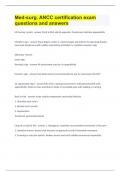
Med-surg. ANCC certification exam
questions and answers
Mc burney's point - answer Point in RLQ abd of appendix. Tenderness indicates appendicitis


Murphy's sign - answer Place fingers under rt coastal margin and instruct to take deep breath.
Increased tenderness with sudden stop during inhalation is a positive murphy's sign


Obturator muscle,
psoas sign,
Rovsing's sign - answer All assessment used to r/o appendicitis


Homan's sign - answer Out dated and not recommended to use for assessment for DVT


Jar sign(markle sign) - answer Pain from a jarring movement to indicate peritonitis with
appendicitis. Stand on toes and drop to heals or increaded pain with walking or running


Beck's triad - answer Acute cardiac tamponade- pericardial effusion
1. Disended neck vein's
2. Distant heart sounds
3. Hypotention
Treatment- pericardiocentesis


Charcot's triad for MS - answer 1. Nystagmas- repetitive uncontrolled movements of the eyes
2. Intention tremor- tremor that worsens as approaches end of intended movement
3. Scanning or staccato speech- broken speech and each syllable pronounced separately

, Charcot's triad for ascending cholangitis - answer Inf. of bile duct caused by bacteria ascending
from junction with duodenum
1.Jaundice
2. Fever, usually with rigors
3. RUQ ABD pain


Cushing's triad - answer Signs of increased ICP
1. HTN- widened pulse pressure
2. Bradycardia
3. Irregular respirations- cheyne- stokes( slow, fast, slow period of apnea then slow,fast,slow


Kaussmaul breathing - answer Deep and labored. Presents in severe metabolic acidosis- DKA
and kidney failure


Bergman's triad - answer Signs of fat embolism
1. Mental status changes
2. Petechiae-late sign
3. Dyspnea


Brudzinski sign - answer Sign of meningitis- supine flex neck will cause involuntary flexion of
hips and knees


Kernig's sign - answer Sign of meningitis- lift flexed knee and slowly extend will cause back pain
if positive


Chvostek's sign


Trousseau' sign - answer Nerve hyperexcitability (tetany) seen with hypocalemia
$13.99
Accede al documento completo:

100% de satisfacción garantizada
Inmediatamente disponible después del pago
Tanto en línea como en PDF
No estas atado a nada


Documento también disponible en un lote

Conoce al vendedor

Seller avatar
Los indicadores de reputación están sujetos a la cantidad de artículos vendidos por una tarifa y las reseñas que ha recibido por esos documentos. Hay tres niveles: Bronce, Plata y Oro. Cuanto mayor reputación, más podrás confiar en la calidad del trabajo del vendedor.
BRAINBOOSTERS Chamberlain College Of Nursing
Seguir Necesitas iniciar sesión para seguir a otros usuarios o asignaturas
Vendido
641
Miembro desde
2 año
Número de seguidores
249
Documentos
22536
Última venta
2 horas hace

In this page you will find all documents , flashcards and package deals offered by seller BRAINBOOSTERS

4.5

340 reseñas

5
264
4
30
3
21
2
5
1
20

Recientemente visto por ti

Por qué los estudiantes eligen Stuvia

Creado por compañeros estudiantes, verificado por reseñas

Calidad en la que puedes confiar: escrito por estudiantes que aprobaron y evaluado por otros que han usado estos resúmenes.

¿No estás satisfecho? Elige otro documento

¡No te preocupes! Puedes elegir directamente otro documento que se ajuste mejor a lo que buscas.

Paga como quieras, empieza a estudiar al instante

Sin suscripción, sin compromisos. Paga como estés acostumbrado con tarjeta de crédito y descarga tu documento PDF inmediatamente.

Student with book image

“Comprado, descargado y aprobado. Así de fácil puede ser.”

Alisha Student

Preguntas frecuentes