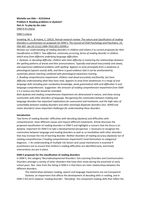
Michelle van Diën – 413154md
Problem 3. ¿swardkcab
Snowling, M. J., & Hulme, C. (2015). Disorders of reading, mathematical and motor development. In
Rutter's child and adolescent psychiatry (p.p. 702-718). John Wiley & Sons, Ltd : Chichester, UK.
doi:10.1002/9781118381953.ch53
Disorders of reading and writing
Reading and spelling difficulties
Forms of reading disorder in children:
1. Dyslexia: children have difficulty learning to decode (in mastering the relationships between the
spelling patterns of words and their pronunciations). Typically read aloud inaccurately and slowly and
experience additional problems with spelling.
2. Reading comprehension impairment: children can read aloud accurately and fluently but have
difficulty understanding what they have read. Children with reading comprehension impairment tend
to go unnoticed in the classroom and tend not to come to the attention of clinical or educational
services.
Dyslexia
Dyslexia (International Dyslexia Association): “a specific learning disability characterized by
difficulties learning to read and write despite adequate cognitive ability, motivation, access to
instruction, and intact sensory mechanisms”.
Problems of decoding (“dyslexia”) are a bottleneck to reading comprehension; but the nature
of the difficulties change with age. Early on in development: dyslectic children have difficulty learning
letter names and sounds. Later: problem with “phonics”: the translation of print into sound.
Adolescence and adulthood: reading may be accurate but fluency is usually affected and a slow
reading rate will affect performance in formal settings such as examinations. Problems of spelling,
initially in producing a phonetically acceptable transcription of target words and later, in English and
to a lesser extent in other languages, with the many irregularities of the orthographic system.
Typically diagnosed when a person has severe difficulties with reading accuracy as assessed
by a well-standardized test. Reading skills have a continuous distribution in the population the
cut-off point for defining “dyslexia” is arbitrary. Estimates of its prevalence in English-speaking
countries range from 3% to 10% of school-aged children. Social factors play a key role in risk for
reading disability. Boys are more likely to be referred for reading difficulties than girls.
Causal models and risk factors
Phonological deficits in dyslexia
Predominant cognitive explanation of dyslexia: it arises from a phonological deficit; a problem in
processing the speech sounds of spoken words. Phonological skills provide support for verbal short-
term memory and more broadly the learning of verbal information. Early manifestations are
difficulties with the development of phonological memory, phonological awareness, and
phonological learning. These affect the acquisition of letter-knowledge, one of the first signs that a
child is at risk of reading problems. Problems with word recognition ensue together with
phonological decoding deficits, seen most clearly when attempting to read novel words.
The phonological deficit theory does not fully account for the reading problems found in
children with dyslexia. Disabled readers with deficits in naming speed measured by RAN (a task
requiring the rapid naming of familiar objects, colors, etc.). Performance in RAN is a better marker of
who will go on to have reading problems among children with communication impairments than are
measures of phonological skill.
Hypothesis: RAN taps processing speed and this accounts for its relationship particularly with
Problem 3. ¿swardkcab
Snowling, M. J., & Hulme, C. (2015). Disorders of reading, mathematical and motor development. In
Rutter's child and adolescent psychiatry (p.p. 702-718). John Wiley & Sons, Ltd : Chichester, UK.
doi:10.1002/9781118381953.ch53
Disorders of reading and writing
Reading and spelling difficulties
Forms of reading disorder in children:
1. Dyslexia: children have difficulty learning to decode (in mastering the relationships between the
spelling patterns of words and their pronunciations). Typically read aloud inaccurately and slowly and
experience additional problems with spelling.
2. Reading comprehension impairment: children can read aloud accurately and fluently but have
difficulty understanding what they have read. Children with reading comprehension impairment tend
to go unnoticed in the classroom and tend not to come to the attention of clinical or educational
services.
Dyslexia
Dyslexia (International Dyslexia Association): “a specific learning disability characterized by
difficulties learning to read and write despite adequate cognitive ability, motivation, access to
instruction, and intact sensory mechanisms”.
Problems of decoding (“dyslexia”) are a bottleneck to reading comprehension; but the nature
of the difficulties change with age. Early on in development: dyslectic children have difficulty learning
letter names and sounds. Later: problem with “phonics”: the translation of print into sound.
Adolescence and adulthood: reading may be accurate but fluency is usually affected and a slow
reading rate will affect performance in formal settings such as examinations. Problems of spelling,
initially in producing a phonetically acceptable transcription of target words and later, in English and
to a lesser extent in other languages, with the many irregularities of the orthographic system.
Typically diagnosed when a person has severe difficulties with reading accuracy as assessed
by a well-standardized test. Reading skills have a continuous distribution in the population the
cut-off point for defining “dyslexia” is arbitrary. Estimates of its prevalence in English-speaking
countries range from 3% to 10% of school-aged children. Social factors play a key role in risk for
reading disability. Boys are more likely to be referred for reading difficulties than girls.
Causal models and risk factors
Phonological deficits in dyslexia
Predominant cognitive explanation of dyslexia: it arises from a phonological deficit; a problem in
processing the speech sounds of spoken words. Phonological skills provide support for verbal short-
term memory and more broadly the learning of verbal information. Early manifestations are
difficulties with the development of phonological memory, phonological awareness, and
phonological learning. These affect the acquisition of letter-knowledge, one of the first signs that a
child is at risk of reading problems. Problems with word recognition ensue together with
phonological decoding deficits, seen most clearly when attempting to read novel words.
The phonological deficit theory does not fully account for the reading problems found in
children with dyslexia. Disabled readers with deficits in naming speed measured by RAN (a task
requiring the rapid naming of familiar objects, colors, etc.). Performance in RAN is a better marker of
who will go on to have reading problems among children with communication impairments than are
measures of phonological skill.
Hypothesis: RAN taps processing speed and this accounts for its relationship particularly with