Michelle van Diën – 413154md
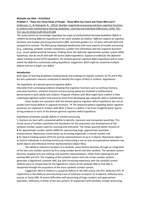
Problem 7. "There Are Three Kinds of People - Those Who Can Count and Those Who Can't"
Andersson, U., & Ostergren, R. . (2012). Number magnitude processing and basic cognitive functions
in children with mathematical learning disabilities. Learning and Individual Differences, 22(6), 701–
714. doi:10.1016/j.lindif.2012.05.004
The study extend our knowledge regarding the origin of mathematical learning disabilities (MLD) in
children by testing different hypotheses in the same samples of children. Different aspects of cognitive
functions and number processing assessed in fifth- and sixth-graders (11–13 years old) with MLD and
compared to controls. The MLD group displayed weaknesses with most aspects of number processing
(e.g., subitizing, symbolic number comparison, number-line estimation) and two cognitive functions
(e.g., visual–spatial working memory). Findings favor the defective approximate number system (ANS)
hypothesis, but do not fit well with the access deficit hypothesis. Support provided for the defective
object-tracking system (OTS) hypothesis, the domain general cognitive deficit hypothesis and to some
extent the defective numerosity-coding hypothesis. Suggestion: MLD might be caused by multiple
deficits and not a single core deficit.
Introduction
Both types of learning disabilities (mathematical and reading) are equally common (4-7% and 6-9%),
but less systematic research conducted to identify the origins of MLD in children. Hypotheses:
The hypothesis of a domain general cognitive deficit
Emanates from converging evidence showing that cognitive functions such as working memory,
executive functions, semantic memory and processing speed are involved in mathematical
performance in both adults and children. Proposal: children with MLD might have a deficit in their
underlying cognitive system that prevents them from developing age-adequate skills in mathematics.
Some studies are consistent with the domain general cognitive deficit hypothesis, but not all
studies have found deficits in cognitive functions. The empirical pattern regarding which cognitive
processes are impaired in children with MLD, if there is a deficit, is far from straightforward. Sparse
strong evidence in favor of the domain general cognitive deficit hypothesis.
Hypotheses of domain specific deficits in number processing
1. Humans are born with a preverbal ability to identify, represent and manipulate quantities. This
innate sense of number constitutes the foundation for the acquisition and development of the
symbolic number system used for counting and arithmetic. The innate quantity ability consists of:
● An approximate number system (ANS) for representing large, approximate quantities
(numerosities). Represents numerosities via an analog magnitude, a mental number line.
● An object-tracking system (OTS) for precise representations of up to 4 objects. Represents objects
as distinct individuals in working memory by constructing a one-to-one correspondence between real
world objects and individual mental representations (object files).
The ability to represent numbers in a symbolic, exact fashion develops through an integration
of the two core number systems by first using number words and later symbols. The symbolic system
becomes mapped onto pre-existing core quantity representations, rather than replacing the pre-
existing ANS and OTS. The mapping of the symbolic system onto the innate number systems
generates a logarithmic symbolic ANS, but with increasing experience with the symbolic system
children learn to compensate for the logarithmic nature of the symbolic ANS or that ANS is
sharpened through the acquisition of the exact symbolic number system.
Suggestion: MLD in children is caused by deficits in the ANS and/or the OTS. Defective OTS
impairment in the ability to precisely keep track of small sets of objects (3–4 objects). Defective (less
precise or fuzzy) ANS severe difficulties with processing of large numbers and approximate
quantities. Deficiency in either of the two systems impairment with symbolic number processing,
Problem 7. "There Are Three Kinds of People - Those Who Can Count and Those Who Can't"
Andersson, U., & Ostergren, R. . (2012). Number magnitude processing and basic cognitive functions
in children with mathematical learning disabilities. Learning and Individual Differences, 22(6), 701–
714. doi:10.1016/j.lindif.2012.05.004
The study extend our knowledge regarding the origin of mathematical learning disabilities (MLD) in
children by testing different hypotheses in the same samples of children. Different aspects of cognitive
functions and number processing assessed in fifth- and sixth-graders (11–13 years old) with MLD and
compared to controls. The MLD group displayed weaknesses with most aspects of number processing
(e.g., subitizing, symbolic number comparison, number-line estimation) and two cognitive functions
(e.g., visual–spatial working memory). Findings favor the defective approximate number system (ANS)
hypothesis, but do not fit well with the access deficit hypothesis. Support provided for the defective
object-tracking system (OTS) hypothesis, the domain general cognitive deficit hypothesis and to some
extent the defective numerosity-coding hypothesis. Suggestion: MLD might be caused by multiple
deficits and not a single core deficit.
Introduction
Both types of learning disabilities (mathematical and reading) are equally common (4-7% and 6-9%),
but less systematic research conducted to identify the origins of MLD in children. Hypotheses:
The hypothesis of a domain general cognitive deficit
Emanates from converging evidence showing that cognitive functions such as working memory,
executive functions, semantic memory and processing speed are involved in mathematical
performance in both adults and children. Proposal: children with MLD might have a deficit in their
underlying cognitive system that prevents them from developing age-adequate skills in mathematics.
Some studies are consistent with the domain general cognitive deficit hypothesis, but not all
studies have found deficits in cognitive functions. The empirical pattern regarding which cognitive
processes are impaired in children with MLD, if there is a deficit, is far from straightforward. Sparse
strong evidence in favor of the domain general cognitive deficit hypothesis.
Hypotheses of domain specific deficits in number processing
1. Humans are born with a preverbal ability to identify, represent and manipulate quantities. This
innate sense of number constitutes the foundation for the acquisition and development of the
symbolic number system used for counting and arithmetic. The innate quantity ability consists of:
● An approximate number system (ANS) for representing large, approximate quantities
(numerosities). Represents numerosities via an analog magnitude, a mental number line.
● An object-tracking system (OTS) for precise representations of up to 4 objects. Represents objects
as distinct individuals in working memory by constructing a one-to-one correspondence between real
world objects and individual mental representations (object files).
The ability to represent numbers in a symbolic, exact fashion develops through an integration
of the two core number systems by first using number words and later symbols. The symbolic system
becomes mapped onto pre-existing core quantity representations, rather than replacing the pre-
existing ANS and OTS. The mapping of the symbolic system onto the innate number systems
generates a logarithmic symbolic ANS, but with increasing experience with the symbolic system
children learn to compensate for the logarithmic nature of the symbolic ANS or that ANS is
sharpened through the acquisition of the exact symbolic number system.
Suggestion: MLD in children is caused by deficits in the ANS and/or the OTS. Defective OTS
impairment in the ability to precisely keep track of small sets of objects (3–4 objects). Defective (less
precise or fuzzy) ANS severe difficulties with processing of large numbers and approximate
quantities. Deficiency in either of the two systems impairment with symbolic number processing,