100% de satisfacción garantizada Inmediatamente disponible después del pago Tanto en línea como en PDF No estas atado a nada 4,6 TrustPilot
logo-home
Examen

TNCC EXAM QUESTIONS AND ANSWERS

Puntuación
-
Vendido
-
Páginas
14
Grado
A+
Subido en
22-09-2023
Escrito en
2023/2024

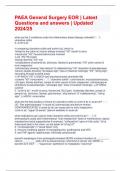
1. Preparation and Triage 2. Primary Survery (ABCDE) with resuscitation adjuncts (F,G) 3. Reevaluation (consideration of transfer) 4. Secondary Survey (HI) with reevaluation adjuncts 5. Reevaluation and post resuscitation care 6. Definitive care of transfer to an appropriate trauma nurse Initial Assessment 1. A- airway and Alertness with simultaneous cervical spinal stabilization 2. B- breathing and Ventilation 3. circulation and control of hemorrhage 4. D - disability (neurologic status) 5. F - full set of vitals and Family presence 6. G - Get resuscitation adjuncts L- Lab results (arterial gases, blood type and crossmatch) M- monitor for continuous cardiac rhythm and rate assessment N- naso or orogastric tube consideration O- oxygenation and ventilation analysis: Pulse oxygemetry and end-tidal caron dioxide (ETC02) monitoring and capnopgraphy H- History and head to toe assessment I- Inspect posterior surfaces ABCDEFGHI Before the arrival of the pt When should PPE be placed: Pt is at hospital in the right amount of time, right care, right trauma facility, right resources Safe Care: Uncontrolled Hemorrhage Major cause of preventable death: reorganize care to C-ABC If uncontrolled hemorrhage .. Used at the beginning of the initial assessment 1. A Alert. If the pt is alert he or she will be able to maintain his or her airway once it is clear. 2. V responds to verbal stimuli responds to pain. If the patient needs verbal stimulation to respond, an airway adjunct may be needed to keep the tongue from obstructing the airway. 3. P responds to pain. If the pt. responds only to pain, he or she may not be able to maintain his or her airway adjunct may need to be placed while further assessment is made to determine the need for intubation. 4. U Unresponsive. If the pt. is unresponsive, announce it loudly to the team and direct someone to chk in the pt is pulseless while assessing if the cause of the problem is the airway. Airway and AVPU: ask pt to pen his or her mouth While assessing airway the patient is alert and responds to verbal stimuli you should.. jaw thrust maneuver to open airway and assess for obstruction. If pt has a suspected csi, the jaw thrust procedure should be done by two providers. One provider can maintain c-spine and the other can perform the jaw thrust maneuver. While assessing airway pt is unable to open mouth, responds only to pain, or is unresponsive you should.. 1. The tongue obstructing the airway 2. loose or missing teeth 3. foreign objects 4. blood, vomit, or secretions' 5. edema 6. burns or evidence of inhalation injury Auscultiate or listen for: 1. Obstructive airway sounds such as snoring or gurgling 2. Possible occlusive maxillofacial bony deformity 3. Subcutaneous emphysema Inspect the mouth for: 1. Check the presence of adequate rise and fall of the chest with assisted ventilation 2. Absence of gurgling on auscultation over the epigastrium 3. Bilateral breath sounds present on auscultation 4. Presence of carbon dioxide (CO2) verified by a CO2 device or monitor If the pt has a definitive airway in what should you do? 1. Suction the airway 2, Use care to avoid stimulating the gag reflex 3. If the airway is obstructed by blood or vomitus secretions, use a rigid suction device If foreign body is noted, remove it carefully with forceps or another appropriate method If Airway is not patent 1. Apnea 2. GCS 8 or less 3. Maxillary fractures 4. Evidence of inhalation injury (facial burns) 5. Laryngeal or tracheal injury or neck hematoma 6. High risk of aspiration and patients inability to protect the airway 7. Compromised or ineffective ventilation Following conditions might require a definitive airway Breathing: To assess breathing expose the chest: 1. Inspect for a. spontaneous breathing b. symmetrical rise and fall c. depth, pattern, and rate of respiration d. signs of difficulty breathing such as accessory muscle use e. skin color (normal, pale, flushed, cyanotic) f. contusions, abrasions, deformities (flail chest) g. open pneumothoraces (sucking chest wounds) h. JVD i. signs of inhalation injury (singed nasal hairs, carbonaceous sputum) B tracheal deviation and jvd Late signs of tension pneumo: 1. equal breath sounds bilaterally at the second intercostal space midclavicular line and the bases for fifth intercostal space at the axillary line Auscultate the chest for: 1. bony fractures and possible rib fractures, which may impact ventilation 2. palpate for crepitus 3. subcutaneous emphysema which may be a sign for a pneumothorax 4. soft tissue injury Palpate the chest for 1. open the airway, use jaw thrust 2. insert an oral airway 3. assist ventilations with a bag mask 4. prepare for definitive airway If breathing is absent.. trauma its need early supplemental oxygen, start with 15 mL O2 and titrate oxygen delivery. Oxygen on trauma patients Circulation and Control of Hemorrhage Inspect first for any uncontrolled bleeding Skin color palpate for central pulses - carotid and femoral - rate, rhythm, and strength Skin temp: cool, diaphoretic, or warm and dry C apply direct pressure to bleeding elevate extremity apply pressure over arterial sites Consider a pelvic binder for pelvic fractures consider a tourniquet cannulate two veins with large caliber IV - if unable to gain assess consider IO a. obtain labs, type and cross b. infuse warm isotonic fluids c. consider balanced resuscitation d. use rapid infusion device C Interventions: Disability - Neurologic Status 1. Assess pupils for equality, shape, and reactivity (PERRL) 2. Assess GCS (eye opening, verbal response, and motor response) D 1. Get a CT 2. Consider ABG 's if decreased LOC 3. Consider glucose check D Interventions Exposure and Environmental Control Remove all clothes and assess for any obvious injuries and uncontrolled bleeding E IF clothing is needed for evidence preserve in paper bag. Maintain body temp - cover the pt, turn up heat in room, administer warm fluids E Interventions: Full set of vitals and family presence F Get Resuscitation Adjuncts L - Labs (maybe a lactic acid), a b g 's, blood type M - monitors N - naso or oro gastric tubes O Oxygen and ETC02 monitors P - pain assessment and management G Reevaluation and Consider the need to Transfer Final step in primary survey H,I Secondary Survery History and Head to toe MIST - prehospital report MOI Injuries sustained S s/s in the field T treatment in the field if patients family present get a better hx on them H Sample is part of history S symptoms associated with injury A allergies and tetanus status M meds currently on including anticoagulant therapy P past medical hx L last oral intake E Events and environment factors related to the injury SAMPLE inspect for lacs, abrasions, asymmetry of facial expressions palate for depressions and tenderness look at ears for drainage Head to toe assessment: Head and face immobilize cervical spine, tenderness, tracheal deviation Head to toe assessment: Neck and cervical spine inspect, auscultate, palpate any spontaneous breathing, rate, depth, and degree of effort, use of accessory muscles lacs, contusions, auscilate lung sounds and heart sounds Head to toe assessment: Chest don't forget flanks!!! inspect of lacs, puncture wounds, contusions, auscultate then palpate: bowel sounds? any rigidity, guarding? begin with light palpation start to palpate with side that does not hurt maybe do a fast scan? Head to toe assessment: Abdomen any lacs? deformities? blood at the urtheral meatus palpate pelvis with high pressure over the iliac wings downward and medially Head to toe assessment: pelvis and perineum any deformities? bleeding? contusions, lacs? skin temp?? place splints on deformities, pulses Head to toe assessment: Extremities inspect posterior surfaces blogroll with at least 3 people. maintain c spine take out backboard Rectal tone per MD I labs, wound care, tetanus, administer meds, prepare for transfer Secondary Reval Adjuncts Vital signs Interventions Primary survey Pain Post resuscitation care parameters that are continuously evaluated: Capnography monitors numeric value, as well as continuous waveform, indicating real-time measurement and trending over time. Quantitative: Colorimetric CO2 detectors provide info about the presence or absence of CO2. A chemically treated indicator strip changes color revealing the presence or absence of exhaled CO2 Qualitative

Mostrar más Leer menos
Institución
Grado


Ups! No podemos cargar tu documento ahora. Inténtalo de nuevo o contacta con soporte.

Escuela, estudio y materia

Institución
Estudio
Desconocido
Grado

Información del documento

Subido en
22 de septiembre de 2023
Número de páginas
14
Escrito en
2023/2024
Tipo
Examen
Contiene
Preguntas y respuestas

Temas

Vista previa del contenido

TNCC EXAM QUESTIONS AND
ANSWERS
1. Preparation and Triage
2. Primary Survery (ABCDE) with resuscitation adjuncts (F,G)
3. Reevaluation (consideration of transfer)
4. Secondary Survey (HI) with reevaluation adjuncts
5. Reevaluation and post resuscitation care
6. Definitive care of transfer to an appropriate trauma nurse - answer Initial Assessment


1. A- airway and Alertness with simultaneous cervical spinal stabilization
2. B- breathing and Ventilation
3. circulation and control of hemorrhage
4. D - disability (neurologic status)
5. F - full set of vitals and Family presence
6. G - Get resuscitation adjuncts
L- Lab results (arterial gases, blood type and crossmatch)
M- monitor for continuous cardiac rhythm and rate assessment
N- naso or orogastric tube consideration
O- oxygenation and ventilation analysis: Pulse oxygemetry and end-tidal caron dioxide (ETC02)
monitoring and capnopgraphy
H- History and head to toe assessment
I- Inspect posterior surfaces - answer ABCDEFGHI


Before the arrival of the pt - answer When should PPE be placed:

, Pt is at hospital in the right amount of time, right care, right trauma facility, right resources -
answer Safe Care:


Uncontrolled Hemorrhage - answer Major cause of preventable death:


reorganize care to C-ABC - answer If uncontrolled hemorrhage ..


Used at the beginning of the initial assessment


1. A Alert. If the pt is alert he or she will be able to maintain his or her airway once it is clear.
2. V responds to verbal stimuli responds to pain. If the patient needs verbal stimulation to
respond, an airway adjunct may be needed to keep the tongue from obstructing the airway.
3. P responds to pain. If the pt. responds only to pain, he or she may not be able to maintain his
or her airway adjunct may need to be placed while further assessment is made to determine
the need for intubation.
4. U Unresponsive. If the pt. is unresponsive, announce it loudly to the team and direct
someone to chk in the pt is pulseless while assessing if the cause of the problem is the airway. -
answer Airway and AVPU:


ask pt to pen his or her mouth - answer While assessing airway the patient is alert and responds
to verbal stimuli you should..


jaw thrust maneuver to open airway and assess for obstruction. If pt has a suspected csi, the
jaw thrust procedure should be done by two providers. One provider can maintain c-spine and
the other can perform the jaw thrust maneuver. - answer While assessing airway pt is unable to
open mouth, responds only to pain, or is unresponsive you should..


1. The tongue obstructing the airway
2. loose or missing teeth
3. foreign objects
$14.99
Accede al documento completo:

100% de satisfacción garantizada
Inmediatamente disponible después del pago
Tanto en línea como en PDF
No estas atado a nada


Documento también disponible en un lote

Conoce al vendedor

Seller avatar
Los indicadores de reputación están sujetos a la cantidad de artículos vendidos por una tarifa y las reseñas que ha recibido por esos documentos. Hay tres niveles: Bronce, Plata y Oro. Cuanto mayor reputación, más podrás confiar en la calidad del trabajo del vendedor.
BRAINBOOSTERS Chamberlain College Of Nursing
Seguir Necesitas iniciar sesión para seguir a otros usuarios o asignaturas
Vendido
666
Miembro desde
2 año
Número de seguidores
250
Documentos
23255
Última venta
1 semana hace

In this page you will find all documents , flashcards and package deals offered by seller BRAINBOOSTERS

4.5

341 reseñas

5
265
4
30
3
21
2
5
1
20

Recientemente visto por ti

Por qué los estudiantes eligen Stuvia

Creado por compañeros estudiantes, verificado por reseñas

Calidad en la que puedes confiar: escrito por estudiantes que aprobaron y evaluado por otros que han usado estos resúmenes.

¿No estás satisfecho? Elige otro documento

¡No te preocupes! Puedes elegir directamente otro documento que se ajuste mejor a lo que buscas.

Paga como quieras, empieza a estudiar al instante

Sin suscripción, sin compromisos. Paga como estés acostumbrado con tarjeta de crédito y descarga tu documento PDF inmediatamente.

Student with book image

“Comprado, descargado y aprobado. Así de fácil puede ser.”

Alisha Student

Preguntas frecuentes