Project 2
Part 1
Learning goals:
● What do the different conditions mean? Explain the results.
● Is there evidence for the effect of elaborative interrogations on comprehension?
Wood, E., Pressley, M., & Winne, P. H. (1990). Elaborative interrogation effects on children’s learning
of factual content.
Experiment 1
Elaborative interrogation might not be as potent with children as with adults.
Subjects. 139 English-speaking elementary-school children. In Grades 4-8. Randomly assigned to 4
conditions:
1. base sentence only: subjects were provided only the factual sentences. They were instructed to
learn them so that later when given the action they could recall the man performing the action.
2. precise elaboration provided: the facts were embellished with precise elaborations provided by
the experimenter. The precise elaboration provided an answer to the question "Why would that
particular man do that particular action?"
3. imagery: subjects were instructed to code the fact by constructing an imaginal representation.
4. elaborative interrogation: subjects were given the base sentence and instructed to answer the why
question about the fact ("Why did the man do that?").
Materials. 18 white cards with one sentence. “Man” sentences: each sentence described a particular
type of man and the activity the man did.
Subjects read the sentences, and heard the sentences read by an audiotaped male voice.
No feedback provided during study.
Recall test (immediately following the 4.5-min presentation of the 18 to-be-learned
sentences): 18 questions. Given an action, the child was required to recall the man who did it.
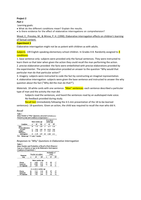
Recall
Responses to "Why" Questions in Elaborative Interrogation
Part 1
Learning goals:
● What do the different conditions mean? Explain the results.
● Is there evidence for the effect of elaborative interrogations on comprehension?
Wood, E., Pressley, M., & Winne, P. H. (1990). Elaborative interrogation effects on children’s learning
of factual content.
Experiment 1
Elaborative interrogation might not be as potent with children as with adults.
Subjects. 139 English-speaking elementary-school children. In Grades 4-8. Randomly assigned to 4
conditions:
1. base sentence only: subjects were provided only the factual sentences. They were instructed to
learn them so that later when given the action they could recall the man performing the action.
2. precise elaboration provided: the facts were embellished with precise elaborations provided by
the experimenter. The precise elaboration provided an answer to the question "Why would that
particular man do that particular action?"
3. imagery: subjects were instructed to code the fact by constructing an imaginal representation.
4. elaborative interrogation: subjects were given the base sentence and instructed to answer the why
question about the fact ("Why did the man do that?").
Materials. 18 white cards with one sentence. “Man” sentences: each sentence described a particular
type of man and the activity the man did.
Subjects read the sentences, and heard the sentences read by an audiotaped male voice.
No feedback provided during study.
Recall test (immediately following the 4.5-min presentation of the 18 to-be-learned
sentences): 18 questions. Given an action, the child was required to recall the man who did it.
Recall
Responses to "Why" Questions in Elaborative Interrogation