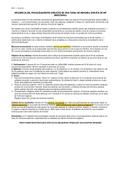
HESI: Med Surg Evolve Qui zzes 2022 Which assessment finding should most concern the nurse who is monitoring a client two hours after a thoracentesis? New onset of coughing. Low resting heart rate. Distended neck veins. Decreased shallow respirations. - New onset of coughing. A pneumothorax (partial or complete lung collapse) is the potential complication of a thoracentesis. Manifestations of a pneumo thorax include new onset of a nagging cough, tachycardia, and an increased shallow respiration rate. Which assessment is most important for the nurse to perform on a client who is hospitalized for Guillain -Barre syndrome that is rapidly progressing? Respiratory effort. Unsteady gait. Intensity of pain. Ability to eat. - Respiratory effort. Guillain -Barre syndrome causes paralysis or weakness that typically starts at the feet and progresses upwards. As the condition progresses, the nurse must ensure that the client is able to breathe effectively. What is the primary nursing problem for a client with asymptomatic primary syphilis? Acute pain. Risk for injury. Sexual dysfunction. Deficient knowledge - Deficient knowledge An asymptomatic client with primary syphilis is most likely unaware of this disease, so to prevent transmission to others and recurrence in the client, the priority nursing diagnosis is deficient knowledge of the disease pathophysiology. A client with heart failure is prescribed di goxin 0.125 mg PO. The client's apical heart rate is70 beats per minute, blood pressure is 125/75 mmHg, and respirations are 18 breaths per minute. Which action should the nurse implement next? Administer the medication. Inform the healthcare provider. Review the vital sign flowsheet. Reassess the apical heart rate. - Administer the medication. Obtaining the apical heart rate is a common parameter prior to administering digoxin, which may indicate early digoxin toxicity if the heart rate is less than 6 0 beats per minute, so the dose should be administered since the client is not demonstrating any signs of toxicity. A nurse is preparing to insert an IV catheter after applying an eutectic mixture of lidocaine and prilocaine (EMLA), a topical anesthetic c ream. What action should the nurse take to maximize its therapeutic effect? -Rub a liberal amount of cream into the skin thoroughly. Incorrect -Cover the skin with a gauze dressing after applying the cream. -Leave the cream on the skin for 1 to 2 hours be fore the procedure. -Use the smallest amount of cream necessary to numb the skin surface. - Leave the cream on the skin for 1 to 2 hours before the procedure. Topical anesthetic creams, such as EMLA, should be applied to the puncture site at least 60 mi nutes to 2 hours before the insertion of an IV catheter. A male client is admitted after falling from his bed. The healthcare provider (HCP) tells the family that he has an incomplete fracture of the humerus. The family ask the RN what this means. Which e xplanation by the nurse accurately describes the client's fracture? Straight fracture line that is also a simple, closed fracture. Nondisplaced fracture line that wraps around the bone. A complete fracture that also punctures the skin. A fracture that be nds or splinters part of the bone. - A fracture that bends or splinters part of the bone. An incomplete fracture occurs when part of the bone is splintered (broken) and it has not gone completely through the thickness of the bone. The unlicensed assisti ve personnel (UAP) reports that an 87 -year-old client who is sitting in a chair at the bedside has an oral temperature of 97.2°F (36.4°C). Which intervention should the nurse implement? Document the temperature reading on the vital sign graphic sheet. Report the temperature to the healthcare provider immediately. Instruct the UAP to take the client's temperature again in 30 minutes. Advise the UAP to assist the client in returning to bed. - Document the temperature reading on the vital sign graphic sheet. A subnormal oral temperature of 97.2°F (36.4°C) is a common finding in elderly clients, so the nurse should document the findings and continue with the plan of care.
Examen
HESI: Med Surg Evolve Quizzes 2024
Puntuación
Vendido
-
Páginas
7
Grado
A+
Subido en
20-09-2023
Escrito en
2023/2024
HESI: Med Surg Evolve Quizzes 2022 Which assessment finding should most concern the nurse who is monitoring a client two hours after a thoracentesis? New onset of coughing. Low resting heart rate. Distended neck veins. Decreased shallow respirations. - New onset of coughing. A pneumothorax (partial or complete lung collapse) is the potential complication of a thoracentesis. Manifestations of a pneumothorax include new onset of a nagging cough, tachycardia, and an increased shallow respiration rate. Which assessment is most important for the nurse to perform on a client who is hospitalized for Guillain-Barre syndrome that is rapidly progressing? Respiratory effort. Unsteady gait. Intensity of pain. Ability to eat. - Respiratory effort. Guillain-Barre syndrome causes paralysis or weakness that typically starts at the feet and progresses upwards. As the condition progresses, the nurse must ensure that the client is able to breathe effectively. What is the primary nursing problem for a client with asymptomatic primary syphilis? Acute pain. Risk for injury. Sexual dysfunction. Deficient knowledge - Deficient knowledge An asymptomatic client with primary syphilis is most likely unaware of this disease, so to prevent transmission to others and recurrence in the client, the priority nursing diagnosis is deficient knowledge of the disease pathophysiology. A client with heart failure is prescribed digoxin 0.125 mg PO. The client's apical heart rate is70 beats per minute, blood pressure is 125/75 mmHg, and respirations are 18 breaths per minute. Which action should the nurse implement next? Administer the medication. Inform the healthcare provider. Review the vital sign flowsheet. Reassess the apical heart rate. - Administer the medication.
Mostrar más
Leer menos
Institución
HESI: Med Surg
Grado
HESI: Med Surg
Ups! No podemos cargar tu documento ahora. Inténtalo de nuevo o contacta con soporte.
Escuela, estudio y materia
- Institución
- HESI: Med Surg
- Grado
- HESI: Med Surg
Información del documento
- Subido en
- 20 de septiembre de 2023
- Número de páginas
- 7
- Escrito en
- 2023/2024
- Tipo
- Examen
- Contiene
- Preguntas y respuestas
Temas
-
hesi med surg
Vista previa del contenido
$10.99
Accede al documento completo:
100% de satisfacción garantizada
Inmediatamente disponible después del pago
Tanto en línea como en PDF
No estas atado a nada
Conoce al vendedor

GENERALFRANK3
Documento también disponible en un lote
Package deal
Nursing
5
2023
$ 53.45
Más información