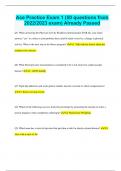
Ace Practice Exam 1 (50 questions from 2022/2023 exam) Already Passed
Ace Practice Exam 1 (50 questions from 2022/2023 exam) Already Passed Q1: When answering the Physical Activity Readiness Questionnaire (PAR-Q), your client answers "yes" to a bone or joint problem that could be made worse by a change in physical activity. What is the next step in his fitness program? A1: Talk with her doctor about her readiness for exercise. Q2: What blood pressure measurement is considered to be a risk factor for cardiovascular disease? A2: 140/90 mmHg Q3: Tight hip adductors and weak gluteus medius muscles can lead to which compensation? A3: Knees moving inward Q4: Which of the following assesses body fat percentage by measuring the amount of water a person displaces when completely submerged? A4: Hydrostatic Weighing Q5: Which man has a waist to hip ratio that puts him at risk for obesity-related disease? A5: Alex with a ratio of .96 Q6: Jose is 18 years old. What is his estimated maximum heart rate? A6: 202 bpm Q7: Which of the following factors influence a client's resting heart rate? A7: All of the above Q8: You have performed the Thomas test with Susan and have observed that her lower thigh does not touch the table and her knee does not flex to 80 degrees. What muscles do you suspect to be tight? A8: Primary hip flexor muscles Q9: Your client, Ben, comes to you with a goal of "being more flexible for his golf and tennis game". You help Randy define his goals in more specific and measurable terms so that his progress can be evaluated. Helping him set these effective goals are commonly said to be: A9: SMART Goals Q10: Which of the following functional fitness tests is not contraindicated for individuals who suffer from low-back pain, have had recent back surgery, and/or are in the midst of an acute low-back flare-up? A10: Apley's scratch test Q11: Which of the following is not a part of muscular endurance testing? A11: Vertical jump test Q12: You are watching your client's heart rate during moderate aerobic exercise and notice that her heart rate is not increasing. Which antihypertensive medication could be preventing your client's heart rate to rise even though she is exercising? A12: Beta blockers Q13: What is an example of the "tell, show, do" technique used in the early stages of training? A13: Explaining the proper way to perform an exercise, showing your client, and then allowing them to try the exercise. Q14: What is the main muscle group involved in the extension portion of a leg extension exercise? A14: Quadriceps Q15: Your client tells you that he wants to get into better shape because his wife loves to play tennis and he wants to be able to play with her. Which principle of behavior change is this an example of? A15: Observational Learning Q16: Which phase of cardiorespiratory training challenges the phosphagen system and is typically only entered into for clients with sport specific training goals? A16: Anaerobic-power Training Q17: Muscular Power takes what two performance factors into account? A17: Force and Velocity Q18: Which of the following is an example of a concentric contraction? A18: Hamstrings in a leg curl Q19: Achieving efficient movement through opposing and contralateral pulls at joints refers to which movement principle? A19: Force-couple Relationships Q20: When referring to the body's "core" muscles, which of the following is not a part of this group? A20: Rectus femoris Q21: During the first two weeks of an exercise program, strength gains are typically a result of what adaptation? A21: Motor learning Q22: Which of the following best describes the principle of training overload? A22: Gradually adding more resistance than the muscles have encountered. Q23: Which type of exercise should older adults avoid in order to prevent spikes in blood pressure? A23: Isometric contractions Q24: What is the major benefit of performing a cool down? A24: Prevents blood from pooling in your arms and legs Q25: All of the following joints are responsible for stability except: A25: Glenohumeral Q26: Ben is a new client that has been released from his physician to take part in a basic exercise program. Ben is considered a low-risk cardiac client. What is Ben's functional capacity? A26: Greater than 7 METS Q27: Mind-body exercise continues to emerge as an effective fitness and health-enhancement modality. Which of the following are core benefits from regular participation in programs such as tai chi, qigong, and hatha yoga? A27: All of the above Q28: Bob has been training for and competing in triathlons for 5 years. He wants to increase running speed and cycling power. How many times should you suggest he train per week? A28: 4-7 Q29: This week Janet has 3 sessions at 60 minutes apiece with an RPE rating of 5. According to the training progression scale using RPE, what is Janet's rating in points for this week? A29: 900 points Q30: Janet is a 55-year-old woman you have recently taken on as a client. She currently walks the mile in 15 minutes and wants to be able to run in a 5k in six months. Which is an example of a SMART goal for her? A30: Janet will complete the mile in 12 minutes within two months. Q31: In which resistance training phase should muscular strength and endurance be periodically assessed? A31: Load training Q32: How many days per week should a client do cardio exercise if they are in phase 2 of cardiorespiratory training and want to keep progressing toward their goal? A32: 2-4 days Q33: A one rep max test should be given in which phase of the ACE IFT Model? A33: Phase 3 or 4 Q34: Trainers can utilize the ACE IFT model for core conditioning and balance training. Which stage of the ACE IFT model emphasizes seat and standing stabilization over a fixed base of support? A34: Stage 2 Q35: Jon has been strength training for 6 weeks. He is excited the he can now perform 12 repetitions of a seated row easily. What advise should you give Jon if he wants to increase his strength with this exercise? A35: Add 5% more resistance Q36: Which of the following is not true when planning a resistance workout for an older adult? A36: Clients should begin with unsupported resistance exercises to improve balance. Q37: What type of activities would you recommend to a client with arthritis? A37: All of the above Q38: Using the overload principle, which of the following techniques are used to advance upper-body strength? A38: All of the above Q39: What would be a goal of exercising in the treatment of cancer? A39: All of the above. Q40: All of the following are ways to progress agility drills, except: A40: Increase the base of support Q41: Which of the following is appropriate according to the ACE personal trainer's scope of practice? A41: Teaching a client self myo-fascial releasing techniques. Q42: You notice that a member of the gym has fallen to the ground. What is the first thing you should do? A42: Ask her if she is ok Q43: Which of the following is an example of negligence? A43: Neglecting to spot a client during a bench press exercise. Q44: Your client wants to lose 10 lbs. and wants your advice. Which of the following is considered within your scope of practice? A44: Show the client how to read nutrition labels Q45: Which of the following does not fit within the scope of practice for an ACE Personal trainer? A45: Provide specific diet advice Q46: Catherine is a new client who has paid for 5 one-hour training sessions. In order for you to retain her as a long-term client, it is important that you develop a long-term exercise plan based on which of the following concepts? A46: Concept of periodization Q47: You are performing the risk-management protocol and are specifying the risks that may be encountered in the areas of instruction, supervision, facilities, equipment, contracts, and business structure. What step of the risk-management protocol are you performing? A47: Risk identification Q48: You notice that a piece of equipment is not working properly, but have seen others using the piece of equipment with no problems. Which of the following would not be an approach for managing risk? A48: Solve Q49: A personal trainer may own and operate his or her own business. Which of the following would be the risk that consists of the costs of such things as property rental fees, equipment, employees and marketing in the opening of a business? A49: Barriers to entry Q50: What role would a personal trainer play in keeping a client's diabetes in control? A50: Motivate and client to safely and regularly participate in physical activity
Escuela, estudio y materia
- Institución
- Ace Practice
- Grado
- Ace Practice
Información del documento
- Subido en
- 19 de septiembre de 2023
- Número de páginas
- 9
- Escrito en
- 2023/2024
- Tipo
- Examen
- Contiene
- Preguntas y respuestas
Temas
-
ace practice exam 1 50 questions from e

Documento también disponible en un lote