ESL Praxis Practice with 100% correct answers
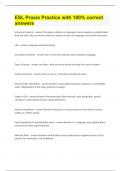
Universal Grammar Chomsky-no dialect or language is more complex or sophisticated than the other. We are all born with the capacity to learn any language w/o formal instruction LAD Language Aquisition Device Generative Grammar set of rules that could be used to produce language Deep Structure our ideas, what we mean-derive meaning from social context Surface Structure what we say or write-literal meaning of words Natural Order Hypothesis Krashen- grammatical structures aquired in a predictable order, independent of the order grammar is taught Stages of SLA Krashen-Pre-production (silent period), early production, speech emergence, intermediate fluency, advanced fluency Monitor Hypothesis Krashen-learning is a concious process and used to monitor spoken or written output Input Hypothesis/Comprehensible Input Krashen-i+1, language input slightly above current level yields optimal growth Affective Filter Krashen-mental block can be produced by negative factors such as anxiety, low motivation, self confidence Zone of Proximal Development (ZPD) Vygotsky-distance between developmental level and level of potential development. Area between independent performance and assisted performance Communicative Competence learner's abiity to apply and use grammatical uses, form correct utterances and know how and when to use them appropriately Language Interference effect of L1 on production of L2 Negative Transfer interference of previous learning inprocess of learning something new Interlanguage language system "inbetween" L1 & L2 that student develops while learning the L2 but is neither L1 or L2 SUP Social underlying proficiency (conversational language) CUP Common underlying proficiency - commonalities between L1 & L2, skills, ideas, concepts that students learn in L1 transfer to L2 BICS Cummins-Basic Interpersonal Communication Skills - social setting language skills CALP Cummins-Cognitive Academic Language Proficiency - languatge needed to acquire academic skills and concepts Cummins Quadrant A-cognitively undemanding/context embedded; B-cognitively demanding/context embedded; C-cognitively undemanding/context reduced; D-cognitively demanding/context reduced Phoneme class of speech sounds, ie. /t/ Allophone one of a phones that make up a phoneme, ie. /t/ -> [t], [th], [ſ] Monothong one part vowel Diphthong two part vowels consisting of a vowel and a glide in same syllable Reduced Vowel occurs in unstressed word or syllable -schwa most common Phonology organization of speech sounds Homophone two words pronounced the same but different meaning, ie. carrot & carat Homonym two words spelled the same but that mean different things, ie. left & left Contrastive change of meaning by replacing one sound (phoneme) with another Non-Contrastive change in sound (phoneme) does not change the meaning Minimal Pair two words w/ different meanings that are pronounced the same except for one sound that differs, ie. team & teen Palatization when a consonant becomes like a neighboring sound, ie. [d]->[dЗ], did you eat Digraph single sound represented by two letters, ie. siNG -> ŋ Consonant Digraph ch, sh, th, wh Consonant Blend two or more consonants together and each sound is heard, ie. "blend" Intonation pattern of pitch movement across a sentence, the meaning of the sentence can depend in part on the intonation, it also helps mark boundaries of a syntactic unit Graphophonics sound relationship between the orthography and phonology of a language Morphology study of word formation Morphemes smallest linguistic unit that can have meaning or grammatical function - 1 word = 1 morph Affix added pieces to a word (prefix, suffix) - change meaning or syntactic function to what attaches to Bound Morpheme has to be attached to something else for it to mean something Free Morpheme can stand alone and mean something Syntax how words combine to form phrases and ultimately sentences Subject position immediately before verb Object position immediately after verb (direct object) Prepositions used to express thing involvedin action, possesor, spatial relations, ie. with, in, or into, for, before, without, over, under Adverbs express manner, attutude, jusdgment of speaker, frequency, time, place, cause, or degree (answer how, when, where, how much), ie. quickLY, fast, often Determiners to express definiteness, indefiniteness, quantity, ie. THE book, A table, EVERY day Prepositional Phrase preposition + noun phrase Clause a group of words containing a subject and a verb Indefinite Pronouns refer to unspecified people of things, many express some idea of quantity, ie. all, seceral, few, none, nobody, somebody
Escuela, estudio y materia
- Institución
- Columbia International University
- Grado
- TESOL PRAXIS
Información del documento
- Subido en
- 16 de septiembre de 2023
- Número de páginas
- 14
- Escrito en
- 2023/2024
- Tipo
- Examen
- Contiene
- Preguntas y respuestas
Temas
-
esl praxis practice with 100 correct answers

Documento también disponible en un lote