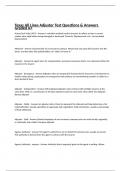
Texas All Lines Adjuster Test Questions & Answers Graded A+
Actual Cash Value (ACV) - Answer A valuation method used by insurers to reflect an item's current market value right before being damaged or destroyed. Formula: (Replacement cost - Accumulated Depreciation) Adhesion - Answer Characteristic of an insurance contract. Means that one party (the insurer) sets the terms, and the other (the policyholder) can "take it or leave it." Adjuster - Answer An agent who, for compensation, processes insurance claims. Can represent either the insured or the insurer. Adjuster - Emergency - Answer Adjusters who are temporarily licensed by the insurance commissioner to handle claims during catastrophes or emergencies that produce an overwhelming number of claims in a short period of time. Adjuster - Independent - Answer Self-employed adjusters who contract with multiple insurers at the same time. Paid on a commission or fee-plus-expenses basis for each claim. Also called: Fee Adjuster, Bureau Adjuster Adjuster - Public - Answer An adjuster who is hired to represent the claimant and help determine a fair indemnification. Usually specializes in appraisals and negotiation. Paid commission, usually a percentage of final settlement. Adjuster - Staff - Answer Salaried employee of one insurance company who can work locally, regionally, or nationally. Also called: Company Adjuster Agency Authority - Answer The Agent's authority to act on behalf of someone else, usually an insurer. This authority is derived from the agent's contract with the insurer. Agency Authority - express - Answer Authority that is expressly given to the agent in writing. Allows agent to act on behalf of the principal. Agency Authority - implied - Answer Authority that an agent possesses by implication of her behavior, regardless of whether this authority is granted in writing. Agency Authority - apparent - Answer Authority that an agent possesses based on the appearance of representing the insurer. Agent - Answer Someone who has received authority from an insurer to sell or service insurance policies. Aggregate Limit - Answer A type of policy limit found in some health, liability, and property damage policies. It represents the total amount the insurer will pay for all losses (as opposed to an occurrence limit, which denotes the total amount the insurer will pay per occurrence). Agreement - Answer One of the four requirements of a legally binding contract. All parties involved must agree to the terms of the contract. Can also refer to a binder, which is the preliminary substance of a contract. Aleatory Contract - Answer Appraisal - Answer A negotiation method which allows the claimant and the insurer each to select an appraiser. The two appraisers in turn select an Umpire. The appraisers then work together to determine a settlement amount. If they cannot agree, the Umpire steps in. Agreement by any two of the three is binding. Arbitration - Answer A negotiation method in which the opposing parties each submit their evidence to a mutually-agreed-upon and neutral third party, called an arbitrator. The arbitrator reviews the positions of each opposing side, and makes a final and legally binding decision. Arbitrator - Answer The mutually-agreed-upon and neutral third party in an arbitration who reviews the positions of each opposing side, and makes a final and legally binding decision. Auto Policy - Answer Insurance policy designed to protect the policyholder while owning, occupying, or operating a vehicle. Usually combines liability coverage and property coverage into one policy. Automobile - Answer In Insurance policies, Automobile generally means any vehicle designed for use on public roads. Automobile No-Fault Laws - Answer Laws in effect in some states that require any owner of a vehicle to purchase no-fault insurance; that is, insurance that indemnifies the insured regardless of who was at fault in an accident. No-fault laws also restrict the insured's right to sue the at-fault party. Aviation - Answer Aviation insurance combines hull insurance for the aircraft and liability insurance for any damage to others' property or to people who are not passengers. Bailee - Answer An individual or company that receives the property of someone else for a special purpose, and returns the product after use. BAP - Answer The Business Auto Policy provides property damage and liability insurance for automobiles used by a business. Binder - Answer A temporary contract provided by an insurer that ensures coverage until the complete, permanent policy is issued. Bodily Injury (BI) - Answer (Bodily Injury): Physical damage to someone's person. Liability insurance covers bodily injury that the insured might cause to another person through negligence. Boiler & Machinery - Answer Boiler and machinery insurance is designed to indemnify a business for damages to, and damages by, boilers, machinery, motors, generators and a variety of other electrical devices and appliances. Bond - Answer A contract wherein one party guarantees the performance of a third party. Bonds involve three parties: (1) the surety agrees to pay the second party, (2) the obligee, if the third party, (3) the principal, neglects to carry out an obligation it has to the obligee. Breach of Product Warranty - Answer The failure or falsehood of a stated promise of a product stipulation. Business Personal Property - Answer Moveable property used for business Catastrophe Loss - Answer An occurrence or a sequence of occurrences that causes enormous property losses. Catastrophes are normally uninsurable by private insurers. Cause of Loss Forms - Answer Commercial General Liability (CGL) - Answer Civil Commotion - Answer Claim - Answer The "offer of settlement" that the policyholder files with an insurer after she experiences a loss. Claims-Made Policy - Answer Coinsurance Clause - Answer Code of Ethics - Answer A set of governing professional standards of conduct, usually created by regulatory bodies or government regulatory agencies. These standards may also be formally codified with statutes. Coercion - Answer The practice of forcing another party to behave in an involuntary manner (whether through action or inaction) by use of threats or intimidation or some other form of pressure or force. Commercial Lines - Answer Having to do with commerce or business activity in general. Commercial Lines - Answer A variety of insurance coverages that protect those involved in the business of creating, selling, displaying, evaluating, or shipping, etc. Example include: Business Owner's Policy; Commercial Property; Commercial General Liability; Workers Compensation; Professional Liability (D&O), Errors and Omissions (E&O) and Employment-Related Practices Liability. Commercial Property Floater - Answer A means of protecting a business' property that is not in one fixed location. Common Crop Insurance Policy - Answer A single uniform policy that combines Crop Revenue Coverage, Revenue Assurance, Income Protection, and Indexed Income Protection. Common Law - Answer Based on court decisions and customs when statutory law does not provide an answer; creates precedent. Compensatory Damages - Answer Compensatory damages - General - Answer Money awarded for the emotional losses of the plaintiff that will continue after the trial date. These are a subjective value and are determined by the court. Concealment - Answer The act of withholding relevant material facts from an insurer. Conditions - Answer Contract - Answer An agreement entered into voluntarily by two parties or more with the intention of creating a legal obligation. Coverage Extensions - Answer Crop Insurance - Answer Insurance coverage designed to protect a farmer's financial investment in his or her crops. Covers losses to a crop's profitability. Crop Revenue Insurance - Answer Crop insurance that combines crop-yield insurance and price insurance to protect against losses to crop value. Crop Yield Insurance - Answer Crop insurance that covers physical losses to actual crops. Damages - general - Answer Intangible losses such as pain and suffering, or mental anguish. Damages - special - Answer Tangible, financial losses that can be documented. Dec Page - Answer Also called the Declarations Page. First page of a policy, which provides a summary of the contract; includes names of insured, addresses, coverage limits, policy period, etc. Declined Coverage - Answer takes place when an insurance company rejects an application for coverage. Deductible - Answer Deductible: the amount the policyholder must pay out-of-pocket before the insurance company will pay the remaining costs. Deductible - fixed - Answer A fixed deductible is one specific, predetermined amount that a policyholder must pay out-of-pocket before he can be indemnified. Deductible - percentage - Answer A deductible that is calculated as a percentage of the value of the insured risk. Defamation - Answer Damage to another's name or reputation, whether by libel, which is in print, or by slander, which is in speech. Depreciation - Answer A decline in value of property caused by wear or loss of usefulness usually measured by a specific formula. Direct Loss - Answer Physical harm to tangible property caused by a peril. Discoverable - Answer Capable of being demanded and handed over as evidence in a court of law; during litigation proceedings, the adjuster's claims file is discoverable. Endorsement(s) - Answer An optional provision that can be added to a policy to increase, reduce, or modify coverage for specific property types or perils. Errors and Omissions - Answer Liability insurance that indemnifies professionals for errors or oversights on the part of the insured that caused harm to their clients. Estoppel - Answer A legal principle that bars a party from asserting something contrary to what has been implied by his previous actions or statements. Ethical - Answer Adhering to moral laws and to principles of fairness. Evaluation - Answer Evaluation, determining the approximate value of damages relevant to a claim i.e. total of medical bills, costs of repair & replacement of damaged property and the consideration of the financial provisions of the insurance policy. Exclusions - Answer A section of an insurance policy that reduces coverage by listing specific individuals, property, or perils that are NOT covered by the policy. Exposure - Answer The extent to which an item is open to damage or loss. More exposure means a loss is more likely. Fair Credit Reporting - Answer Federal legislation that gives an applicant for insurance the right to investigate the reasons his insurance application was denied. False Advertising - Answer Presenting something in a deceptive or untrue manner to the consumer; misrepresentations in advertisements. Farm - Answer A property where a farmer or rancher both resides and conducts commercial business. FEMA - Answer Federal Emergency Management Agency - a branch of homeland security that coordinates relief programs when disaster strikes an entire community. Fiduciary - Answer One of the terms that describes the adjuster's relationship with the principal (the insurer). As Fiduciary Agent, the adjuster acts for the benefit of the principal, rather than for his own benefit.
Escuela, estudio y materia
- Institución
- Texas All Lines Adjuster
- Grado
- Texas All Lines Adjuster
Información del documento
- Subido en
- 15 de septiembre de 2023
- Número de páginas
- 23
- Escrito en
- 2023/2024
- Tipo
- Examen
- Contiene
- Preguntas y respuestas
Temas
-
texas all lines adjuster stuvia
-
texas all lines adjuster test questions answers
-
actual cash value acv a valuation method used by
-
adhesion characteristic of an insurance contract

Documento también disponible en un lote