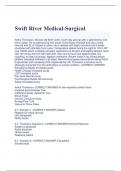
Swift River Medical-Surgicals practice test 2023/2024
Swift River Medical-Surgical Arthur Thomason, 56-year-old MVA victim, fourth day post op with a splenectomy and femur repair. He is experiencing new onset of shortness of breath and has a nasal cannula with 2L of Oxygen in place. He is restless with slight confusion but is easily orientated with attempts from nurse. Temperature spiked during the night to 102.4, BP now 146/94 which is slightly elevated, respirations at 30 bpm and slightly labored, heart rate 102 versus 84 from last night shift. Skin cool to touch and appears pale. His coughing, to clear his airway, appears ineffective. Recent chest X-ray shows diffuse bilateral interstitial infiltrates in all lobes. Recent blood gases demonstrate falling PaO2 (hypoxemia) and increasing CO2 (Hypercapnia). Mr. Thomason is anxious and is obviously worsened from the shift before in overall condition. -CORRECT ANSWER Educational Needs Increased acuity Health Change Increased acuity LOC Increased acuity Pain level Normal acuity Psychological Needs Normal acuity Safety Increased acuity Arthur Thomason -CORRECT ANSWER At risk impaired comfort False Impaired gas exchange True Ineffective airway clearance True Shock False Chronic Confusion False Anxiety/Fear True Failure to Thrive False A.T. Scenario 1 -CORRECT ANSWER Assess Replace O2 nasal cannula Use therapeutic Notify Doctor A.T. Thomason Scenario 2 -CORRECT ANSWER Remind Physician Explain to physician Assist physician Obtain recent Reassure patient A.T. Scenario 3 -CORRECT ANSWER Tap patient Elevate head Call rapid response Start secondary Remain with patient A.T. Scenario 4 -CORRECT ANSWER Provide verbal report Emergency intubation Assume role Obtain patient record Provide information A.T. Scenario 5 -CORRECT ANSWER You Explain that his condition You explain that he is receiving You have them remain with you You escort them with you You call his doctor Charlie Raymond, 65-year-old male who was admitted to a negative pressure room on Med-Surg for COVID precautions.. He has a history of COPD, hypertension, diabetes type II, and a recent myocardial infarction. He is a retired postal worker who lives at home with his wife. He is on Claforan (cefotaxime) 2 g IV q4hr and sliding scale insulin. Initially this cardiologist was concerned about congestive heart failure and Mr. Raymond is receiving Furosemide (Lasix) 20 mg IV twice a day for pulmonary edema. Vital Signs: BP is 145/78, Pulse 89 Respirations 24 and slightly labored, Temperature 100.2 SaO2 94% on 2L nasal cannula. The patient/family is fearing the worst due to COVID-19 Pandemic. -CORRECT ANSWER Educational Needs Increased acuity Fall Risk Increased acuity Health change Increased acuity Neurological Normal acuity Pain level Normal acuity Psychological Needs Normal acuity Charlie Raymond 65-year-old male who was admitted to a negative pressure room on Med-Surg for COVID precautions.. He has a history of COPD, hypertension, diabetes type II, and a recent myocardial infarction. He is a retired postal worker who lives at home with his wife. He is on Claforan (cefotaxime) 2 g IV q4hr and sliding scale insulin. Initially this cardiologist was concerned about congestive heart failure and Mr. Raymond is receiving Furosemide (Lasix) 20 mg IV twice a day for pulmonary edema. Vital Signs: BP is 145/78, Pulse 89 Respirations 24 and slightly labored, Temperature 100.2 SaO2 94% on 2L nasal cannula. The patient/family is fearing the worst due to COVID-19 Pandemic -CORRECT ANSWER Bleeding False Death anxiety True Distrubed body image False Esteem False Impaired acute confusion False Impaired gas exchange True Ineffective breathing True Knowledge Deficit False Pain False Physical mobility False Skin integrity False Charlie Raymond Scenario 1 The next day, he tests positive for COVID 19 and his condition has deteriorated as he is now in respiratory distress. Mr. Raymond weighs 260 lbs. Vital Signs: BP is 92/58, Pulse 102, Respirations 30 and labored, Temperature 101.3, SaO2 91% . He has bilateral lower lobe atelectasis with bronchial/vesicular wheezing. -CORRECT ANSWER Don appropiate Change to simple Perform focused Notify respiratory therapist Notify family Charlie Raymond Scenario 2 Mr. Raymond continues to deteriorate and becomes confused. In his confusion, he becomes combative and pulls out his IV. He is on a 100% nonrebreather and he keeps pulling his mask off. Just received an order to initiate 20 mg of Furosemide (Lasix) IVP, BID. -CORRECT ANSWER Reorient patient Obtain a sitter Restart the IV Begin strict I & O Obtain an order Charlie Raymond Scenario 3 Order for a foley catheter has been obtained and Lucy Jones, LPN, is there to assist. Both nurses have donned appropriate PPE and have entered the room. -CORRECT ANSWER Use therapeutic communication Position the patient Create sterile field Instruct Lucy to assist Insert foley catheter Charlie Raymond Scenario 4 UAP reports urinary output of 50 mL over the past three hours. Repeat focused pulmonary assessment reveals profound bilateral atelectasis in the bases and frothy white sputum. Increased Respiratory rate of 32 and labored, peripheral edema +3 in both ankles and JVD. Based on findings, nursing care actions that are most concerning are: -CORRECT ANSWER Make sure O2 mask Ensure patient is Check foley cathe Notify RRT Provide initial report Charlie Raymond Scenario 5 Mr. Raymond is stabilized with RRT. Give an SBAR to Hospitalist: -CORRECT ANSWER Mr. Raymond, COVID-19 Patient has a history Intubated by RRT Recommend patient be Accompany your patient Donald Lyles Room 301 Donald Lyles, 52-year old male, was admitted yesterday evening for stabilization of his uncontrolled type II diabetes. He is married, and his wife is requesting to stay at his side. His HbgA1c is 10.6%. He has a history of a Myocardial Infarction, MI, one year ago, and has refused all cardiac rehab, and has not had another cardiac event. He refuses to comply with dietary recommendations. His BMI is 37. Vital signs are: BP: 146/94, P: 88, R: 22, T: 99.2, PaO2: 94% Blood glucose upon admission is 340 mg/dl - CORRECT ANSWER Educational Needs Increased acuity Fall Risk Normal acuity Health change Increased acuity Neurological Normal acuity Pain level Normal acuity Psychological Normal acuity Donald Lyles 52-year old male, was admitted yesterday evening for stabilization of his uncontrolled type II diabetes. He is married, and his wife is requesting to stay at his side. His HbgA1c is 10.6%. He has a history of a Myocardial Infarction, MI, one year ago, and has refused all cardiac rehab, and has not had another cardiac event. He refuses to comply with dietary recommendations. His BMI is 37. Vital signs are: BP: 146/94, P: 88, R: 22, T: 99.2, PaO2: 94% Blood glucose upon admission is 340 mg/dl -CORRECT ANSWER Acute Pain False Impaired comfort False Knowledge deficit True Nausea False Fall Risk False Risk for infection True Donald Lyles Scenario 1 Mr. Lyles calls you via the call light. Upon entering the room, he asks if you have medication for "heartburn". He says, "I take TUMS at home when this happens." You tell the patient you will be glad to check-on what is available for relief of his "heartburn" after you complete his physical assessment. You begin his assessment, and he falls back in the bed and becomes unresponsive. You shout, "Are you okay? Are you okay?" - CORRECT ANSWER Establish response Call for CODE Check for breathin
Escuela, estudio y materia
- Institución
- Swift River Medical-Surgical
- Grado
- Swift River Medical-Surgical
Información del documento
- Subido en
- 12 de septiembre de 2023
- Número de páginas
- 8
- Escrito en
- 2023/2024
- Tipo
- Examen
- Contiene
- Preguntas y respuestas
Temas
-
swift river medical surgicals
-
swift river medical surgical
Documento también disponible en un lote