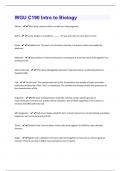
Abiotic - ✔✔ Non -living, may be within or made by a living organism. Biotic - ✔✔ Living. Matter is considered ______ if it was ever alive at some point in time Atom - ✔✔ Smallest level. The basic unit of matter. Consists of a dense nucleus surrounded by electrons. Molecule - ✔✔ Second level. A chemical structure consisting o f at least two atoms held together by a chemical bond. Macromolecule - ✔✔ Third level. Biologically important molecules that are technically polymers. Example: DNA. Cell - ✔✔ Fourth level. The fundamental unit of life. Essentially a tiny droplet of water a nd other molecules enclosed by a fluid "skin" or membrane. The smallest and simplest entity that possesses all the characteristics of life. Organelle - ✔✔ Fifth level. Compartments inside the cell that contain specific groups of macromolecules and carry ou t specific cellular functions. One of these organelles is the nucleus; it encloses the DNA within the cell. Microorganism - ✔✔ Sixth level. Single -celled life form. Consists of just one cell and include unicellular organisms such as bacteria and protists. Tissue - ✔✔ Seventh level. Formed when similar cells work together to fulfill the same detailed function. Organ - ✔✔ Eighth level. Collections of tissues that work together to carry out a common general function. Present not only in higher level animals bu t also in plants. Organ System - ✔✔ Ninth level. Consists of functionally related organs. Mammals have many. Organism - ✔✔ Tenth Level. Individual living entities that survive and reproduce as a unit. For example, each tree in a forest. Population - ✔✔ Eleventh level. Consists of all the individuals of a species living within a specific area. Community - ✔✔ Twelfth level. Populations can interact with each other in positive and negative ways, and together they form this. Ecosystem - ✔✔ Thirteenth level. Consists of all the living things in a particular area together with the abiotic, or nonliving, parts of that environment. Biosphere - ✔✔ Fourteenth level. The highest level of organization in living systems. The collection of all ecosystems on Earth. Includes all habitable zones on the planet, including land, soil, and rocks to a great depth in the Earth's crust; water and ice; and the atmosphere to a great height. Emergent Properties - ✔✔ Characteristics of a system that ar e not present in any of its component parts. Biology - ✔✔ The scientific study of life and is the branch of science that studies living organisms and the way organisms interact with their environments. Homeostasis - ✔✔ The ability or tendency of organisms and cells to maintain stable internal conditions. Nutrient - ✔✔ Any matter an organism needs but cannot make for itself. Energy - ✔✔ The capacity to do work or to make a change in the location, temperature, or structure of matter. Does not have mass and it does not take up space, but it can be measured in terms of what it does. Growth - ✔✔ An increase in size. Development - ✔✔ Structure and function change in an orderly way as an organism passes through its life cycle. An individual's pattern of _______ is partly determined by genetic instructions. Reproduction - ✔✔ Occurs when an individual organism passes on its genetic information to a newly independent organism, or offspring. Evolution - ✔✔ A scientific theory that explains how and why life changes over time. Provides the explanation for why all living organisms share profound similarities, and yet, the life forms on our planet are so incredibly diverse. Natural Selection - ✔✔ Individuals are always a bit different from their parents and from each other, partly because of changes to their genes. These differences may be helpful or harmful to the individuals that inherit them. In nature, individuals often have very low odds of surviving to reproduce. Individuals with slightly harmful or even average charact eristics might be less likely to make it, and those with traits that fit in very well with the local habitat will have the greatest chance to survive and reproduce. This sorting process goes on generation after generation. Atomic Mass - ✔✔ The sum of the n umber of protons and the number of neutrons. The mass of an atom. Atomic Number - ✔✔ The number of protons in an atom, displayed for each atom in the periodic table. Chemical Bonds - ✔✔ Attractions between atoms that hold atoms and molecules together. Covalent Bonds - ✔✔ Strongest chemical bond. Occurs between atoms of in the same molecule. Electron pairs are shared, creating a strong bond between atoms. electron - ✔✔ Subatomic particle, located in shells on the outside of the nucleus, has a negative charge and almost no mass.
Examen
WGU C190 Intro to Biology | 311 Questions and Answers(A+ Solution guide)
Puntuación
Vendido
-
Páginas
27
Grado
A+
Subido en
10-09-2023
Escrito en
2023/2024
Abiotic - Non-living, may be within or made by a living organism. Biotic - Living. Matter is considered ______ if it was ever alive at some point in time Atom - Smallest level. The basic unit of matter. Consists of a dense nucleus surrounded by electrons. Molecule - Second level. A chemical structure consisting of at least two atoms held together by a chemical bond. Macromolecule - Third level. Biologically important molecules that are technically polymers. Example: DNA. Cell - Fourth level. The fundamental unit of life. Essentially a tiny droplet of water and other molecules enclosed by a fluid "skin" or membrane. The smallest and simplest entity that possesses all the characteristics of life. Organelle - Fifth level. Compartments inside the cell that contain specific groups of macromolecules and carry out specific cellular functions. One of these organelles is the nucleus; it encloses the DNA within the cell. Microorganism - Sixth level. Single-celled life form. Consists of just one cell and include unicellular organisms such as bacteria and protists. Tissue - Seventh level. Formed when similar cells work together to fulfill the same detailed function. Organ - Eighth level. Collections of tissues that work together to carry out a common general function. Present not only in higher level animals but also in plants.Organ System - Ninth level. Consists of functionally related organs. Mammals have many.
Mostrar más
Leer menos
Institución
WGU C190 Intro To Biology
Grado
WGU C190 Intro to Biology
Vista previa del contenido
Escuela, estudio y materia
- Institución
- WGU C190 Intro to Biology
- Grado
- WGU C190 Intro to Biology
Información del documento
- Subido en
- 10 de septiembre de 2023
- Número de páginas
- 27
- Escrito en
- 2023/2024
- Tipo
- Examen
- Contiene
- Preguntas y respuestas
Temas
-
wgu c190 intro to biology
$8.89
Accede al documento completo:
100% de satisfacción garantizada
Inmediatamente disponible después del pago
Tanto en línea como en PDF
No estas atado a nada

Documento también disponible en un lote
Package deal
WGU Academy Biology Bundled exam with complete solution
9
2023
$ 50.41
Más información