Neuronal Communication Revision Notes
Neurones
Structure of Neurones
-very long to transmit action potential over a long distance
-membrane has many gated protein channels (Sodium and Potassium)
-sodium/potassium pump to maintain ion concentrations (requires ATP)
-cell body contains nucleus, mitochondria and ribosomes
-dendrites connect to together neurones
-dendron carries impulse towards the cell body
-axon carries impulse away from the cell body
-myelin sheath insulates the neurone from other electrical impulses
Motor Neurones
-carries action potential from Central Nervous System (CNS) to effector
Sensory Neurone
-carries action potential from Central Nervous System (CNS) to effector
Relay Neurone
-connects sensory and motor neurones
Function of Neurones
-once stimulus has been detected and its energy has been used to depolarise the membrane, impulse needs to transmit to parts of the body
-impulse transmitted as action potential which is rapid depolarisation of the membrane due to an influx of Na+ ions
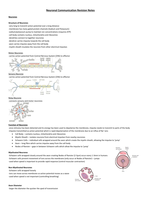
Cell Body – contains nucleus, mitochondria and ribosomes
Myelin Sheath – isolates neurone from electrical impulses from nearby neurones
Schwann Cells – individual cells wrapped around the axon which create the myelin sheath, allowing the impulse to ‘jump’
Axon – long fibre which carries impulse away from the cell body
Nodes of Ranvier – gaps in between Schwann cells which allow the impulse to ‘jump’
Myelinated Neurones
-Schwann cells wrapped closely around the axon creating Nodes of Ranvier (2-3μm) occur every 1-3mm in humans
-Schwann cells prevent movement of ions across the membrane (only occur at Nodes of Ranvier) – jumps
-used when speed is important to provide rapid response (control muscular contraction)
Non-Myelinated Neurones
-Schwann cells wrapped loosely
-ions can move across membrane so action potential moves as a wave
-used when speed is not important (controlling breathing)
Axon Diameter
-larger the diameter the quicker the sped of transmission
Neurones
Structure of Neurones
-very long to transmit action potential over a long distance
-membrane has many gated protein channels (Sodium and Potassium)
-sodium/potassium pump to maintain ion concentrations (requires ATP)
-cell body contains nucleus, mitochondria and ribosomes
-dendrites connect to together neurones
-dendron carries impulse towards the cell body
-axon carries impulse away from the cell body
-myelin sheath insulates the neurone from other electrical impulses
Motor Neurones
-carries action potential from Central Nervous System (CNS) to effector
Sensory Neurone
-carries action potential from Central Nervous System (CNS) to effector
Relay Neurone
-connects sensory and motor neurones
Function of Neurones
-once stimulus has been detected and its energy has been used to depolarise the membrane, impulse needs to transmit to parts of the body
-impulse transmitted as action potential which is rapid depolarisation of the membrane due to an influx of Na+ ions
Cell Body – contains nucleus, mitochondria and ribosomes
Myelin Sheath – isolates neurone from electrical impulses from nearby neurones
Schwann Cells – individual cells wrapped around the axon which create the myelin sheath, allowing the impulse to ‘jump’
Axon – long fibre which carries impulse away from the cell body
Nodes of Ranvier – gaps in between Schwann cells which allow the impulse to ‘jump’
Myelinated Neurones
-Schwann cells wrapped closely around the axon creating Nodes of Ranvier (2-3μm) occur every 1-3mm in humans
-Schwann cells prevent movement of ions across the membrane (only occur at Nodes of Ranvier) – jumps
-used when speed is important to provide rapid response (control muscular contraction)
Non-Myelinated Neurones
-Schwann cells wrapped loosely
-ions can move across membrane so action potential moves as a wave
-used when speed is not important (controlling breathing)
Axon Diameter
-larger the diameter the quicker the sped of transmission