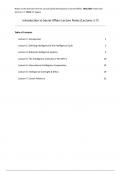
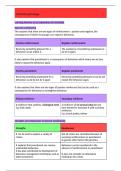
Notes on the lectures from the course (2023) Introduction to Secret Affairs. INCLUDES notes from
lectures 1-7 (Total: 27 pages).
Introduction to Secret Affairs Lecture Notes (Lectures 1-7)
Table of Contents
Lecture 1: Introduction 1
Lecture 2: Defining Intelligence & the Intelligence Cycle 3
Lecture 3: National Intelligence Systems 6
Lecture 4: The Intelligence Collection (“the INTs”) 10
Lecture 5: International Intelligence Cooperation 14
Lecture 6: Intelligence Oversight & Ethics 19
Lecture 7: Covert Influence 22
, 1
Lecture 1: Introduction
Why study intelligence?
Intelligence institutions/studying intelligence can:
● Provide a better understanding/develop theories about international & domestic politics &
history (e.g., ULTRA secret in WWII).
● Underpin security decision-making (e.g., counter-terrorism).
● Be at the forefront of international competition.
● Be instruments of state control in society.
● Provide a more professional understanding than journalism & popular culture (i.e., address
misconceptions, conspiracy theories).
➔ What intelligence can & CANNOT do.
➔ Success & failures.
● Hold intrusive institutions responsible (especially in liberal democracies) = restrain, learn
lessons.
What is intelligence?
Intelligence (Warner): Secret, state activity to Contested definition:
understand or influence foreign entities. ● Can be domestic, planned/open, non-state
➔ Boundaries started to blur post-9/11 (e.g., private institutions, political actors).
● Need to think about it more than just
era.
influencing BUT also shaping.
● Strong informational dimension.
● More than entities → individuals
Breaking down intelligence as:
● An informational product.
● Secrecy = secret institutions collecting other’s secrets using secret methods to generate
secret products.
● A process = information becomes intelligence.
➔ Inform consumers to provide decision-advantage, foresight, avoid surprises.
➔ Understanding intentions & capabilities.
➔ Protect citizens, state, party, regime or leader.
➔ Tactical vs. strategic.
● Organisations/bureaucracies (decision-making).
● Surveillance.
➔ Secret intelligence = source of state power (Herman) = decision-advantage, project
influence abroad, increase relative state power domestically.
➔ Supporting politics/security (e.g., business/commercial intelligence).
Products, Processes & Organisations
The intelligence cycle (facilitates well-informed business & security decisions about risks):
1. Planning & direction (e.g., government present intelligence services with certain priorities).
2. Collection.
3. Data processing.
4. Analysis & production.
, 2
5. Dissemination & feedback.
Intelligence types:
● HUMINT = human intelligence.
● SIGINT = signals intelligence
● IMINT/GEOINT = image intelligence/geospatial intelligence.
● OSINT = open-source intelligence.
● MASINT/ELINT = measurements & signatures/electronic intelligence.
Studying Intelligence
Intelligence Studies:
● British School = diplomatic history, need for intelligence to fill “The Missing Dimension”.
● American School = tends towards the social sciences (models & methodologies).
● Anglo-American dominance = changing in the last 15 years.
Paradox of studying secrecy (why do states wish to keep intelligence secret?):
● Avoid causing tensions in society & domestic politics.
● Avoid international embarrassment/diplomatic escalation.
● Protect sources & methods (i.e., reputation; loss of access; adaptation costs).
● Protect secrets/identities (including foreknowledge) from adversaries.
● Enable negotiations (moderate, pragmatic, adopt unpopular positions).
● Bureaucratic resources for vetting & release (lean towards caution).
Cultures of Secrecy (how can we know?)
What sources can we use to research intelligence? What challenges do they pose?
● Archival material (national/state archives).
● Government reports.
Significant variation in source access between countries (i.e., nature of polities & declassification;
domestic & international politics).
Why do governments disclose intelligence & security materials?
● Transparency norms & laws over time.
● National reconciliation post-political change (e.g., Poland, Romania, Algeria).
● To influence particular audiences (e.g., support; action; incriminate; resilience).
Significant variation in source access between countries (e.g., traditions of memoir writing, granting
interviews, civil society, media freedoms, resources for investigative journalism):
● May be significant variation within systems too (e.g., UK’s MI5 vs. SIS).
● Few systems have organised official histories.
● Further empowered by the internet (e.g., whistleblowing laws/norms, leaks, defectors).
● Wide variation in independent oversight accountability, transparency laws (e.g. Freedom of
Information) & bodies to produce public scrutiny/reports.
● Imperfect & biased knowledge/understanding (ethical dilemmas of source access).
lectures 1-7 (Total: 27 pages).
Introduction to Secret Affairs Lecture Notes (Lectures 1-7)
Table of Contents
Lecture 1: Introduction 1
Lecture 2: Defining Intelligence & the Intelligence Cycle 3
Lecture 3: National Intelligence Systems 6
Lecture 4: The Intelligence Collection (“the INTs”) 10
Lecture 5: International Intelligence Cooperation 14
Lecture 6: Intelligence Oversight & Ethics 19
Lecture 7: Covert Influence 22
, 1
Lecture 1: Introduction
Why study intelligence?
Intelligence institutions/studying intelligence can:
● Provide a better understanding/develop theories about international & domestic politics &
history (e.g., ULTRA secret in WWII).
● Underpin security decision-making (e.g., counter-terrorism).
● Be at the forefront of international competition.
● Be instruments of state control in society.
● Provide a more professional understanding than journalism & popular culture (i.e., address
misconceptions, conspiracy theories).
➔ What intelligence can & CANNOT do.
➔ Success & failures.
● Hold intrusive institutions responsible (especially in liberal democracies) = restrain, learn
lessons.
What is intelligence?
Intelligence (Warner): Secret, state activity to Contested definition:
understand or influence foreign entities. ● Can be domestic, planned/open, non-state
➔ Boundaries started to blur post-9/11 (e.g., private institutions, political actors).
● Need to think about it more than just
era.
influencing BUT also shaping.
● Strong informational dimension.
● More than entities → individuals
Breaking down intelligence as:
● An informational product.
● Secrecy = secret institutions collecting other’s secrets using secret methods to generate
secret products.
● A process = information becomes intelligence.
➔ Inform consumers to provide decision-advantage, foresight, avoid surprises.
➔ Understanding intentions & capabilities.
➔ Protect citizens, state, party, regime or leader.
➔ Tactical vs. strategic.
● Organisations/bureaucracies (decision-making).
● Surveillance.
➔ Secret intelligence = source of state power (Herman) = decision-advantage, project
influence abroad, increase relative state power domestically.
➔ Supporting politics/security (e.g., business/commercial intelligence).
Products, Processes & Organisations
The intelligence cycle (facilitates well-informed business & security decisions about risks):
1. Planning & direction (e.g., government present intelligence services with certain priorities).
2. Collection.
3. Data processing.
4. Analysis & production.
, 2
5. Dissemination & feedback.
Intelligence types:
● HUMINT = human intelligence.
● SIGINT = signals intelligence
● IMINT/GEOINT = image intelligence/geospatial intelligence.
● OSINT = open-source intelligence.
● MASINT/ELINT = measurements & signatures/electronic intelligence.
Studying Intelligence
Intelligence Studies:
● British School = diplomatic history, need for intelligence to fill “The Missing Dimension”.
● American School = tends towards the social sciences (models & methodologies).
● Anglo-American dominance = changing in the last 15 years.
Paradox of studying secrecy (why do states wish to keep intelligence secret?):
● Avoid causing tensions in society & domestic politics.
● Avoid international embarrassment/diplomatic escalation.
● Protect sources & methods (i.e., reputation; loss of access; adaptation costs).
● Protect secrets/identities (including foreknowledge) from adversaries.
● Enable negotiations (moderate, pragmatic, adopt unpopular positions).
● Bureaucratic resources for vetting & release (lean towards caution).
Cultures of Secrecy (how can we know?)
What sources can we use to research intelligence? What challenges do they pose?
● Archival material (national/state archives).
● Government reports.
Significant variation in source access between countries (i.e., nature of polities & declassification;
domestic & international politics).
Why do governments disclose intelligence & security materials?
● Transparency norms & laws over time.
● National reconciliation post-political change (e.g., Poland, Romania, Algeria).
● To influence particular audiences (e.g., support; action; incriminate; resilience).
Significant variation in source access between countries (e.g., traditions of memoir writing, granting
interviews, civil society, media freedoms, resources for investigative journalism):
● May be significant variation within systems too (e.g., UK’s MI5 vs. SIS).
● Few systems have organised official histories.
● Further empowered by the internet (e.g., whistleblowing laws/norms, leaks, defectors).
● Wide variation in independent oversight accountability, transparency laws (e.g. Freedom of
Information) & bodies to produce public scrutiny/reports.
● Imperfect & biased knowledge/understanding (ethical dilemmas of source access).