Ways of the World Chapter 15: Cultural Transformations
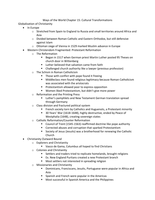
Globalization of Christianity
In Europe
o Stretched from Spain to England to Russia and small territories around Africa and
Asia
o Divided between Roman Catholic and Eastern Orthodox, but still defensive
against Islam
o Ottoman siege of Vienna in 1529 marked Muslim advance in Europe
Western Christendom Fragmented: Protestant Reformation
o The Reformation
Began in 1517 when German priest Martin Luther posted 95 Theses on
church door in Wittenberg
Luther believed that salvation came from faith
Challenged church authority like a lawyer (previous profession)
o The Schism in Roman Catholicism
Those with conflict with pope found it freeing
Middleclass men found religious legitimacy because Roman Catholicism
was associated with the aristocrats
Protestantism allowed poor to express opposition
Women liked Protestantism, but didn’t give more power
o Reformation and the Printing Press
Luther’s pamphlets and New Testament German translation spread
through Germany
o Class division and fractured political system
French society torn by Catholics and Huguenots, a Protestant minority
30 Years’ War (1618-1648), highly destructive, ended by Peace of
Westphalia (1648), creating sovereign states
o Catholic Reformation/Counter Reformation
Council of Trent (1545-1563) reaffirmed doctrine like pope authority
Corrected abuses and corruption that sparked Protestantism
Society of Jesus (Jesuits) was a brotherhood for renewing the Catholic
Church
Christianity Outward Bound
o Explorers and Christianity
Vasco de Gama, Columbus all hoped to find Christians
o Colonies and Christianity
Settlers and traders tried to replicate homelands, brought religions
Ex. New England Puritans created a new Protestant branch
Most settlers not interested in spreading religion
o Missionaries and Christianity
Dominicans, Franciscans, Jesuits, Portuguese were popular in Africa and
Asia
Spanish and French were popular in the Americas
Most successful in Spanish America and the Philippines
Globalization of Christianity
In Europe
o Stretched from Spain to England to Russia and small territories around Africa and
Asia
o Divided between Roman Catholic and Eastern Orthodox, but still defensive
against Islam
o Ottoman siege of Vienna in 1529 marked Muslim advance in Europe
Western Christendom Fragmented: Protestant Reformation
o The Reformation
Began in 1517 when German priest Martin Luther posted 95 Theses on
church door in Wittenberg
Luther believed that salvation came from faith
Challenged church authority like a lawyer (previous profession)
o The Schism in Roman Catholicism
Those with conflict with pope found it freeing
Middleclass men found religious legitimacy because Roman Catholicism
was associated with the aristocrats
Protestantism allowed poor to express opposition
Women liked Protestantism, but didn’t give more power
o Reformation and the Printing Press
Luther’s pamphlets and New Testament German translation spread
through Germany
o Class division and fractured political system
French society torn by Catholics and Huguenots, a Protestant minority
30 Years’ War (1618-1648), highly destructive, ended by Peace of
Westphalia (1648), creating sovereign states
o Catholic Reformation/Counter Reformation
Council of Trent (1545-1563) reaffirmed doctrine like pope authority
Corrected abuses and corruption that sparked Protestantism
Society of Jesus (Jesuits) was a brotherhood for renewing the Catholic
Church
Christianity Outward Bound
o Explorers and Christianity
Vasco de Gama, Columbus all hoped to find Christians
o Colonies and Christianity
Settlers and traders tried to replicate homelands, brought religions
Ex. New England Puritans created a new Protestant branch
Most settlers not interested in spreading religion
o Missionaries and Christianity
Dominicans, Franciscans, Jesuits, Portuguese were popular in Africa and
Asia
Spanish and French were popular in the Americas
Most successful in Spanish America and the Philippines