Test 2
Question 1
Flag this item
Question 1-3
Plants and animals can react to stimuli in different ways. Animals can move towards or away
from a stimulus. Such movement is called a taxis. For instance, a moth flying towards a
particular scent is exhibiting positive chemotaxis. In a similar manner, plants often exhibit a
growth response towards or away from a stimulus. Such a response is called a tropism.
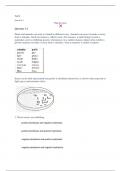
Insects in the dish represented here prefer to distribute themselves as shown when exposed to
light (grey) and moisture (dots).
1. These insects are exhibiting
positive phototaxis and negative hydrotaxis.
positive phototaxis and positive hydrotaxis.
negative phototaxis and positive hydrotaxis.
negative phototaxis and negative hydrotaxis.
,Correct Answer: D
Explanation:
The grey shading represents the area exposed to light and is not shadow. Using the prefixes
provided, phototaxis is movement relative to light; hydrotaxis is movement relative to water.
Option A → If this were true, the insects would be in the lower left region of the dish
(towards light, away from water).
Option B → If this were true, the insects would be in the upper left region of the dish
(towards both light and water).
Option C → If this were true, the insects would be in the upper right region of the dish (away
from light, towards water).
Option D → The insects are in the lower right region, having apparently moved away from
both light and water.
Question 2
Flag this item
Question 1-3
Plants and animals can react to stimuli in different ways. Animals can move towards or away
from a stimulus. Such movement is called a taxis. For instance, a moth flying towards a
particular scent is exhibiting positive chemotaxis. In a similar manner, plants often exhibit a
growth response towards or away from a stimulus. Such a response is called a tropism.
Insects in the dish represented here prefer to distribute themselves as shown when exposed to
light (grey) and moisture (dots).
2. A plant would be exhibiting positive thigmotropism if
, its stem grew away from the stems of other plants.
it had flowers that closed on hot, dry days.
it had tendrils that grew around a support.
its roots grew sideways towards a water source.
Correct Answer: C
Explanation:
Using the prefixes provided, positive thigmotropism is growth towards something that the
plant is touching.
Option A → This would be an example of negative thigmotropism, as the plant would be
growing away from contact (touch) with other plants.
Option B → This would be an example of negative thermotropism, as the plant would be
reducing exposure of the flower to heat and dryness.
Option C → This pattern of growth would maintain the plant’s contact (touch) with the
support.
Option D → This would be an example of positive hydrotropism, as the plant would be
growing towards water.
Question 3
Flag this item
Question 1-3
Plants and animals can react to stimuli in different ways. Animals can move towards or away
from a stimulus. Such movement is called a taxis. For instance, a moth flying towards a
particular scent is exhibiting positive chemotaxis. In a similar manner, plants often exhibit a
growth response towards or away from a stimulus. Such a response is called a tropism.
Insects in the dish represented here prefer to distribute themselves as shown when exposed to
light (grey) and moisture (dots).
, 3. In this experiment, snails in a tube are exposed to light from a lamp and heat from a hair-
drier.
If the snails settled as shown, it would suggest that snails are
more negatively thermotaxic than negatively phototaxic.
more positively thermotaxic than positively phototaxic.
equally positively thermotaxic and positively phototaxic.
negatively thermotaxic but positively phototaxic.
Correct Answer: A
Explanation:
Option A → Those snails between the heat and the light are closer to the light than to the
heat. This could be a result of the snails being attracted to both heat and light, or repelled by
both. However, the snails at the left end of the tube are not attracted to the light (if they were,
they would be under it). Thus, the snails are apparently negatively thermotaxic and negatively
phototaxic, but more adverse to heat than to light.
Option B → If this were true, the snails would be located closer to the heat than to the light.
There would not be any snails at the left end of the tube, which is as far as possible from the
heat.
Option C → If this were true, the snails would be distributed either in two groups, one under
the light and one above the heat, or be in a single group midway between the heat and light.
Option D → If this were true, the snails would be in a single group under the light.
Question 4
Flag this item
Question 1
Flag this item
Question 1-3
Plants and animals can react to stimuli in different ways. Animals can move towards or away
from a stimulus. Such movement is called a taxis. For instance, a moth flying towards a
particular scent is exhibiting positive chemotaxis. In a similar manner, plants often exhibit a
growth response towards or away from a stimulus. Such a response is called a tropism.
Insects in the dish represented here prefer to distribute themselves as shown when exposed to
light (grey) and moisture (dots).
1. These insects are exhibiting
positive phototaxis and negative hydrotaxis.
positive phototaxis and positive hydrotaxis.
negative phototaxis and positive hydrotaxis.
negative phototaxis and negative hydrotaxis.
,Correct Answer: D
Explanation:
The grey shading represents the area exposed to light and is not shadow. Using the prefixes
provided, phototaxis is movement relative to light; hydrotaxis is movement relative to water.
Option A → If this were true, the insects would be in the lower left region of the dish
(towards light, away from water).
Option B → If this were true, the insects would be in the upper left region of the dish
(towards both light and water).
Option C → If this were true, the insects would be in the upper right region of the dish (away
from light, towards water).
Option D → The insects are in the lower right region, having apparently moved away from
both light and water.
Question 2
Flag this item
Question 1-3
Plants and animals can react to stimuli in different ways. Animals can move towards or away
from a stimulus. Such movement is called a taxis. For instance, a moth flying towards a
particular scent is exhibiting positive chemotaxis. In a similar manner, plants often exhibit a
growth response towards or away from a stimulus. Such a response is called a tropism.
Insects in the dish represented here prefer to distribute themselves as shown when exposed to
light (grey) and moisture (dots).
2. A plant would be exhibiting positive thigmotropism if
, its stem grew away from the stems of other plants.
it had flowers that closed on hot, dry days.
it had tendrils that grew around a support.
its roots grew sideways towards a water source.
Correct Answer: C
Explanation:
Using the prefixes provided, positive thigmotropism is growth towards something that the
plant is touching.
Option A → This would be an example of negative thigmotropism, as the plant would be
growing away from contact (touch) with other plants.
Option B → This would be an example of negative thermotropism, as the plant would be
reducing exposure of the flower to heat and dryness.
Option C → This pattern of growth would maintain the plant’s contact (touch) with the
support.
Option D → This would be an example of positive hydrotropism, as the plant would be
growing towards water.
Question 3
Flag this item
Question 1-3
Plants and animals can react to stimuli in different ways. Animals can move towards or away
from a stimulus. Such movement is called a taxis. For instance, a moth flying towards a
particular scent is exhibiting positive chemotaxis. In a similar manner, plants often exhibit a
growth response towards or away from a stimulus. Such a response is called a tropism.
Insects in the dish represented here prefer to distribute themselves as shown when exposed to
light (grey) and moisture (dots).
, 3. In this experiment, snails in a tube are exposed to light from a lamp and heat from a hair-
drier.
If the snails settled as shown, it would suggest that snails are
more negatively thermotaxic than negatively phototaxic.
more positively thermotaxic than positively phototaxic.
equally positively thermotaxic and positively phototaxic.
negatively thermotaxic but positively phototaxic.
Correct Answer: A
Explanation:
Option A → Those snails between the heat and the light are closer to the light than to the
heat. This could be a result of the snails being attracted to both heat and light, or repelled by
both. However, the snails at the left end of the tube are not attracted to the light (if they were,
they would be under it). Thus, the snails are apparently negatively thermotaxic and negatively
phototaxic, but more adverse to heat than to light.
Option B → If this were true, the snails would be located closer to the heat than to the light.
There would not be any snails at the left end of the tube, which is as far as possible from the
heat.
Option C → If this were true, the snails would be distributed either in two groups, one under
the light and one above the heat, or be in a single group midway between the heat and light.
Option D → If this were true, the snails would be in a single group under the light.
Question 4
Flag this item