

Pathophysiology Chapter 2- Test Bank Field-Expert certified responses
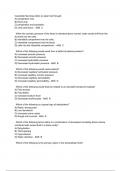
Pathophysiology Chapter 2- Test Bank Insensible fluid loss refers to water lost through: A) perspiration only. B) feces only. C) perspiration and expiration. D) urine and feces. - ANS C When the osmotic pressure of the blood is elevated above normal, water would shift from the: A) blood into the cells. B) interstitial compartment into the cells. C) interstitial compartment into the blood. D) cells into the interstitial compartment. - ANS C Which of the following would result from a deficit of plasma proteins? A) Increased osmotic pressure B) Decreased osmotic pressure C) Increased hydrostatic pressure D) Decreased hydrostatic pressure - ANS B Which of the following would cause edema? A) Decreased capillary hydrostatic pressure B) Increased capillary osmotic pressure C) Decreased capillary permeability D) Increased capillary permeability - ANS D Which of the following would likely be related to an elevated hematocrit reading? A) Fluid excess B) Fluid deficit C) Increased sodium level D) Decreased erythrocytes - ANS B Which of the following is a typical sign of dehydration? A) Rapid, strong pulse B) Low hematocrit C) Increased urine output D) Rough oral mucosa - ANS D Which of the following terms refers to a combination of decreased circulating blood volume combined with excess fluid in a body cavity? A) Dehydration B) Third-spacing C) Hypovolemia D) Water retention - ANS B
Información del documento
- Subido en
- 4 de septiembre de 2023
- Número de páginas
- 7
- Escrito en
- 2023/2024
- Tipo
- Examen
- Contiene
- Preguntas y respuestas

