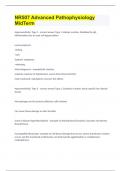
NR507 Advanced Pathophysiology MidTerm exam with 100% correct answers
Hypersensitivity: Type 1 Type 1: Allergic reaction, Mediated by IgE, Inflammation due to mast cell degranulation Local symptoms: -itching -rash Systemic symptoms: -wheezing Most dangerous = anaphylactic reaction systemic response of hypotension, severe bronchoconstriction Main treatment: epinephrine reverses the effects Hypersensitivity: Type 2 Type 2: Cytotoxic reaction; tissue specific (ex: thyroid tissue) Macrophages are the primary effectors cells involved Can cause tissue damage or alter function Grave's disease (hyperthyroidism) - example of altering thyroid function, but does not destroy thyroid tissue Incompatible blood type- example of cell/tissue damage that occurs; severe transfusion reaction occurs and the transfused erythrocytes are destroyed by agglutination or complement-mediated lysis. Type 1 Hypersensitivity VS. Type 2 Hypersensitivity Type 1 Hypersensitivity Organ Specific Antibody binds to the antigen on the cell surface Type 2 Hypersensitivity Not Organ Specific Antibody binds to the soluble antigen outside the cell surface that was released into the blood or body fluids, and the complex is then deposited in the tissues Hypersensitivity: Type 3 - Examples Rheumatoid arthritis: Antigen/antibodies are deposited in the joints Systemic Lupus Erythematosus (SLE)- very closely related to autoimmunity- antigen/antibodies deposit in organs that cause tissue damage Hypersensitivity: Type 4 Delayed response Does not involve antigen/antibody complexes like Types 1, 2 and 3 Is T-cell mediated Differentiating Between the Rash of a Type 1 vs. Type 4 Reaction: Type 1: Immediate hypersensitivity reactions, termed atopic dermatitis, are usually characterized by widely distributed lesions Type 4: Contact dermatitis (delayed hypersensitivity) consists of lesions only at the site of contact with the allergen The key determinant is the timing of the rash: -Type 1 = Immediate -Type 4 = Delayed: Several days following contact, ex would be poison ivy Treatment of Type 4 Rash A non-severe case of contact dermatitis would be treated with topical corticosteroid. Why not epinephrine or antihistamines? -Epinephrine is for emergent Type 1 anaphylactic reactions. Antihistamines act on the H1 receptors. Type 4 does not involve mast cells and H1 receptors. Antibiotics not appropriate since not an infection Autoimmunity Autoimmune disease can be familial, Affected family members may not all develop the same disease, but several members may have different disorders characterized by a variety of hypersensitivity reactions, These include autoimmune and allergic reactions Associations with particular autoimmune diseases have been identified for a variety of major histocompatibility complex (MHC) alleles or non-MHC genes Alloimmunity General term used to describe when an individual's immune system reacts against antigens on the tissues of other members of the same species. Examples: Neonatal disease where the maternal immune system becomes sensitized against antigens expressed by the fetus, Transplant rejection, Transfusion reaction Primary Immunodeficiency Most primary immune deficiencies are result of single gene defects Something is lacking with the immune system itself. Example: B-lymphocyte deficiency - one of the most severe forms of a primary immunodeficiency Secondary Immunodeficiency Complication of some other physiological condition/disease, Malnutrition one of most common causes worldwide. Example: Pt. with HIV gets pneumocystis carinii Hematology Anemias, Involve RBCs, Most of body's iron stores come from the recycling of iron from old RBCs Iron Deficiency Anemia Microcytic/Hypochromic Anemia, Caused by disorders of hemoglobin synthesis, particularly iron deficiency, Ferritin is an important measurement that reflects the body's total iron stores, The NP will order a ferritin level to get an idea of the body's total iron stores, Low ferritin reflects anemia Major Lab Marker for Anemia Increased RBC distribution width (RDW) is one of the earliest lab markers in developing microcytic or macrocytic anemia Folate Deficiency Can cause megaloblastic anemia, Alcoholics can easily get folate deficiency Ferritin level normal Hgb low Hct low Vitamin B-12 Deficiency Fatigue, Dyspnea, Peripheral Neuropathy in BLE (numbness and tingling) Risk Factors: Older adults, H-pylori infection Affects Vitamin B-12 absorption Hemolytic Anemia Who is at risk? RBCs destroyed, Mismatched blood types destroy RBCs. Autoimmune hemolytic anemia due to autoantibodies against erythrocytes that the immune system perceives as an antigen and then attacks it. Allergic reaction to a drug causes drug-induced hemolytic anemia Acute Blood Loss Anemia Trauma victims who are losing blood, GI bleed (Acute) Aplastic Anemia Diagnosis made by blood tests and bone marrow biopsy. AA is suspected if levels of circulating erythrocytes, leukocytes and platelets diminished: -Granulocyte count less than 500/ uL -Platelet count less than 20,000/ uL -Absolute reticulocyte count less than or equal to 40 x 109/ L Sickle Cell Anemia Patients encountered who have sickle cell trait, Inherited a normal Hb gene from one parent and an abnormal Hb gene from the other parent Thalassemia Inherited blood disorder causing decreased circulating hemoglobin, Many possible genetic mutations Heart Failure Pathophysiology (Wk 2 Discussion) Underlying patho is that there is less cardiac output to meet the body's oxygen demands. Over time there is decreased contractility, decreased stroke volume, increased left ventricular end-diastolic volume (LVEDV) When contractility is decreased, stroke volume falls, and LVEDV increases. This causes dilation of the heart and an increase in preload. Major risk factor is long standing hypertension. Preload = stretch Afterload = resistance
Escuela, estudio y materia
- Institución
- NR 507 ADVANCED PATHOPHYSIOLOGY
- Grado
- NR 507 ADVANCED PATHOPHYSIOLOGY
Información del documento
- Subido en
- 4 de septiembre de 2023
- Número de páginas
- 15
- Escrito en
- 2023/2024
- Tipo
- Examen
- Contiene
- Preguntas y respuestas
Temas
-
nr507 advanced pathophysiology midterm

Documento también disponible en un lote