aPHR Exam Questions With Verified Answers
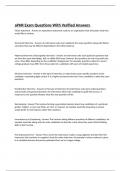
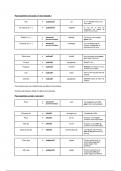
Vision Statement - Answer an aspirational statement made by an organization that articulates what they would like to achieve. Structured Interview - Answer An interviewer asks every applicant the same questions along with follow-up probes that may be different depending on the initial response. Patterned Interview (aka targeted interview) - Answer an interviewer asks each applicant questions that are from the same knowledge, skill, or ability (KSA) area; however, the questions are not necessarily the same. They differ depending on the candidate's background. For example, questions asked of a recent college graduate may differ from those asked of a candidate with years of related experience. Directive Interview - Answer In this type of interview, an interviewer poses specific questions to the candidate, maintaining tight control; it is a highly structured interview. Every candidate is asked the same questions. Nondirective Interview - Answer In this type of interview, the interviewer asks open-ended questions and provides only general direction; the interviewer allows the candidate to guide the process. A response to one question dictates what the next question will be. Stereotyping - Answer This involves forming a generalized opinion about how candidates of a particular gender, religion, or race may think, act, feel, or respond. An example would be presuming a woman would prefer to work indoors rather than outdoors. Inconsistency In Questioning - Answer This involves asking different questions of different candidates. An example would be asking only the male candidates to describe a time when they used critical-thinking skills in their last job. First Impression Error - Answer This is when the interviewer makes a snap judgment and lets their first impression (be it positive or negative) cloud the entire interview. An example is where credence is given to a candidate because the person graduated from an Ivy League college. Negative Emphasis - Answer This involves rejecting a candidate on the basis of a small amount of negative information. An example is when a male candidate is wearing a large earring plug and in the interviewer's judgment this is inappropriate, yet the job that the candidate is interviewing for is a phone customer service position—there is no customer visual contact. Halo/ Horn Effect - Answer This is when the interviewer allows one strong point that he or she values to overshadow all other information. Halo is in the candidate's favor, and horn is in the opposite direction. Cultural Noise Bias - Answer This is when a candidate is masking their response, providing what is considered as "politically correct," and not revealing anything or being factual. Direct Compensation - Answer Base pay (wages and salary) Commissions Bonuses Merit pay Piece rate Differential pay Cash awards Profit sharing Gainsharing Indirect Compensation - Answer Social Security Unemployment insurance Disability insurance Pensions 401(k) and other similar programs Healthcare Vacations Sick leave Paid time off Wage Surveys - Answer To determine the prevailing rate for a job, a company can "benchmark" jobs against compensation surveys that are detailed and specific to the company's industries and regions. Job Evaluation - Answer the systematic process for assessing the relative worth of jobs within an organization. A comprehensive analysis of each position's tasks, responsibilities, knowledge, and skill requirements is used to assess the value of the job's content to the employer and provide an internal ranking of the jobs. Job ranking, point factor, job classification, and factor comparison are four of the most common methods used. Job Ranking - Answer The _______ method is often called a whole-job comparison because it is a comparison of the whole job compared to another whole job rather than a comparison based on each job's measurable factors. Jobs are arranged in order of their value or merit to the organization by Skill, Effort (physical and mental), Responsibility &Working conditions Paired Comparison - The _______ method is often called a whole-job comparison because it is a comparison of the whole job compared to another whole job rather than a comparison based on each job's measurable factors. Job Classification Method - Answer Jobs can be compared to an outside scale. _____ is the result of grouping jobs into a predetermined number of grades or classifications. Each classification has a class description. The federal government has a classification system known as the General Schedule (GS). The _____ method is a nonquantitative job evaluation method. In the _____ method, a job may be compared to a similar job or to other jobs in the General Schedule to determine its relative ranking. Usually performed by large companies. Point Factor Method - Answer The most commonly used job evaluation method is the _______ method, which uses specific compensable factors as its reference points to measure relative job worth. Compensable factors are significant job characteristics that contribute to the value of the work and the organization as a whole. Hay Plan & FES 1. Identify Key Jobs 2. Identify Compensible Factors 3. Weigh the Factors 4. Divide Factors into degrees (high to low) 5. Table of Ranges Factor Comparison Method - Answer Most Complex method of Job Evaluation & Often used by Labor Unions. _____ breaks down a job into a small number of key factors, such as skills, effort, knowledge, and responsibilities. The next stage is to identify benchmark jobs, which are well-known positions that retain consistency across different companies and organizations. Each job is then assigned a salary, which is further broken down for each factor. Hay Group Guide Chart/Profile Method - Answer 1. Train Reps from major departments & HR 2. Revise all job descriptions across the organization with HR assistance. 3. Create job evaluation boards, which includes a mix of line management, HR, and experts deciding on the plotting of jobs. 4. HR works with senior management to put together a banding proposal expressed in Hay points by grading staff and describing the benefits that will be attracted by each band. 5. Once the jobs are all rated and mapping is completed, the company board of directors (or equivalent) reviews the summary, the banding proposals, and cost (if any) with the company and recommends for the activities to go live. If approved, the project manager then moves to implement the changes.
Escuela, estudio y materia
- Institución
- APHR - Associate Professional in Human Resources
- Grado
- APHR - Associate Professional in Human Resources
Información del documento
- Subido en
- 3 de septiembre de 2023
- Número de páginas
- 17
- Escrito en
- 2023/2024
- Tipo
- Examen
- Contiene
- Preguntas y respuestas
Temas
-
aphr
-
aphr exam questions with verified answers
-
vision statement an aspirational statement made by
-
structured interview an interviewer asks every app
-
patterned interview aka targeted interview an in

Documento también disponible en un lote