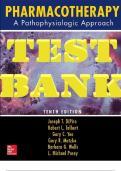
,Pharmacotherapy A Pathophysiologic Approach 10th Edition Dipiro Talber
Yee Test Bank
Chapter 1: Health Literacy and Medication Use
1. What time will the trough blood level need to be drawn if the nurse administers the
intravenous medication dose at 9:00 AM?
a. 6:30 AM
b. 8:30 AM
c. 9:30 AM
d. 11:30 AM
ANS: B
Trough blood levels measure the lowest blood level of medicine and are obtained just before the
dose is administered. In this case, 6:30 AM is too early to obtain the blood level. The other two
times occur after the medication is administered.
2. What will the nurse expect the health care providers order to be when starting an older adult
patient on thyroid hormone replacement therapy?
a. Administering a loading dose of the drug
b. Directions on how to taper the drug
c. A dosage that is one third to one half of the regular dosage
d. A dosage that is double the regular dosage
ANS: C
To prevent toxicity, dosages for new medications in older adults should be one third to one half
the amount of a standard adult dosage. Loading doses of drugs could cause severe toxicity.
Tapering off is characteristic of discontinuation of medications and is not appropriate for this
situation. Older adults generally need a lower medication dosage than younger patients.
DIF: Cognitive Level: Application REF: p. 29 OBJ: 3
TOP: Nursing Process Step: Implementation
MSC: NCLEX Client Needs Category: Physiological Integrity
3. Which drugs cause birth defects?
a. Teratogens
b. Carcinogens
c. Metabolites
d. Placebos
ANS: A
Teratogens are drugs that cause birth defects. Carcinogens cause cancer. Metabolites are the end
product of metabolism. Placebos are drugs that have no pharmacologic activity.
4. Which life threatening illness may occur as a result of aspirin (salicylate) administration
during viral illness to patients younger than 20 years of age?
a. Anaphylactic shock
, b. Reyes syndrome
c. Chickenpox
d. Influenza A
ANS: B
Children are susceptible to Reyes syndrome if they ingest aspirin at the time of or shortly after a
viral infection of chickenpox or influenza. Anaphylactic shock is caused by a hypersensitivity
reaction. Chickenpox is the result of being infected with a virus. Influenza A is caused by a
pathogen.
5. Which classification of medications commonly causes allergic reactions in children?
a. Antacids
b. Analgesics
c. Antibiotics
d. Anticonvulsants
ANS: C
Antibiotics, especially penicillins, commonly cause allergic reactions in children. Intravenous
antibiotics can cause rapid reactions; therefore, the pediatric patients response to a medication
should be assessed and monitored closely. Antacids rarely cause allergic reactions. Children are
not particularly allergic to analgesics or anticonvulsants.
6. After giving instructions to an expectant mother about taking medications during pregnancy,
which patient statement indicates the need for further teaching?
a. I will not take herbal medicines during pregnancy.
b. For morning sickness, I will try crackers instead of taking a drug.
If I get a cold, I will avoid taking nonprescription medications until I check with my
c. physician.
d. I will limit my alcohol intake to only one glass of wine weekly.
ANS: D
Alcohol needs to be eliminated during pregnancy and for 2 to 3 months prior to conception.
Limited studies are available regarding the use of herbal medications in general, and thus they
should be avoided during pregnancy. Alternative nonpharmacologic treatments are appropriate to
use during morning sickness. The pregnant woman should also avoid using nonprescription
drugs because few data are available about safe use in pregnancy. Because few medicines can be
considered completely safe for use in pregnancy, the physician needs to approve and recommend
the use of nonprescription drugs.
7. When is the ideal time for a nursing mother to take her own medications?
a. Before the infant latches on to begin to breastfeed
b. As soon as the mother wakes up in the morning
c. Right before the mother goes to sleep at night
d. As soon as the infant finishes breastfeeding
ANS: D
, Taking medications after breastfeeding reduces the amount of the medication that will reach the
baby. Medications taken directly before breastfeeding may have a high concentration in the milk
and possibly pass on to the baby. The mother must take into consideration when her medications
are ordered to be taken, and schedule them around breastfeeding.
8. Which age-related change would affect transdermal drug absorption in geriatric patients the
most?
a. Difficulty swallowing
b. Diminished kidney function
c. Changes in pigmentation
d. Altered circulatory status
ANS: D
The decreased circulation that occurs with aging will affect transdermal drug absorption.
Difficulty swallowing would not affect transdermal drugs being absorbed. Kidney function
affects drug excretion. Changes in pigmentation would not affect transdermal drug absorption.
9. Which intervention would be considered to reduce accumulation of a drug in a patient who has
decreased liver function?
a. Decreasing the time interval between dosages
b. Reducing the dosage
c. Administering the medication intravenously
d. Changing the drug to one that has a longer half life
ANS: B
Dosages must be reduced to prevent accumulation. Decreasing the time interval between dosages
would increase the accumulation of the drug. The intravenous route has the fastest absorption
and with liver dysfunction would increase the accumulation of the drug. A similar drug with a
longer half life would stay in the system longer; with impaired liver function, the result would be
increased accumulation.
10. The nurse is teaching an elderly patient with difficulty swallowing about his medications.
Which explanation by the nurse is most helpful?
a. Enteric coated tablets can be crushed and taken with applesauce.
b. Tablets that are scored can be broken in half.
c. Medications labeled SR can be crushed.
d. Avoid taking medications in liquid form.
ANS: B
It is acceptable to break scored tablets in half to facilitate swallowing of the medication. Enteric
coated tables should never be crushed because of the effect on the absorption rate and potential
for toxicity. Medications labeled SR indicate sustained release and should not be crushed
because of the effect on the absorption rate. Medication in liquid form may be easier to swallow.
11. The nurse is administering an antibiotic intravenously. Which blood level determines the
lowest amount of medication present in the patient?
a. Peak
Yee Test Bank
Chapter 1: Health Literacy and Medication Use
1. What time will the trough blood level need to be drawn if the nurse administers the
intravenous medication dose at 9:00 AM?
a. 6:30 AM
b. 8:30 AM
c. 9:30 AM
d. 11:30 AM
ANS: B
Trough blood levels measure the lowest blood level of medicine and are obtained just before the
dose is administered. In this case, 6:30 AM is too early to obtain the blood level. The other two
times occur after the medication is administered.
2. What will the nurse expect the health care providers order to be when starting an older adult
patient on thyroid hormone replacement therapy?
a. Administering a loading dose of the drug
b. Directions on how to taper the drug
c. A dosage that is one third to one half of the regular dosage
d. A dosage that is double the regular dosage
ANS: C
To prevent toxicity, dosages for new medications in older adults should be one third to one half
the amount of a standard adult dosage. Loading doses of drugs could cause severe toxicity.
Tapering off is characteristic of discontinuation of medications and is not appropriate for this
situation. Older adults generally need a lower medication dosage than younger patients.
DIF: Cognitive Level: Application REF: p. 29 OBJ: 3
TOP: Nursing Process Step: Implementation
MSC: NCLEX Client Needs Category: Physiological Integrity
3. Which drugs cause birth defects?
a. Teratogens
b. Carcinogens
c. Metabolites
d. Placebos
ANS: A
Teratogens are drugs that cause birth defects. Carcinogens cause cancer. Metabolites are the end
product of metabolism. Placebos are drugs that have no pharmacologic activity.
4. Which life threatening illness may occur as a result of aspirin (salicylate) administration
during viral illness to patients younger than 20 years of age?
a. Anaphylactic shock
, b. Reyes syndrome
c. Chickenpox
d. Influenza A
ANS: B
Children are susceptible to Reyes syndrome if they ingest aspirin at the time of or shortly after a
viral infection of chickenpox or influenza. Anaphylactic shock is caused by a hypersensitivity
reaction. Chickenpox is the result of being infected with a virus. Influenza A is caused by a
pathogen.
5. Which classification of medications commonly causes allergic reactions in children?
a. Antacids
b. Analgesics
c. Antibiotics
d. Anticonvulsants
ANS: C
Antibiotics, especially penicillins, commonly cause allergic reactions in children. Intravenous
antibiotics can cause rapid reactions; therefore, the pediatric patients response to a medication
should be assessed and monitored closely. Antacids rarely cause allergic reactions. Children are
not particularly allergic to analgesics or anticonvulsants.
6. After giving instructions to an expectant mother about taking medications during pregnancy,
which patient statement indicates the need for further teaching?
a. I will not take herbal medicines during pregnancy.
b. For morning sickness, I will try crackers instead of taking a drug.
If I get a cold, I will avoid taking nonprescription medications until I check with my
c. physician.
d. I will limit my alcohol intake to only one glass of wine weekly.
ANS: D
Alcohol needs to be eliminated during pregnancy and for 2 to 3 months prior to conception.
Limited studies are available regarding the use of herbal medications in general, and thus they
should be avoided during pregnancy. Alternative nonpharmacologic treatments are appropriate to
use during morning sickness. The pregnant woman should also avoid using nonprescription
drugs because few data are available about safe use in pregnancy. Because few medicines can be
considered completely safe for use in pregnancy, the physician needs to approve and recommend
the use of nonprescription drugs.
7. When is the ideal time for a nursing mother to take her own medications?
a. Before the infant latches on to begin to breastfeed
b. As soon as the mother wakes up in the morning
c. Right before the mother goes to sleep at night
d. As soon as the infant finishes breastfeeding
ANS: D
, Taking medications after breastfeeding reduces the amount of the medication that will reach the
baby. Medications taken directly before breastfeeding may have a high concentration in the milk
and possibly pass on to the baby. The mother must take into consideration when her medications
are ordered to be taken, and schedule them around breastfeeding.
8. Which age-related change would affect transdermal drug absorption in geriatric patients the
most?
a. Difficulty swallowing
b. Diminished kidney function
c. Changes in pigmentation
d. Altered circulatory status
ANS: D
The decreased circulation that occurs with aging will affect transdermal drug absorption.
Difficulty swallowing would not affect transdermal drugs being absorbed. Kidney function
affects drug excretion. Changes in pigmentation would not affect transdermal drug absorption.
9. Which intervention would be considered to reduce accumulation of a drug in a patient who has
decreased liver function?
a. Decreasing the time interval between dosages
b. Reducing the dosage
c. Administering the medication intravenously
d. Changing the drug to one that has a longer half life
ANS: B
Dosages must be reduced to prevent accumulation. Decreasing the time interval between dosages
would increase the accumulation of the drug. The intravenous route has the fastest absorption
and with liver dysfunction would increase the accumulation of the drug. A similar drug with a
longer half life would stay in the system longer; with impaired liver function, the result would be
increased accumulation.
10. The nurse is teaching an elderly patient with difficulty swallowing about his medications.
Which explanation by the nurse is most helpful?
a. Enteric coated tablets can be crushed and taken with applesauce.
b. Tablets that are scored can be broken in half.
c. Medications labeled SR can be crushed.
d. Avoid taking medications in liquid form.
ANS: B
It is acceptable to break scored tablets in half to facilitate swallowing of the medication. Enteric
coated tables should never be crushed because of the effect on the absorption rate and potential
for toxicity. Medications labeled SR indicate sustained release and should not be crushed
because of the effect on the absorption rate. Medication in liquid form may be easier to swallow.
11. The nurse is administering an antibiotic intravenously. Which blood level determines the
lowest amount of medication present in the patient?
a. Peak