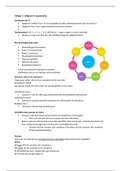
Summary Customer Management – Hoekstra (RUG) 06.02.2017
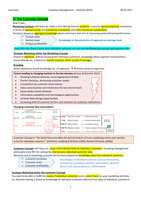
1) The Customer Concept
How it was…
Marketing Concept with focus on: Value a firm derives from its products, customer (group/segment) orientation
in terms of segment needs and competitor orientation with inter-functional coordination.
Decisions (based on aggregate knowledge about customers) that aim at improving product/brand performance:
Product sales
Market share Knowledge of characteristics of segments on average level
Product profitability
Every firm that doesn’t know their individual customer can only use the Marketing concept and segments etc.!
Strategic Marketing within the Marketing Concept
Choice of segments, without knowing the individual customers. Knowledge about segment characteristics,
brand attitude etc. is based on market research, which results in averages
Branding
Brand awareness, brand knowledge etc. of segments. Activities aimed at segments.
Factors leading to changing markets in the last decades (Kumar & Reinartz 2012)
Growing customer diversity, more fragmented markets
Shorter lifecycles, decreasing customer loyalty
Competition for customer more intense
Value consciousness and intolerance for low service levels
Social media /social networks
Information availability and technological opportunities
Increase data storage opportunities
Increasing level of customer-to-firm and customer-to-customer interactions
Changing customer-firm interactions:
Customer Concept is “the belief that prescribes the unit of analysis of every marketing action and reaction
to be the individual customer”. (Hoekstra, Leeflang & Wittink (1999), Ramani & Kumar (2008))
Customer Concept with focus on: Value a firm derives from its individual customers. Prevailing management
philosophy since 90’s for companies that possess individual-customer data.
Decisions aim at improving customer performance (based on knowledge about the individual customer):
Customer purchases Knowledge of individual customer such as transactions,
Customer share response to marketing activities, interactions, Word of
Customer profitability Mouth (C2C interactions) in a CRM System
Strategic Marketing within the Customer Concept
You want to be able to fulfill the needs of individual customers and to select them for your marketing activities.
So: decision-making is based on knowledge of individual customers (derived from data of individual customers).
1
1) The Customer Concept
How it was…
Marketing Concept with focus on: Value a firm derives from its products, customer (group/segment) orientation
in terms of segment needs and competitor orientation with inter-functional coordination.
Decisions (based on aggregate knowledge about customers) that aim at improving product/brand performance:
Product sales
Market share Knowledge of characteristics of segments on average level
Product profitability
Every firm that doesn’t know their individual customer can only use the Marketing concept and segments etc.!
Strategic Marketing within the Marketing Concept
Choice of segments, without knowing the individual customers. Knowledge about segment characteristics,
brand attitude etc. is based on market research, which results in averages
Branding
Brand awareness, brand knowledge etc. of segments. Activities aimed at segments.
Factors leading to changing markets in the last decades (Kumar & Reinartz 2012)
Growing customer diversity, more fragmented markets
Shorter lifecycles, decreasing customer loyalty
Competition for customer more intense
Value consciousness and intolerance for low service levels
Social media /social networks
Information availability and technological opportunities
Increase data storage opportunities
Increasing level of customer-to-firm and customer-to-customer interactions
Changing customer-firm interactions:
Customer Concept is “the belief that prescribes the unit of analysis of every marketing action and reaction
to be the individual customer”. (Hoekstra, Leeflang & Wittink (1999), Ramani & Kumar (2008))
Customer Concept with focus on: Value a firm derives from its individual customers. Prevailing management
philosophy since 90’s for companies that possess individual-customer data.
Decisions aim at improving customer performance (based on knowledge about the individual customer):
Customer purchases Knowledge of individual customer such as transactions,
Customer share response to marketing activities, interactions, Word of
Customer profitability Mouth (C2C interactions) in a CRM System
Strategic Marketing within the Customer Concept
You want to be able to fulfill the needs of individual customers and to select them for your marketing activities.
So: decision-making is based on knowledge of individual customers (derived from data of individual customers).
1