Unit 11: Genetics and Genetic Engineering
D: Explore basic DNA techniques and the use of genetic engineering technologies.
Assignment title: Basic DNA techniques and genetic engineering technology
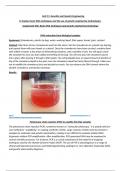
DNA extraction from biological samples
Equipment: Strawberries, plastic zip bag, water, washing liquid, filter paper, funnel, glass, alcohol.
Method: Take three to four strawberries and trim the stems. Put the strawberries in a plastic zip-top bag
and squash them with your hands or a utensil. Once the strawberries have been crushed, combine them
with 100ml of water, a few drops of dishwashing solutions, and a sprinkle of salt. You will again crush
the strawberries once you have added everything to the bag. You will now pour the strawberry puree
into a glass after passing it through a filter paper. You will gradually pour an equal amount of alcohol on
top of the strawberry liquid in the glass once the strawberry liquid has been filtered through. Make sure
not to muddle the strawberry juice and alcohol too much. You can observe the DNA strands where the
alcohol, strawberry, and alcohol converge.
Results:
https:// curiousteam.typepad.com/.a/
6a017ee48809da970d01a3fd1a98a3970b-800wi
Polymerase chain reaction (PCR) to amplify the DNA samples
The polymerase chain reaction (PCR), sometimes known as "molecular photocopy," is a speedy and low-
cost method for "amplifying" or copying small bits of DNA. Large volumes of DNA must be present in
samples for molecular and genetic examination, making it very difficult to evaluate isolated DNA
fragments without PCR amplification. After amplification, PCR-generated DNA may be employed in
several scientific processes. For instance, PCR is a crucial component of the majority of mapping
techniques used by the Human Genome Project (HGP). The use of PCR is advantageous in a range of
clinical and laboratory processes such DNA fingerprinting, pathogen or virus detection (especially AIDS),
and genetic abnormality diagnosis.
, Method: The material is heated to denature the DNA or break it into
two single-stranded DNAs prior to PCR amplification of DNA segments.
After then, an enzyme known as "Taq polymerase" uses the first DNA
strand as a template to create two new DNA strands. Each new
molecule has both a new and an old DNA strand since the original DNA
is replicated. On each of these chains, two further copies can then be
produced. Over a billion precise duplicates of the original DNA segment
https://www.bio-rad.com/webroot/web/images/tlp/
are produced by denaturing and synthesising new DNA up to 30–40 pcr-thermocyclers.jpg
times. The full PCR cycle may be finished in hours thanks to
automation. A device known as a thermal cycler is used to regulate
the reaction. In order to promote DNA synthesis and denaturation, the
equipment is set to alter the reaction temperature every few minutes.
The reaction mixture consists of a double-stranded DNA template,
four different nucleotide types, DNA polymerase, and two different
primers. The PCR now reads as follows:
Denaturing stage: The temperature is raised to between 94 and 95 https://youtu.be/wBrNbbAIAFo
degrees Celsius in a combination including template DNA and all other
required ingredients. The hydrogen bonds that hold the two strands of
the template DNA together are broken by the high temperature, which also causes the two strands to
separate. Two DNA single strands are produced as a result, serving as templates for the synthesis of
further DNA strands. It is crucial to maintain this temperature for a sufficient amount of time to allow
the DNA strands to completely split. Usually, this takes 15 to 30 seconds.
Annealing stage: The reactants are chilled to a temperature between
50 and 65 °C during this phase. The precise temperature is
determined by the primers' melting points. This enables hydrogen
bonding between the primer and a particular location on the single-
stranded DNA template. Primer sequences are brief DNA or RNA
single strands that are typically 20–30 nucleotides long. The
duplicated sequence has a brief DNA fragment at either end that is
intended to complement the primers. The initial step in the synthesis
of DNA involves primers. Only double strands of DNA may be added to
by polymerase enzymes. Prior to the polymerase enzyme binding and https://cdn.britannica.com/77/22477-050-
16EFB7B3/process-polymerase-chain-reaction.jpg
constructing a new complementary DNA strand from the freed DNA
base, the base must first attach to the primer. There are two primers: forward and reverse primers,
because the two distinct DNA strands are complementary and travel in opposing directions (from one
end, the 5' end, to the other end, the 3' end). It typically takes this process 10 to 30 seconds.
Extending stage: The temperature is then increased to 72°C in a final phase to enable a unique enzyme
called Taq DNA polymerase, which adds DNA bases, to produce new DNA.
Gel electrophoresis to separate the amplified DNA
D: Explore basic DNA techniques and the use of genetic engineering technologies.
Assignment title: Basic DNA techniques and genetic engineering technology
DNA extraction from biological samples
Equipment: Strawberries, plastic zip bag, water, washing liquid, filter paper, funnel, glass, alcohol.
Method: Take three to four strawberries and trim the stems. Put the strawberries in a plastic zip-top bag
and squash them with your hands or a utensil. Once the strawberries have been crushed, combine them
with 100ml of water, a few drops of dishwashing solutions, and a sprinkle of salt. You will again crush
the strawberries once you have added everything to the bag. You will now pour the strawberry puree
into a glass after passing it through a filter paper. You will gradually pour an equal amount of alcohol on
top of the strawberry liquid in the glass once the strawberry liquid has been filtered through. Make sure
not to muddle the strawberry juice and alcohol too much. You can observe the DNA strands where the
alcohol, strawberry, and alcohol converge.
Results:
https:// curiousteam.typepad.com/.a/
6a017ee48809da970d01a3fd1a98a3970b-800wi
Polymerase chain reaction (PCR) to amplify the DNA samples
The polymerase chain reaction (PCR), sometimes known as "molecular photocopy," is a speedy and low-
cost method for "amplifying" or copying small bits of DNA. Large volumes of DNA must be present in
samples for molecular and genetic examination, making it very difficult to evaluate isolated DNA
fragments without PCR amplification. After amplification, PCR-generated DNA may be employed in
several scientific processes. For instance, PCR is a crucial component of the majority of mapping
techniques used by the Human Genome Project (HGP). The use of PCR is advantageous in a range of
clinical and laboratory processes such DNA fingerprinting, pathogen or virus detection (especially AIDS),
and genetic abnormality diagnosis.
, Method: The material is heated to denature the DNA or break it into
two single-stranded DNAs prior to PCR amplification of DNA segments.
After then, an enzyme known as "Taq polymerase" uses the first DNA
strand as a template to create two new DNA strands. Each new
molecule has both a new and an old DNA strand since the original DNA
is replicated. On each of these chains, two further copies can then be
produced. Over a billion precise duplicates of the original DNA segment
https://www.bio-rad.com/webroot/web/images/tlp/
are produced by denaturing and synthesising new DNA up to 30–40 pcr-thermocyclers.jpg
times. The full PCR cycle may be finished in hours thanks to
automation. A device known as a thermal cycler is used to regulate
the reaction. In order to promote DNA synthesis and denaturation, the
equipment is set to alter the reaction temperature every few minutes.
The reaction mixture consists of a double-stranded DNA template,
four different nucleotide types, DNA polymerase, and two different
primers. The PCR now reads as follows:
Denaturing stage: The temperature is raised to between 94 and 95 https://youtu.be/wBrNbbAIAFo
degrees Celsius in a combination including template DNA and all other
required ingredients. The hydrogen bonds that hold the two strands of
the template DNA together are broken by the high temperature, which also causes the two strands to
separate. Two DNA single strands are produced as a result, serving as templates for the synthesis of
further DNA strands. It is crucial to maintain this temperature for a sufficient amount of time to allow
the DNA strands to completely split. Usually, this takes 15 to 30 seconds.
Annealing stage: The reactants are chilled to a temperature between
50 and 65 °C during this phase. The precise temperature is
determined by the primers' melting points. This enables hydrogen
bonding between the primer and a particular location on the single-
stranded DNA template. Primer sequences are brief DNA or RNA
single strands that are typically 20–30 nucleotides long. The
duplicated sequence has a brief DNA fragment at either end that is
intended to complement the primers. The initial step in the synthesis
of DNA involves primers. Only double strands of DNA may be added to
by polymerase enzymes. Prior to the polymerase enzyme binding and https://cdn.britannica.com/77/22477-050-
16EFB7B3/process-polymerase-chain-reaction.jpg
constructing a new complementary DNA strand from the freed DNA
base, the base must first attach to the primer. There are two primers: forward and reverse primers,
because the two distinct DNA strands are complementary and travel in opposing directions (from one
end, the 5' end, to the other end, the 3' end). It typically takes this process 10 to 30 seconds.
Extending stage: The temperature is then increased to 72°C in a final phase to enable a unique enzyme
called Taq DNA polymerase, which adds DNA bases, to produce new DNA.
Gel electrophoresis to separate the amplified DNA