Practical 10
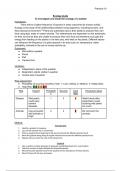
Ecology study
To investigate and study the ecology of a habitat
Hypothesis:
There will be a higher frequency of species in areas untouched by human activity.
Ecology is the study of the relationships between living organisms, including humans, and
their physical environment.[1] Plants are autotrophs due to their ability to produce their own
food using light, water or carbon dioxide. The heterotrophs are dependent on the autotrophs
for their survival as they are unable to produce their own food and therefore must gain the
energy from feeding on the plants or via their prey, who feed on the plants. Different factors
can influence the frequency of a plant species in an area such as: temperature, water
availability, minerals in the soil or human activity etc.
Equipment:
● 50cmx50cm quadrat
● Pencil
● Pad
● Transect line
Variables:
● Independent- place of the quadrat
● Dependent- plants visible in quadrat
● Control-size of quadrat
Risk assessment
● Probability of occuring/ severity of risk: 1- Low/ unlikely, 2- Medium, 3- Highly likely
● Total Risk: 1, 2, 3, 4, 6, 9
Risk Hazard Probabilit Severity Total Precaution taken
y Risk
Disease Wild plants 1 3 3 Wash hands after
could carry experiment, avoid
harmful touching wild plants
diseases too much
Animals may encounter 2 3 6 Do not touch the
wild animals or animals
bugs
Method:
Transect line
1. Identify a gradient to measure
2. Lay out the transect line in a linear line
3. Place a quadrat at the beginning of the line and record the different species found
4. Move the quadrat along along at regular intervals and record the different species found
5. Repeat until you reach the end of the transect line
Quadrat
1. Use a random number generator to generate coordinates/steps from a set location
2. Take this number of steps left/right and forward/backward.
3. Record the plant species found in the quadrat and the abundance of these species.
4. Record these with the pen and paper.
Ecology study
To investigate and study the ecology of a habitat
Hypothesis:
There will be a higher frequency of species in areas untouched by human activity.
Ecology is the study of the relationships between living organisms, including humans, and
their physical environment.[1] Plants are autotrophs due to their ability to produce their own
food using light, water or carbon dioxide. The heterotrophs are dependent on the autotrophs
for their survival as they are unable to produce their own food and therefore must gain the
energy from feeding on the plants or via their prey, who feed on the plants. Different factors
can influence the frequency of a plant species in an area such as: temperature, water
availability, minerals in the soil or human activity etc.
Equipment:
● 50cmx50cm quadrat
● Pencil
● Pad
● Transect line
Variables:
● Independent- place of the quadrat
● Dependent- plants visible in quadrat
● Control-size of quadrat
Risk assessment
● Probability of occuring/ severity of risk: 1- Low/ unlikely, 2- Medium, 3- Highly likely
● Total Risk: 1, 2, 3, 4, 6, 9
Risk Hazard Probabilit Severity Total Precaution taken
y Risk
Disease Wild plants 1 3 3 Wash hands after
could carry experiment, avoid
harmful touching wild plants
diseases too much
Animals may encounter 2 3 6 Do not touch the
wild animals or animals
bugs
Method:
Transect line
1. Identify a gradient to measure
2. Lay out the transect line in a linear line
3. Place a quadrat at the beginning of the line and record the different species found
4. Move the quadrat along along at regular intervals and record the different species found
5. Repeat until you reach the end of the transect line
Quadrat
1. Use a random number generator to generate coordinates/steps from a set location
2. Take this number of steps left/right and forward/backward.
3. Record the plant species found in the quadrat and the abundance of these species.
4. Record these with the pen and paper.