Summary Fundamentals of Abnormal Psychology class notes latest
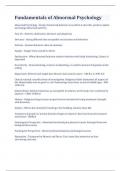
Fundamentals of Abnormal Psychology Abnormal Psychology - Study of abnormal behavior in an effort to describe, predict, explain and change abnormal patterns. Four Ds - Distress, disfunction, deviance and dangerous Deviance - Acting different than acceptable social norms and behaviors Distress - Anxious behavior, ideas of emotions Danger - Danger from oneself to others Dysfunction - When abnormal behavior tends to interfere with daily functioning. Culture is important Eccentricity - Nonconforming, creative, trendsetting, or could be deviant. It depends on the setting. Hippocrates believed and taught that illnesses had natural causes - 500 B.C. to 500 A.D. Church rejected scientific forms of investigation. Religious beliefs dominated all aspects of life. Abnormality seen as good vs. evil. Demonology loses favor at end of middle ages - 500-1350 A.D. Johann Weyer believed mind was as susceptible to sickness as the body. Care continued to improve - A.D. Shrines - Religious things across europe that were devoted to loving treatment of people with disorders Asylum - Where the mentally ill would go. One building, almost prison like Treatment of people w/ mental disorders began to improve. Reversal of moral treatment movement - 1800ish Somatogenic Perspective - Abnormal functioning has physical causes. Emerged from new biological discoveries Psychogenic Perspective - Abnormal functioning has psychological causes Hypnotism - Treatment by Mesmer and Bruer. Can create false memories as they uncovering real ones Psychoanalysis - Freud, unconscious psychological processes Huge change b/c of more drugs. Led to deinstitutionalization, rise in outpatient care. - 1950s How many adults receive treatment for psychological disorders? How many sessions? - 1 in 6, less than 5 sessions Positive psychology - Practitioners teach people skills that help protect them from stress, encourage to pursue psychological wellness, meaningful activities Psychoanalytic, biological, behavioral, cognitive, humanistic, sociocultural - 6 theoretical perspectives Technology and mental health - violent media, cybertherapy, cyberbullying, etc. Model/Paradigm - Certain structure on how to do therapy. Biological Model - Adopts a medical perspective. Focuses on the idea that psychological abnormality is an illness brought about by malfunctioning parts of your brain. Neuron - Nerve cell in your brain. Communicate, chemical messenger. IF things are going wrong, there is a chemical imbalance. Impulse - Received by a neuron's dendrite, travels down the axon, transmitted through the nerve endings. Neuron separated by the synapse, impulse stimulates nerve ending and releases NT, NT travels across the synaptic space to receptors - How do messages get from nerve ending of one neuron to the dendrites of another? Abnormal NTs - These can lead to specific mental disorders. Endocrine system - Some mental disorders are related to abnormal chemical activity here. Drug therapy, electroconvulsive therapy, psychosurgery - 3 types of biological treatment Anti-anxiety, antidepressant, antibipolar, antipsychotic - Four major psychotropic drug groups ECT - test used for depression. almost worst case scenario Psychodynamic Model - Normal or abnormal behavior is determined largely by unconscious psychological forces. ID - Guided by pleasure principle. Child like. Desires drive us.
Escuela, estudio y materia
- Institución
- Fundamentals of Abnormal Psychology
- Grado
- Fundamentals of Abnormal Psychology
Información del documento
- Subido en
- 25 de agosto de 2023
- Número de páginas
- 6
- Escrito en
- 2023/2024
- Tipo
- RESUMEN
Temas
-
fundamentals of abnormal psychology class notes la
-
deviance acting different than acceptable social
-
dysfunction when abnormal behavior tends to inte
-
hippocrates believed and taught that illnesses

Documento también disponible en un lote