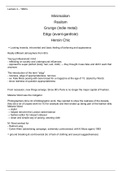
Attachment
Notes
Paper 1 - Section C
,Attachment
- emotional bond between two people
- each seek closeness and feel more secure when in presence of attachment figure
- two-way process that endures over time
- leads to certain behaviours: clinging/proximity seeking
- serves the function of protecting the infant
The four attachment behaviours
1. Separation anxiety
- Distress when separated from caregiver
2. Stranger anxiety
- Trying to stay close to PCG (proximity seeking), wary of others, especially when stressed
3. Reunion behaviour
- Pleased when PCG returns and can be comforted by them
4. Willingness to explore
- Use PCG as a ‘safe base’ from which to explore the environment but frequently makes
contact with them (proximity seeking)
,Caregiver-infant reactions
● Interactions between babies / PCG are baby led, adult responds to babies behaviour
● Early interactions have important functions for the child’s social development, in
particular the development of attachment
● The responsiveness of the caregiver to the infant’s signals has profound effects
Traditional views believe babies are passive
BUT Babies have an active role
PCG and babies take it in turn to interact
Two main aspects of infant-caregiver interactions:
- Reciprocity
- Interactional Synchrony
Reciprocity
● Reciprocal means two-way, or something that is mutual
● Caregiver-infant interaction is a two-way / mutual process
● Each party responds to the other’s signals to sustain interaction (turn-taking)
● The behaviour of each party elicits a response from the other
● E.g Infant smiled, produces a smile from the PCG (normally baby led)
● Reciprocity influences a child’s physical, social and cognitive development
● It becomes basis for development of basic trust or mistrust
● Shapes how children relate to the world,learn, & form relationships throughout life
Interactional synchrony
● Two people interact/tend to mirror what the other is doing in terms of their facial
and body movements (emotions and behaviours)
● Form of rhythmic interaction between infant and PCG
● Infants coordinate actions with PCG in a kind of conversation
● Infant and PCG anticipate how each other will behave and can elicit a particular
response from the other
● E.g A PCG who laughs in response to their infants giggling sound and tickles
them, is experiencing synchronised interaction
Reciprocity refers to the process in which a behaviour is matched during an interaction
e.g. smiling back when someone smiles at us. ...
Interactional synchrony refers to how a parent's speech and infant's behaviour become
finely synchronised so that they are in direct response to one another.
, Study
Reciprocity Interactional synchrony
Brazelton et al (1975) Meltzoff and Moore (1983)
- Observed mums / babies during - Observational experiments to study start
interactions and reported the existence of of interactional synchrony in infants
reciprocity where babies and caregivers - Adults displayed distinctive facial
respond to the actions of the other. gestures (tongue out) and the infants’
- Primary attachment figures were told to responses were observed
not respond to babies signals - Results indicated infants could imitate
- Babies initially showed signs of distress, these facial and manual gestures
when the attachment figures continued to - Argue this interactional synchrony is
ignore the babies some responded by important for development of attachment
curled up and lying motionless - Suggest higher interactional synchrony
associated with better quality attachment
Evaluation
Difficulties in reliability
● Infants mouth are always moving → hard to tell what’s general/ imitated behaviour
● Expressions in the tests (smiling, yawning…)occur in infants so hard to distinguish
Overcome by:
● M+M measured infant responses by filming just their behaviour in an interaction
● Then they got an independent observer to judge the babies behaviour
● They didn’t know which behaviour was being imitated and which behaviour wasn’t
Failure to replicate
● Koepke et al failed to replicate the findings of Meltzoff and Moore (1977)
● They found babies were no more likely to stick out their tongue when the
researcher did compared to if they smiled
● Suggesting infant imitation/reciprocity/ interactional synchrony may need to be
modified or abandoned
Other problems
● Time consuming to study babies
● Babies are always sleeping so it is hard to find a time when they are alert
Notes
Paper 1 - Section C
,Attachment
- emotional bond between two people
- each seek closeness and feel more secure when in presence of attachment figure
- two-way process that endures over time
- leads to certain behaviours: clinging/proximity seeking
- serves the function of protecting the infant
The four attachment behaviours
1. Separation anxiety
- Distress when separated from caregiver
2. Stranger anxiety
- Trying to stay close to PCG (proximity seeking), wary of others, especially when stressed
3. Reunion behaviour
- Pleased when PCG returns and can be comforted by them
4. Willingness to explore
- Use PCG as a ‘safe base’ from which to explore the environment but frequently makes
contact with them (proximity seeking)
,Caregiver-infant reactions
● Interactions between babies / PCG are baby led, adult responds to babies behaviour
● Early interactions have important functions for the child’s social development, in
particular the development of attachment
● The responsiveness of the caregiver to the infant’s signals has profound effects
Traditional views believe babies are passive
BUT Babies have an active role
PCG and babies take it in turn to interact
Two main aspects of infant-caregiver interactions:
- Reciprocity
- Interactional Synchrony
Reciprocity
● Reciprocal means two-way, or something that is mutual
● Caregiver-infant interaction is a two-way / mutual process
● Each party responds to the other’s signals to sustain interaction (turn-taking)
● The behaviour of each party elicits a response from the other
● E.g Infant smiled, produces a smile from the PCG (normally baby led)
● Reciprocity influences a child’s physical, social and cognitive development
● It becomes basis for development of basic trust or mistrust
● Shapes how children relate to the world,learn, & form relationships throughout life
Interactional synchrony
● Two people interact/tend to mirror what the other is doing in terms of their facial
and body movements (emotions and behaviours)
● Form of rhythmic interaction between infant and PCG
● Infants coordinate actions with PCG in a kind of conversation
● Infant and PCG anticipate how each other will behave and can elicit a particular
response from the other
● E.g A PCG who laughs in response to their infants giggling sound and tickles
them, is experiencing synchronised interaction
Reciprocity refers to the process in which a behaviour is matched during an interaction
e.g. smiling back when someone smiles at us. ...
Interactional synchrony refers to how a parent's speech and infant's behaviour become
finely synchronised so that they are in direct response to one another.
, Study
Reciprocity Interactional synchrony
Brazelton et al (1975) Meltzoff and Moore (1983)
- Observed mums / babies during - Observational experiments to study start
interactions and reported the existence of of interactional synchrony in infants
reciprocity where babies and caregivers - Adults displayed distinctive facial
respond to the actions of the other. gestures (tongue out) and the infants’
- Primary attachment figures were told to responses were observed
not respond to babies signals - Results indicated infants could imitate
- Babies initially showed signs of distress, these facial and manual gestures
when the attachment figures continued to - Argue this interactional synchrony is
ignore the babies some responded by important for development of attachment
curled up and lying motionless - Suggest higher interactional synchrony
associated with better quality attachment
Evaluation
Difficulties in reliability
● Infants mouth are always moving → hard to tell what’s general/ imitated behaviour
● Expressions in the tests (smiling, yawning…)occur in infants so hard to distinguish
Overcome by:
● M+M measured infant responses by filming just their behaviour in an interaction
● Then they got an independent observer to judge the babies behaviour
● They didn’t know which behaviour was being imitated and which behaviour wasn’t
Failure to replicate
● Koepke et al failed to replicate the findings of Meltzoff and Moore (1977)
● They found babies were no more likely to stick out their tongue when the
researcher did compared to if they smiled
● Suggesting infant imitation/reciprocity/ interactional synchrony may need to be
modified or abandoned
Other problems
● Time consuming to study babies
● Babies are always sleeping so it is hard to find a time when they are alert