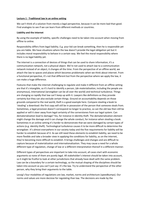
Lecture 1 - Traditional law in an online setting
We can’t think of a solution from merely a legal perspective, because it can be more bad than good.
Find analogies to see if we can learn from different methods or countries.
Liability and the internet
By using the example of liability, specific challenges need to be taken into account when moving from
offline to online.
Responsibility differs from legal liability. E.g. your kid can break something, then he is responsible yet
you are liable. We have situations where the law doesn’t provide the legal obligation yet but it
includes moral responsibility to behave in a certain way. We feel the moral responsibility where
there is no legal liability yet.
The internet is a connection of devices of things that can be used to share information, it’s a
communication network, not a physical object. We’re not used to attach law to a communication
network instead of an object, it changes all the time. From the perspective of an offline world, we
attach the law to spaces and places which becomes problematic when we think about internet. From
a functional perspective, it’s not that different but from the perspective where we apply the law, it
can make a huge difference.
Features that make the internet challenging to regulate and make it different from an offline setting
are that it’s intangible, so it’s hard to identify a person, (de-materialisation, including the people are
anonymous), international (wrongdoer can be all over the world) and technical turbulence. Things
are changing so rapidly that law can’t keep up with it. Lawyers like definitions as they provide
certainty but they can also exclude certain things. Ground on accountability depends on those
grounds compared to the real world, theft is a good example here. Compare stealing a book to
‘stealing’ a download: the first copy will still be in possession of the person that someone steals from.
Sometimes, a legal provision doesn’t correspond no longer to practice, so can the old law then still be
applied or will it steer away from legal certainty of the cornerstones from our legal system. Can
dematerialization lead to damage? Yes, for instance in identity theft. The dematerialization element
might change the damage and it can change the whole conduct, for instance when stealing a book.
Sometimes in an online setting it’s harder to demonstrate that we were damaged by certain types of
actions (e.g. identity theft). Technological turbulence causes it to be more difficult to determine the
wrongdoer. It’s almost everywhere in our society today and the five requirements for liability will be
harder to establish because of it. As we still need these elements to establish liability, we need to be
more flexible and take a broader view in applying the conditions for liability, as on the internet,
they’re becoming more difficult to establish. It brings challenges and changes and are difficult to
capture because of materialization and internationalization. They may cause a need for a whole
different type of regulation, change of law or a different interpretation thereof in a different manner.
Different types of perspectives are important to take into account, all cases start with economic
arguments so none of them are purely legal. All stakeholder’s interest should be taken into account,
so it might be fruitful to look at other jurisdictions that already have dealt with the same problem.
Law can be a boundary for a certain technology, so the mutual shaping of the disciplines should be
taken into account as you can’t just say: it’s the law. Try to understand the perspective of the other
person, why they bring their arguments to the table.
Lessig’s four modalities of regulations are law, market, norms and architecture (speedbumps). Our
norms and values are more decisive for regulating than law. The decisions are made by the
We can’t think of a solution from merely a legal perspective, because it can be more bad than good.
Find analogies to see if we can learn from different methods or countries.
Liability and the internet
By using the example of liability, specific challenges need to be taken into account when moving from
offline to online.
Responsibility differs from legal liability. E.g. your kid can break something, then he is responsible yet
you are liable. We have situations where the law doesn’t provide the legal obligation yet but it
includes moral responsibility to behave in a certain way. We feel the moral responsibility where
there is no legal liability yet.
The internet is a connection of devices of things that can be used to share information, it’s a
communication network, not a physical object. We’re not used to attach law to a communication
network instead of an object, it changes all the time. From the perspective of an offline world, we
attach the law to spaces and places which becomes problematic when we think about internet. From
a functional perspective, it’s not that different but from the perspective where we apply the law, it
can make a huge difference.
Features that make the internet challenging to regulate and make it different from an offline setting
are that it’s intangible, so it’s hard to identify a person, (de-materialisation, including the people are
anonymous), international (wrongdoer can be all over the world) and technical turbulence. Things
are changing so rapidly that law can’t keep up with it. Lawyers like definitions as they provide
certainty but they can also exclude certain things. Ground on accountability depends on those
grounds compared to the real world, theft is a good example here. Compare stealing a book to
‘stealing’ a download: the first copy will still be in possession of the person that someone steals from.
Sometimes, a legal provision doesn’t correspond no longer to practice, so can the old law then still be
applied or will it steer away from legal certainty of the cornerstones from our legal system. Can
dematerialization lead to damage? Yes, for instance in identity theft. The dematerialization element
might change the damage and it can change the whole conduct, for instance when stealing a book.
Sometimes in an online setting it’s harder to demonstrate that we were damaged by certain types of
actions (e.g. identity theft). Technological turbulence causes it to be more difficult to determine the
wrongdoer. It’s almost everywhere in our society today and the five requirements for liability will be
harder to establish because of it. As we still need these elements to establish liability, we need to be
more flexible and take a broader view in applying the conditions for liability, as on the internet,
they’re becoming more difficult to establish. It brings challenges and changes and are difficult to
capture because of materialization and internationalization. They may cause a need for a whole
different type of regulation, change of law or a different interpretation thereof in a different manner.
Different types of perspectives are important to take into account, all cases start with economic
arguments so none of them are purely legal. All stakeholder’s interest should be taken into account,
so it might be fruitful to look at other jurisdictions that already have dealt with the same problem.
Law can be a boundary for a certain technology, so the mutual shaping of the disciplines should be
taken into account as you can’t just say: it’s the law. Try to understand the perspective of the other
person, why they bring their arguments to the table.
Lessig’s four modalities of regulations are law, market, norms and architecture (speedbumps). Our
norms and values are more decisive for regulating than law. The decisions are made by the