PSY343 Cognitive Neuropsychology
Week 1
Cognitive neuropsychology tries to understand cognitive impairment following brain injury, and how our
understanding of these impairments can be explained by cognitive models.
Language impairments – picture naming, reading and repetition
Anomia – a disorder of object naming
Inability to retrieve the name, as in, the verbal label, despite knowing what it is
Caught in permanent state of ‘tip of the tongue’
Described by William James (1890) as a gap that is intensely active, producing a strong visceral
experience.
It is seen in patients who have strokes, aphasia.
Very frustrating.
Sometimes patients can respond to phonological cues.
Research with non-brain injured populations:
-> Brown & McNeil (1966)
Found participants had TOT occur about once a week
Frequently elicited by proper names (people's names, place names)
They identified people could produce some of the information, perhaps using syllabic
information, the first letter of the word, related words
Often eventually resolved (stress can make this harder)
Can increase in frequency with age
Demonstrates an important failure of memory, when you can have something in mind but can't
retrieve it. Elements are quite similar to clinical population, but impairments in patients are an
exaggerated version.
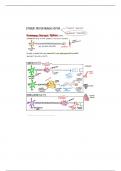
The cognitive model of picture naming
,Advantageous, as they can provide a complete account of all the cognitive elements that may go wrong
in a simple task like picture naming. Also is illustrative of key differences in impairments of ‘access’
(arrows) or ‘representation’ (boxes).
What are the stages that you go through to name the picture of a house?
(As in, to get from the visual input -> verbal output)
3 components necessary:
Visual input (assumption of a visual recognition system)
Semantics (access meaning)
Phonological output (saying it out loud)
In anomia, visual input & semantics must be working fine, so whatever is going wrong must occur after
these processes have occurred (post-semantic)
2 options –
(1) it’s the phonological info itself, don’t have the verbal label, or
(2) it’s a problem with the connection between the components, so failure of retrieval (therapy may
help through phonological cueing & priming)
So, there are 3 major causes of naming impairment:
Problems in visual processing (object agnosia)
Problems in semantic/conceptual processing (what an object is)
Problems in phonological output processing (speech sounds access) {typical ToT/anomia}
Damage can implicate central impairments OR access impairments
Need to be able to have seen the object, know what it is & know how to say the name for it
Those with brain damage can be naming impaired, but it doesn’t suffice to classify them as a single
group of ‘naming impaired’ people, as this can be due to many underlying functional causes. It is vital to
pre-determine these before targeting appropriate therapy.
,Single association – if a patient performs significantly worse on one task than another, it suggests that
the lesion has selectively disrupted some mental representations required by the task they cannot do.
However, this task may just be a lot harder & the lesion may have induced greater sensitivity to this
difference in difficulty.
But, if one patient can do the ‘harder’ task and not the ‘easier’ one, there may be a double dissociation
going on, as its less likely that either patient’s performance is due to differences in task difficulty,
supporting the view that each task requires at least some mental representation which can be
selectively disrupted.
Double dissociations
, A key pattern we see in different patients contrasting patterns impairment
Helps us to understand more about how a cognitive process (and our cognitive model) should be
organized & how different systems are functionally separated, thus can be independently
disrupted following brain injury.
E.g., reading & spelling - have some commonalities in info processing (need to know how words
are spelt in both cases), but are they the same system?
Some patients with acquired dyslexia are unable to read words after brain injury but are still
able to spell them
Some patients with acquired dysgraphia are unable to spell words but are able to read them.
Showing separate systems.
Acquired dyslexia
Fine at reading pre-morbidly
Surface dyslexia– impairment of reading irregular words, like PINT or YACHT (overgeneralization
of regular pronunciation seen)
Phonological dyslexia- impairment of reading nonwords, like GWOOL (more mistakes as number
of letters they have to process increases, often producing real words instead)
In both cases, patients able to do the type of reading task that the other cant (hence a double
dissociation)
Reading system must involve 2 reading routes, (1) lexical system and (2) non-lexical system.
Early cognitive model of reading which has emerged from work with these patients:
The dual route model of reading (Coltheart, 1993)
Two ways you can read words:
->Lexical route
All of the information that you have learned about word reading.
Week 1
Cognitive neuropsychology tries to understand cognitive impairment following brain injury, and how our
understanding of these impairments can be explained by cognitive models.
Language impairments – picture naming, reading and repetition
Anomia – a disorder of object naming
Inability to retrieve the name, as in, the verbal label, despite knowing what it is
Caught in permanent state of ‘tip of the tongue’
Described by William James (1890) as a gap that is intensely active, producing a strong visceral
experience.
It is seen in patients who have strokes, aphasia.
Very frustrating.
Sometimes patients can respond to phonological cues.
Research with non-brain injured populations:
-> Brown & McNeil (1966)
Found participants had TOT occur about once a week
Frequently elicited by proper names (people's names, place names)
They identified people could produce some of the information, perhaps using syllabic
information, the first letter of the word, related words
Often eventually resolved (stress can make this harder)
Can increase in frequency with age
Demonstrates an important failure of memory, when you can have something in mind but can't
retrieve it. Elements are quite similar to clinical population, but impairments in patients are an
exaggerated version.
The cognitive model of picture naming
,Advantageous, as they can provide a complete account of all the cognitive elements that may go wrong
in a simple task like picture naming. Also is illustrative of key differences in impairments of ‘access’
(arrows) or ‘representation’ (boxes).
What are the stages that you go through to name the picture of a house?
(As in, to get from the visual input -> verbal output)
3 components necessary:
Visual input (assumption of a visual recognition system)
Semantics (access meaning)
Phonological output (saying it out loud)
In anomia, visual input & semantics must be working fine, so whatever is going wrong must occur after
these processes have occurred (post-semantic)
2 options –
(1) it’s the phonological info itself, don’t have the verbal label, or
(2) it’s a problem with the connection between the components, so failure of retrieval (therapy may
help through phonological cueing & priming)
So, there are 3 major causes of naming impairment:
Problems in visual processing (object agnosia)
Problems in semantic/conceptual processing (what an object is)
Problems in phonological output processing (speech sounds access) {typical ToT/anomia}
Damage can implicate central impairments OR access impairments
Need to be able to have seen the object, know what it is & know how to say the name for it
Those with brain damage can be naming impaired, but it doesn’t suffice to classify them as a single
group of ‘naming impaired’ people, as this can be due to many underlying functional causes. It is vital to
pre-determine these before targeting appropriate therapy.
,Single association – if a patient performs significantly worse on one task than another, it suggests that
the lesion has selectively disrupted some mental representations required by the task they cannot do.
However, this task may just be a lot harder & the lesion may have induced greater sensitivity to this
difference in difficulty.
But, if one patient can do the ‘harder’ task and not the ‘easier’ one, there may be a double dissociation
going on, as its less likely that either patient’s performance is due to differences in task difficulty,
supporting the view that each task requires at least some mental representation which can be
selectively disrupted.
Double dissociations
, A key pattern we see in different patients contrasting patterns impairment
Helps us to understand more about how a cognitive process (and our cognitive model) should be
organized & how different systems are functionally separated, thus can be independently
disrupted following brain injury.
E.g., reading & spelling - have some commonalities in info processing (need to know how words
are spelt in both cases), but are they the same system?
Some patients with acquired dyslexia are unable to read words after brain injury but are still
able to spell them
Some patients with acquired dysgraphia are unable to spell words but are able to read them.
Showing separate systems.
Acquired dyslexia
Fine at reading pre-morbidly
Surface dyslexia– impairment of reading irregular words, like PINT or YACHT (overgeneralization
of regular pronunciation seen)
Phonological dyslexia- impairment of reading nonwords, like GWOOL (more mistakes as number
of letters they have to process increases, often producing real words instead)
In both cases, patients able to do the type of reading task that the other cant (hence a double
dissociation)
Reading system must involve 2 reading routes, (1) lexical system and (2) non-lexical system.
Early cognitive model of reading which has emerged from work with these patients:
The dual route model of reading (Coltheart, 1993)
Two ways you can read words:
->Lexical route
All of the information that you have learned about word reading.